First Telecom Manufacturing Zone Agreement Signed in Madhya Pradesh
Source:fortune-india ↗
Why It Matters
The establishment of India's first Telecom Manufacturing Zone in Madhya Pradesh is a crucial development for the state's industrial sector and reflects the national strategy to achieve self-reliance (Aatmanirbhar Bharat) in critical technology manufacturing.
Summary
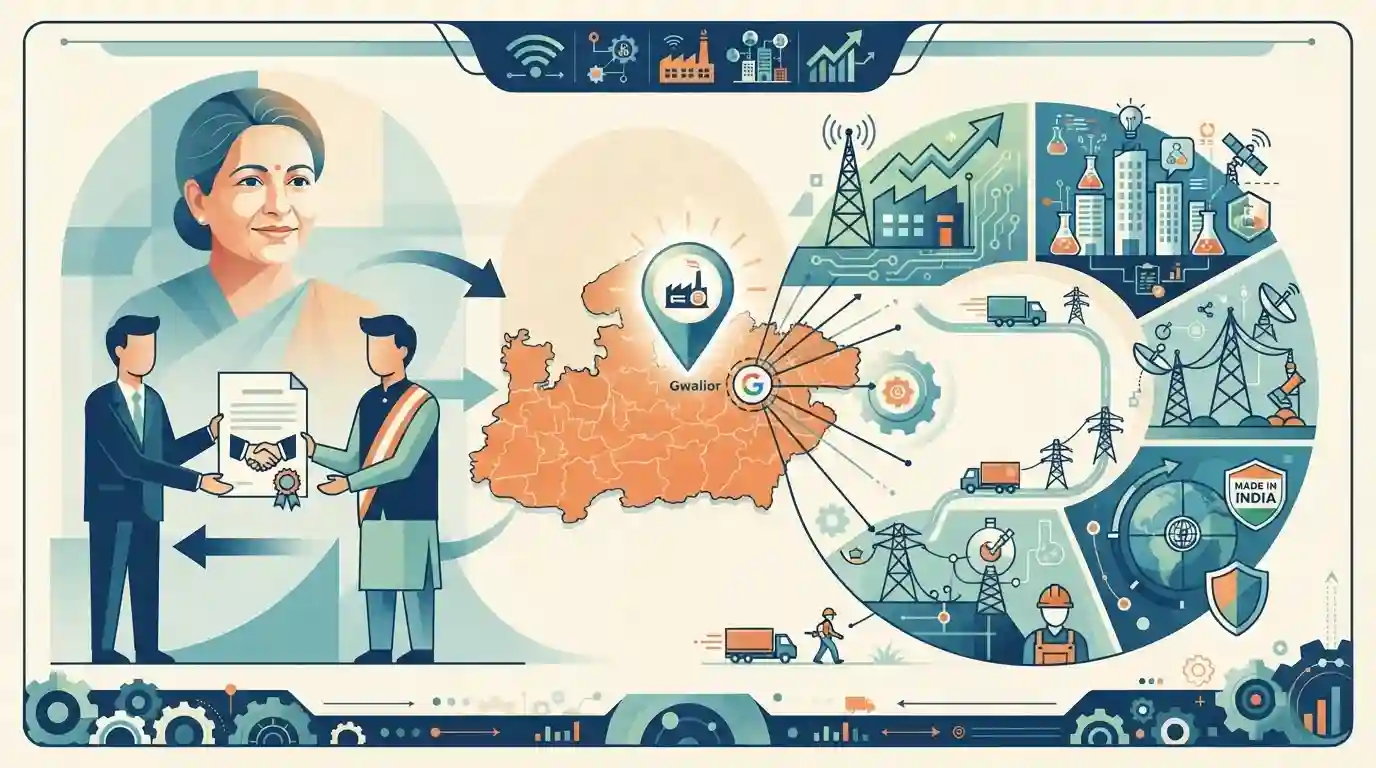
Union Minister for Communications Jyotiraditya M. Scindia announced the establishment of India's first Telecom Manufacturing Zone (TMZ) in Gwalior, Madhya Pradesh. To formalize the initiative, a Memorandum of Understanding (MoU) will be signed between the Department of Telecommunications (DoT) and the state government. The zone is designed to create a robust domestic ecosystem for telecommunications manufacturing, supporting the 'Aatmanirbhar Bharat' vision and enhancing India's global competitiveness in telecom equipment production.
Key Points
- India's first Telecom Manufacturing Zone (TMZ) will be established in Gwalior, Madhya Pradesh.
- A Memorandum of Understanding (MoU) for the TMZ will be signed between the Department of Telecommunications (DoT) and the Madhya Pradesh government.
- The initiative was announced by Union Communications Minister Jyotiraditya M. Scindia and aims to bolster domestic telecom manufacturing.
- The project aligns with the 'Aatmanirbhar Bharat' vision, aiming to make India a globally competitive hub for telecom equipment production.
Important Terms
Telecom Manufacturing Zone (TMZ)

A dedicated industrial ecosystem providing plug-and-play infrastructure to manufacture telecom equipment, data centers, and semiconductor chips. India's first TMZ in Gwalior aims to foster indigenous design, spur innovation, and reduce import reliance.
UPSC context
Relevant to GS-3 (Industrial Policy, Infrastructure), it tests knowledge of state-led manufacturing hubs supporting 5G/6G growth and the digital economy.
Aatmanirbhar Bharat
A flagship national initiative aiming to make India self-reliant by incentivizing domestic manufacturing, reducing import dependency, and promoting self-sufficiency across critical sectors like telecommunications.
UPSC context
Essential for GS-3 (Economic Development) and GS-2 (Government Policies), testing the shift toward indigenous manufacturing and self-reliance in high-tech industries.
Department of Telecommunications (DoT)
A department under the Ministry of Communications that formulates telecom policies, issues licenses, and spearheads initiatives like PLI schemes and manufacturing zones to boost India's digital connectivity and equipment production.
UPSC context
Crucial for GS-2 (Governance) and GS-3 (Infrastructure). Tests knowledge of state interventions driving digital connectivity, 5G/6G deployment, and industrial growth.
Prelims Trap
"TMZs are notified under the SEZ Act of 2005 to exclusively promote telecom equipment exports."
TMZs are sector-specific plug-and-play hubs aimed at domestic ecosystem building and reducing import dependence, distinctly different from the export-mandatory framework of traditional SEZs.
Static Concepts Connected
What are the key features of the Telecom PLI Scheme?
- Core Objective: Aims to offset massive telecom imports by incentivizing incremental investment and sales over a base year.
- Design-Led Bonus: Offers an additional 1% incentive for products designed, developed, and manufactured domestically (shifting from "service" to "product" nation).
- Covered Equipment: Includes core transmission equipment, 4G/5G next-gen Radio Access Networks, IoT access devices, and enterprise routers.
How does the "Plug-and-Play" infrastructure model work?
- Ready Infrastructure: The government ensures pre-cleared land, power, water, and statutory regulatory approvals are in place before allocation to industries.
- Reduced Gestation: It drastically cuts down the setup delays and bureaucratic hurdles associated with traditional greenfield industrial projects.
Cross-Topic Patterns
Telecom PLI + Semiconductor Mission
The TMZ will synergize with the India Semiconductor Mission. Telecom gear and data centers are massive consumers of domestic chipsets, helping create a vertically integrated electronics ecosystem.
Infrastructure & Cooperative Federalism
The DoT-MP joint MoU for plug-and-play clustering reflects "competitive-cooperative federalism," a frequent Mains GS-2 theme regarding infrastructure development and state-level ease of doing business.

Expect a 2026 Prelims question contrasting SEZs, NIMZs, and TMZs based on their export mandates, governing laws, and infrastructure models.
Linked PYQs · 2
Linked PYQs · 2
- 2023MPPSC_PRELIMSGS1
Which city in Madhya Pradesh has a cluster dedicated to the production of transformers and allied products?
- 2022MPPSC_PRELIMSGS1
Where was the Global Investors Summit - 2023 held in Madhya Pradesh?
