Scientists trigger controlled micro earthquakes beneath Swiss Alps
Source:The Hindu ↗
Why It Matters
Earthquakes and fault mechanics fall under GS Paper 1 (Geophysical phenomena) and GS Paper 3 (Disaster Management). Understanding induced seismicity is crucial not only for earthquake prediction and mitigation but also for assessing the environmental impacts of fluid injection, deep mining, and geothermal energy projects, all of which are relevant to India's disaster vulnerability profile.
Summary
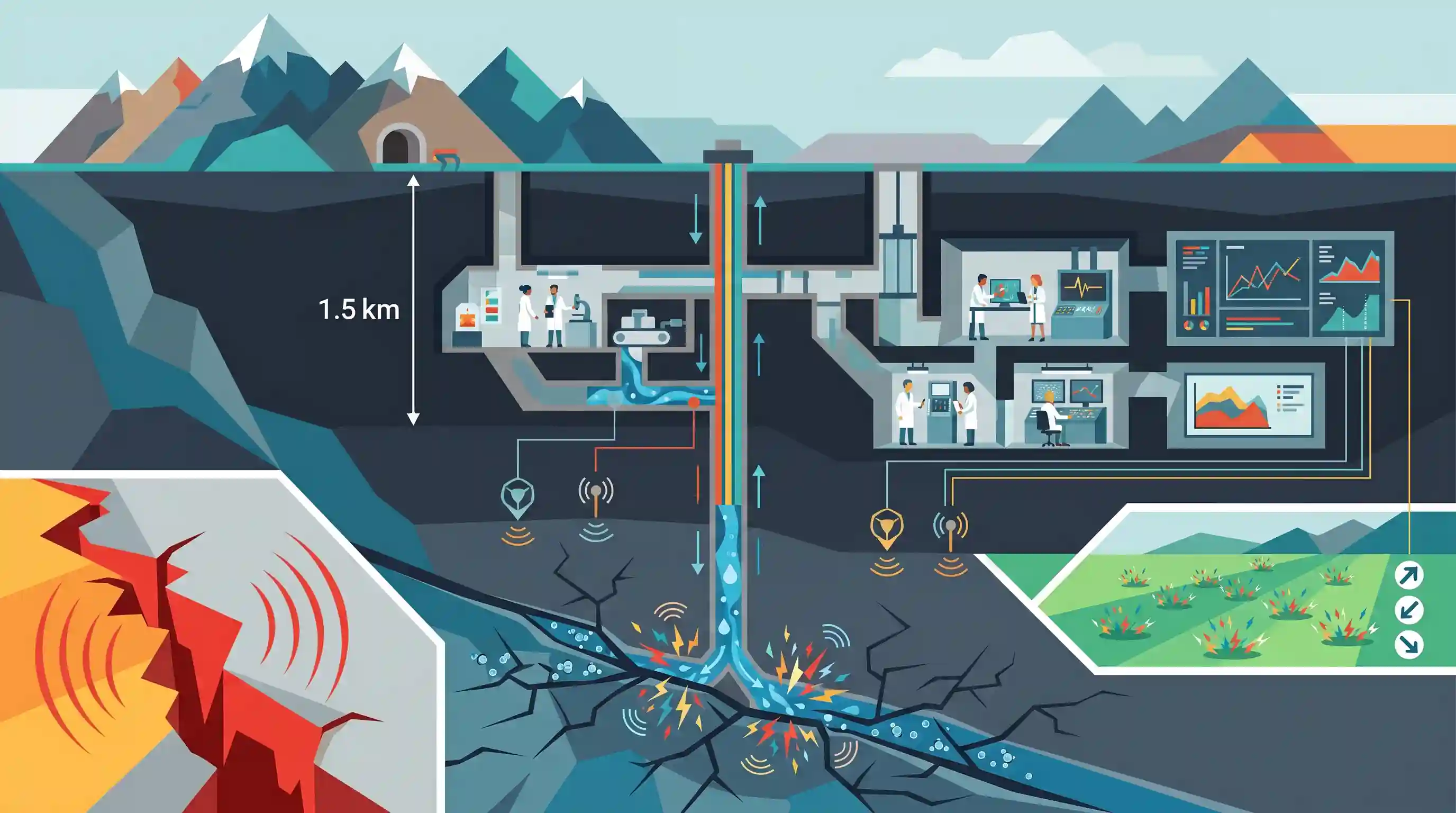
Scientists at the ETH Zurich-led BedrettoLab, located 1.5 km beneath the Swiss Alps, have successfully triggered thousands of 'controlled' micro-earthquakes. By injecting water into fault lines, they are studying deep subterranean seismicity to better understand fault mechanics and mitigate the risks of natural earthquakes.
Key Points
- Researchers injected 750 cubic meters of water into boreholes deep beneath the Swiss Alps to stimulate fault lines and create artificial micro-earthquakes.
- Nearly 8,000 tiny seismic events were recorded, with magnitudes ranging between -5 to -0.14, providing unprecedented data on fault behavior at such depth.
- The experiment helps seismologists understand how faults move in response to fluid injection, which can aid in geothermal energy management and earthquake risk reduction.
- The long-term goal of the BedrettoLab research is to determine how to safely interact with underground faults to mitigate the occurrence and impact of natural earthquakes.
Important Terms
Induced Seismicity

Earthquakes and tremors triggered by human activities—such as fluid injection, mining, or reservoir impoundment—that alter the stress and strain on the Earth's crust.
UPSC context
GS-I: Geophysical phenomena; GS-III: Disaster Management. Tests knowledge of anthropogenic impacts on geological stability.
Micro-earthquakes
Very low-magnitude seismic events (typically magnitude <2.0) that are generally not felt by humans but are detectable by sensitive instruments; crucial for studying fault stress changes.
UPSC context
GS-I: Physical Geography. Important for understanding seismic monitoring and early warning systems for natural hazards.
Enhanced Geothermal Systems (EGS)
Man-made geothermal reservoirs created by injecting high-pressure fluid into hot, impermeable rock to create fractures, allowing heat extraction for renewable energy production.
UPSC context
GS-III: Science and Technology/Energy. Relevant for clean energy transitions and subsurface engineering challenges.
BedrettoLab
A deep underground research facility (1.5 km deep) in Switzerland used for large-scale experiments on rock mechanics, seismicity, and geothermal energy under realistic crustal conditions.
UPSC context
GS-III: International Science and Technology developments. Represents cutting-edge global research in seismic risk mitigation.
Fault Mechanics
The physical study of the processes—including friction, stress, and fluid pressure—that govern how rocks slip and fail along fractures in the Earth's crust.
UPSC context
GS-I: Geomorphology. Fundamental for understanding earthquake origins and the structural behavior of the lithosphere.
Prelims Trap
Micro-earthquakes cannot have a negative magnitude on standard earthquake scales.
Earthquake magnitude scales are logarithmic. Extremely small energy releases, like those from micro-earthquakes, yield negative magnitude values (e.g., -5), which are valid but seem impossible.
Static Concepts Connected
What are the primary anthropogenic causes of induced seismicity?
- Reservoir Impoundment: Large dams create massive hydrostatic pressure, forcing water into deep rock fractures and reactivating dormant faults.
- Hydraulic Fracturing: High-pressure fluid injection for shale gas extraction alters subsurface tectonic stress and pore pressure.
- Mining and Extraction: Removing massive volumes of earth or groundwater alters local stress fields, causing subsidence and micro-seismicity.
How does fluid injection physically trigger fault slips?
- Pore Fluid Pressure: Injected fluids increase pore pressure within the rock fractures, which pushes the rock surfaces apart.
- Friction Reduction: The increased pressure effectively reduces normal stress (friction) on the fault line, lubricating it.
- Elastic Strain Release: The lubricated fault allows rock blocks to slip, releasing stored elastic strain as seismic waves.
Cross-Topic Patterns
Enhanced Geothermal Systems (EGS) & Earthquakes
Deep geothermal extraction (EGS) requires fracturing hot rocks with high-pressure fluids, making induced seismicity a major ecological hurdle for this renewable energy source.
Koyna Dam & Reservoir-Induced Seismicity
The physics of fluid-induced fault lubrication studied here is identical to India's 1967 Koyna earthquake, connecting Swiss lab research directly to Indian disaster management and large dams.

Expect a Prelims multi-statement question linking Enhanced Geothermal Systems (EGS), negative magnitude earthquakes, and induced seismicity.
Linked PYQs · 3
Linked PYQs · 3
- 2004PrelimsGS1
Consider the following geological phenomena: 1. Development of a fault 2. Movement along a fault 3. Impact produced by a volcanic eruption 4. Folding of rocks Which of the above cause earthquakes?
- 2021MainsGS3
Discuss about the vulnerability of India to earthquake related hazards. Give examples including the salient features of major disasters caused by earthquakes in different parts of India during the last three decades.
- 2025MainsGS1
Discuss how the changes in shape and sizes of continents and ocean basins of the planet take place due to tectonic movements of the crustal masses.
