Astronomers Investigate Gamma Ray Excess to Confirm Dark Matter
Source:The Hindu ↗
Why It Matters
Understanding the composition of the universe (Dark Matter and Dark Energy) and the technologies used to study it (Space Telescopes and Observatories) are highly relevant for the Science and Technology portion of GS Paper 3. Concepts like pulsars, gamma rays, and the electromagnetic spectrum also frequently feature in Prelims.
Summary
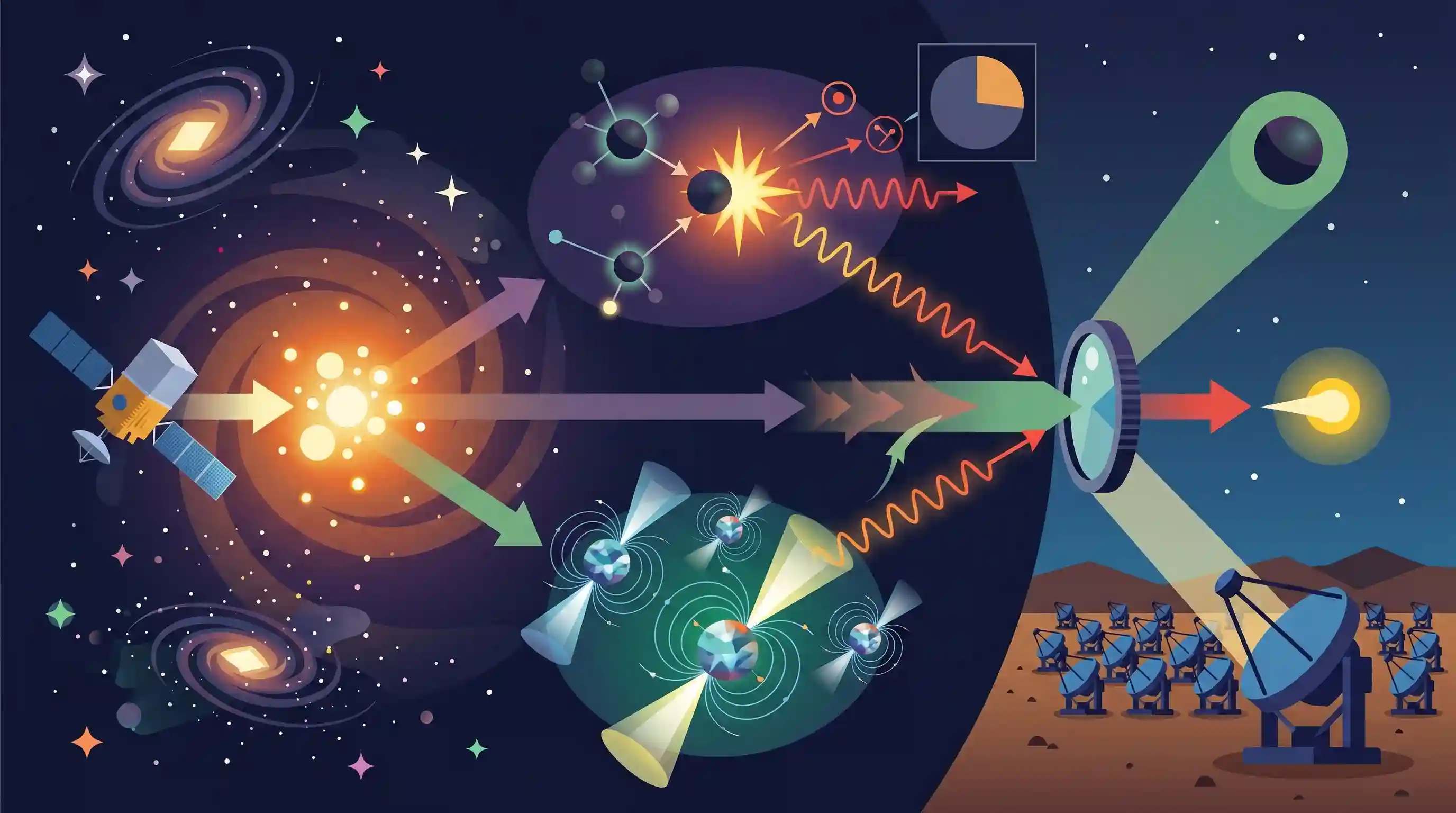
Astronomers are getting closer to potentially confirming the existence of dark matter by investigating a mysterious excess of gamma rays at the center of the Milky Way. Detected by the Fermi Space Telescope, this radiation could be the result of dark matter particles annihilating each other. However, a competing theory suggests the gamma rays are emitted by a dense cluster of rapidly spinning neutron stars called millisecond pulsars. The upcoming Cherenkov Telescope Array Observatory (CTAO) will provide the unprecedented spatial resolution and energy coverage necessary to distinguish between these two phenomena, potentially offering the first indirect detection of dark matter, which constitutes about 27% of the universe.
Key Points
- Dark matter makes up roughly 27% of the universe and dark energy about 68%, while ordinary visible matter accounts for only 5%.
- Dark matter has never been directly detected, but its existence is inferred through its gravitational effects on visible matter, such as binding galaxies together.
- In 2009, astronomers using the Fermi Gamma-ray Space Telescope observed an unexplained excess of gamma rays near the center of the Milky Way, known as the Galactic Center GeV Excess.
- Scientists propose two main theories for this excess: the collision and annihilation of dark matter particles (which act as their own antiparticles), or emissions from a large, dense population of millisecond pulsars (rapidly spinning neutron stars).
- The upcoming Cherenkov Telescope Array Observatory (CTAO), currently under construction, will provide high-resolution gamma-ray observation capabilities that could definitively differentiate between dark matter annihilation and pulsar emissions.
Important Terms
Cherenkov Telescope Array Observatory (CTAO)

A planned next-generation ground-based observatory for very high-energy gamma rays. It uses arrays of telescopes in both hemispheres to investigate dark matter, black holes, and cosmic particle accelerators.
UPSC context
GS Paper III: Science and Technology. Relevant for space missions, international collaborations, and cutting-edge astronomical observation tools.
Fermi Gamma-ray Space Telescope
A NASA space-based observatory launched in 2008 to study the high-energy universe. It maps gamma rays to identify sources like pulsars, active galactic nuclei, and potential dark matter signatures.
UPSC context
GS Paper III: Science and Technology. Important for understanding milestones in space exploration and fundamental physics discoveries.
Galactic Center Excess (GCE)
A mysterious surfeit of high-energy gamma rays detected at the Milky Way's center. Scientists debate whether it originates from dark matter annihilation or dense clusters of millisecond pulsars.
UPSC context
GS Paper III: Science and Technology. Tests knowledge of contemporary astrophysical mysteries and the search for dark matter.
Dark Matter
A hypothetical form of matter that does not emit or reflect light, making it invisible to traditional telescopes. It constitutes approximately 27% of the universe's mass-energy content.
UPSC context
GS Paper III: Science and Technology. A core concept in cosmology and the fundamental properties of the universe.
Millisecond Pulsars (MSPs)
Extremely dense neutron stars that spin hundreds of times per second. They are a primary candidate for explaining high-energy radiation anomalies in the galaxy without invoking dark matter.
UPSC context
GS Paper III: Science and Technology. Tests awareness of stellar evolution and cosmic radiation sources.
WIMPs (Weakly Interacting Massive Particles)
Hypothetical heavy particles that interact only through gravity and the weak force. They are the leading theoretical candidates for the composition of dark matter.
UPSC context
GS Paper III: Science and Technology. Relevant for particle physics and theories on the origin of the universe.
Indirect Detection
The method of searching for dark matter by observing the products of its annihilation or decay, such as gamma rays or neutrinos, rather than the particles themselves.
UPSC context
GS Paper III: Science and Technology. Concerns methodologies used in advanced scientific research and experimental physics.
Prelims Trap
"Dark matter interacts weakly with light, allowing direct observation through high-energy gamma-ray space telescopes."
False. Dark matter does not interact with the electromagnetic force at all. Telescopes like Fermi only look for indirect evidence, such as gamma rays produced when dark matter particles annihilate each other.
Static Concepts Connected
What is the fundamental difference between Dark Matter and Dark Energy?
- Dark Matter: Makes up roughly 27% of the universe. It exerts a gravitational pull, acting as the invisible "glue" that binds galaxies together.
- Dark Energy: Makes up approximately 68% of the universe. It acts as a repulsive force that drives the accelerated expansion of the universe.
- Electromagnetic Invisibility: Neither absorbs, reflects, nor emits light. Both are invisible to standard electromagnetic observation and are inferred entirely by their effects on the universe.
What are Pulsars and Cherenkov Radiation?
- Pulsars: Rapidly rotating, highly magnetized neutron stars (remnants of collapsed massive stars) that emit regular beams of electromagnetic radiation from their magnetic poles.
- Cherenkov Radiation: Faint flashes of light produced when high-energy cosmic gamma rays enter the Earth's atmosphere and interact with its particles. Ground-based telescopes detect these flashes.
Cross-Topic Patterns
CTAO and India's MACE Observatory
The upcoming CTAO shares scientific goals with India's Major Atmospheric Cherenkov Experiment (MACE) telescope in Hanle, Ladakh. Both utilize Cherenkov radiation to detect high-energy gamma rays and study elusive cosmic phenomena.
Elusive Particles: Neutrinos vs Dark Matter
UPSC often groups elusive cosmic particles. Similar to neutrinos studied at the India-based Neutrino Observatory (INO), dark matter candidates like WIMPs interact extremely weakly with ordinary matter, making direct detection notoriously difficult.

Expect a 2026 Prelims question contrasting Dark Matter/Energy percentages with ground-based Cherenkov telescopes like India's MACE.
Linked PYQs · 3
Linked PYQs · 3
- 2023PrelimsGS1
Consider the following pairs: Objects in space Description 1. Cepheids: Giant clouds of dust and gas in space 2. Nebulae: Stars which brighten and dim periodically 3. Pulsars: Neutron stars that are formed when massive stars run out of fuel and collapse How many of the above pairs are correctly matched?
- 2022MainsGS3
Launched on 25th December, 2021, James Webb Space Telescope has been much in the news since then. What are its unique features which make it superior to its predecessor Space Telescopes ? What are the key goals of this mission ? What potential benefits does it hold for the human race?
- 2017PrelimsGS1
The terms 'Event Horizon', 'Singularity', 'String Theory' and 'Standard Model' are sometimes seen in the news in the context of
