Physiological Hazards of Spaceflight on Human Immunity and Brain
Source:The Hindu ↗
Why It Matters
As India prepares for its maiden human spaceflight mission (Gaganyaan), the biological constraints of space travel—such as immune suppression and structural brain changes—are critical focus areas. This directly maps to UPSC questions on the obstacles to manned space missions and general science questions on human immunity and genetics.
Summary
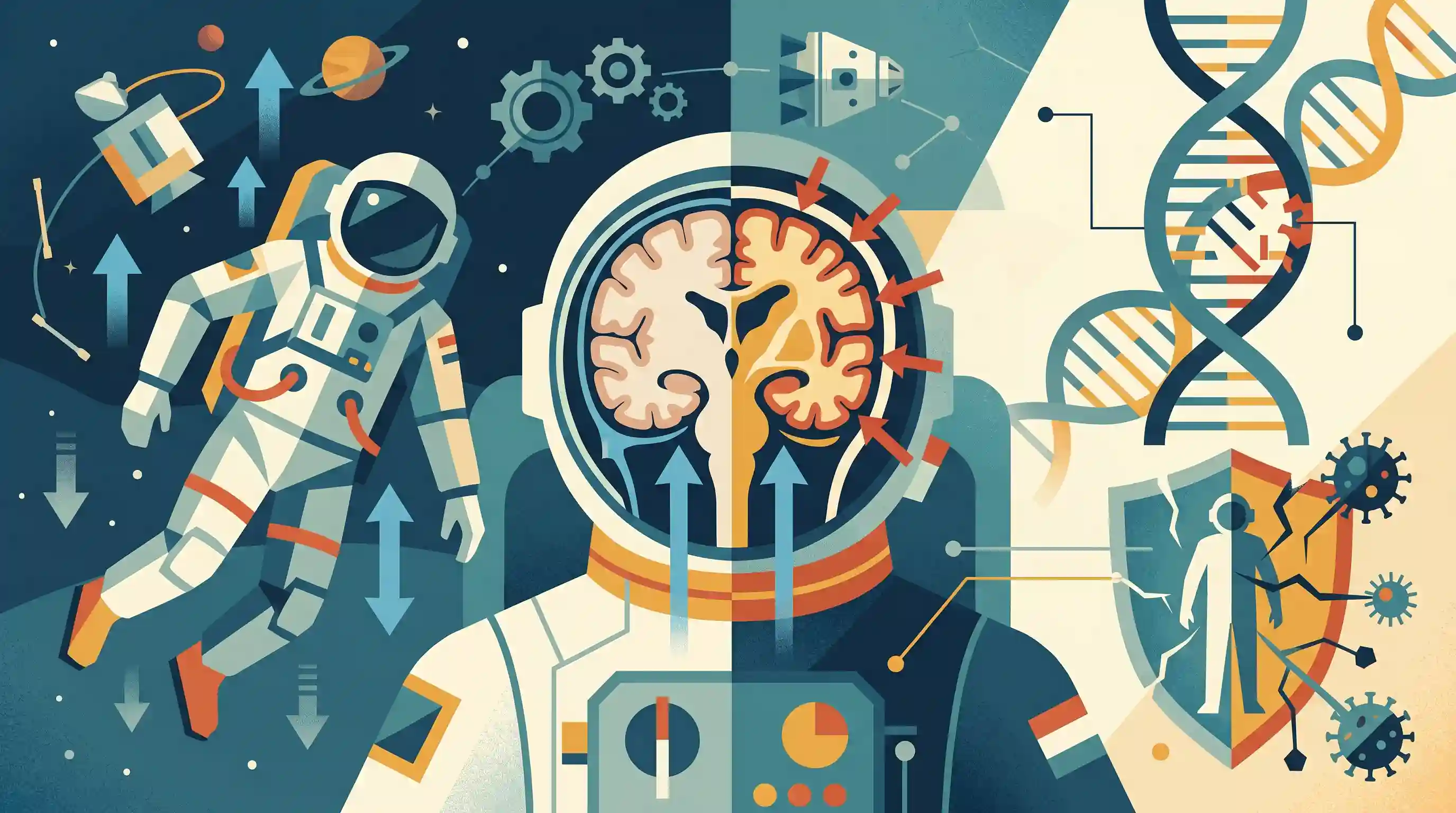
The article discusses scientific findings on the detrimental physiological effects of spaceflight on astronauts. Research indicates that prolonged exposure to microgravity fundamentally alters immune gene expression, leading to a weakened immune system that makes astronauts more vulnerable to pathogens. Additionally, the lack of gravity causes significant fluid shifts within the body, pushing cerebrospinal fluid upward. This increases intracranial pressure and results in physical brain deformations, such as the expansion of brain ventricles. These biological challenges are major hurdles that space agencies must overcome to ensure astronaut safety during long-duration human space exploration missions, such as India's upcoming Gaganyaan program.
Key Points
- Exposure to microgravity during spaceflight causes significant negative physiological adaptations in the human body.
- Research shows that spaceflight alters immune gene expression, leading to a suppressed or dysregulated immune system and impaired T-cell function.
- Microgravity induces bodily fluid shifts that push cerebrospinal fluid toward the head, raising intracranial pressure.
- This upward fluid shift causes brain deformations, most notably the expansion of the brain's ventricles, which can persist post-flight.
- These biological and medical realities present major technological and logistical obstacles for upcoming human spaceflight missions, such as ISRO's Gaganyaan and future Mars explorations.
Important Terms
Gaganyaan

India's first indigenous human spaceflight mission, designed to send a three-member crew to a 400 km orbit for three days and return them safely.
UPSC context
GS Paper 3 (S&T). Tests knowledge of indigenous space programs and India's entry into the elite group of human spacefaring nations.
ISRO (Indian Space Research Organisation)
India's premier space agency, established in 1969 under the Department of Space, tasked with satellite communication, planetary exploration, and launch vehicle development.
UPSC context
GS Paper 3 (S&T). Fundamental for questions regarding institutional achievements, space policy, and national technological self-reliance.
Microgravity
A condition of apparent weightlessness experienced in orbit where gravity is present but balanced by free-fall motion, leading to unique physical and biological effects.
UPSC context
GS Paper 3 (S&T - Space). Tests understanding of physical environments in space and their impact on human physiology and material science.
SANS (Spaceflight-Associated Neuro-ocular Syndrome)
A set of neuro-ophthalmic changes in astronauts, including brain deformation and vision shifts, caused by fluid redistribution and intracranial pressure in microgravity.
UPSC context
GS Paper 3 (S&T - Health). Relevant for discussing the biological challenges and safety risks associated with long-duration human space exploration.
LVM3 (Launch Vehicle Mark 3)
ISRO's heavy-lift launch vehicle, modified to be 'human-rated' for the Gaganyaan mission to safely transport the crew module into space.
UPSC context
GS Paper 3 (S&T). Tests awareness of launch technologies and the evolution of India's propulsion systems for complex missions.
Low Earth Orbit (LEO)
An orbit around Earth at an altitude between 160 km and 2,000 km, commonly used for the International Space Station and human spaceflight missions.
UPSC context
GS Paper 3 (Space Tech). Crucial for understanding mission profiles, satellite communication, and the operational constraints of manned space missions.
Prelims Trap
"Microgravity exposure permanently alters the underlying DNA sequences of astronauts."
Spaceflight alters gene expression (epigenetics) and immune response, but it does not permanently mutate or rewrite the underlying DNA genetic sequence itself.
Static Concepts Connected
What are the primary physiological effects of microgravity on the human body?
- Fluid distribution: Fluids shift toward the head, increasing intracranial pressure and expanding brain ventricles, leading to Spaceflight-Associated Neuro-ocular Syndrome (SANS).
- Musculoskeletal system: Causes rapid bone demineralization and muscle atrophy due to the absence of mechanical load-bearing requirements in space.
- Immune suppression: Alters immune gene expression and impairs T-cell activation, making astronauts highly vulnerable to opportunistic pathogens and infections.
What is the role of T-cells in the human immune system?
- Adaptive immunity: T-cells are specialized white blood cells that target specific foreign pathogens, forming a core part of the adaptive immune response.
- Origin and maturation: They originate from hematopoietic stem cells in the bone marrow but travel to the thymus gland to mature.
Cross-Topic Patterns
Gaganyaan, ECLSS and Vyommitra
ISRO uses the humanoid Vyommitra on uncrewed flights to simulate human functions and test Environmental Control and Life Support Systems (ECLSS) against microgravity stresses.
Epigenetics in extreme environments
The 'Space Omics' field links directly to the static syllabus on epigenetics—showing how extreme environmental stressors alter gene expression without mutating the DNA sequence.

Expect a 2026 prelims question mixing Gaganyaan's Vyommitra with specific microgravity impacts like T-cell suppression or fluid shifts.
Linked PYQs · 3
Linked PYQs · 3
- 2017MainsGS3
India has achieved remarkable successes in unmanned space missions including the Chandrayaan and Mars Orbitter Mission, but has not ventured into manned space missions. What are the main obstacles to launching a manned space mission, both in terms of technology and logistics? Examine critically.
- 2022PrelimsGS1
Which one of the following statements best describes the role of B cells and T cells in the human body?
- 2025PrelimsGS1
Consider the following space missions : I. Axiom-4 II. SpaDeX III. Gaganyaan How many of the space missions given above encourage and support micro-gravity research?
