Scientists Successfully Synthesize Novel 2D Metals
Source:The Hindu ↗
Why It Matters
Understanding the evolution of nanomaterials from carbon-based (graphene, nanotubes) to metal-based (metallenes) is crucial for the UPSC Science & Technology syllabus. Questions often test the unique properties of these materials and their prospective applications in solving contemporary challenges in energy, computing, and electronics.
Summary
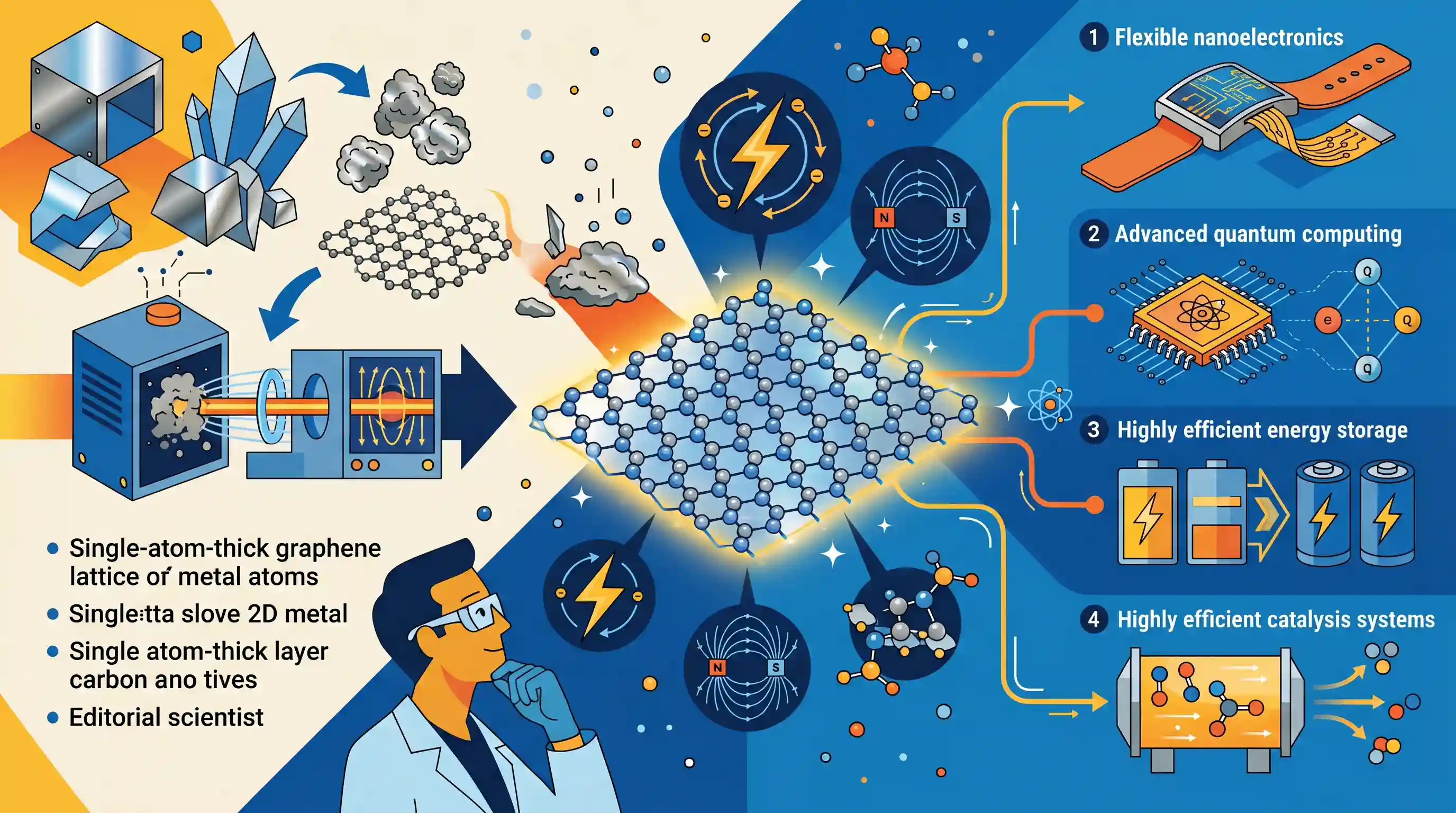
Researchers have achieved a significant breakthrough by successfully creating 2D metals, also known as metallenes. Unlike graphene, which is carbon-based, these are single-atom-thick layers of metal. Synthesizing these materials has long been a challenge because metals naturally prefer to bond into 3D clumps rather than flat 2D sheets. At the 2D scale, these metals demonstrate novel electrical, magnetic, and catalytic properties not seen in their bulk counterparts. This development paves the way for transformative applications in future technologies, such as advanced quantum computing, flexible nanoelectronics, and highly efficient energy storage and catalysis systems.
Key Points
- Scientists have successfully synthesized 2D metals (metallenes), which are single-atom-thick layers of metallic elements.
- Synthesizing 2D metals is inherently difficult because non-directional metallic bonds naturally drive atoms to clump into 3D structures rather than flat sheets.
- These new 2D materials exhibit unique electronic, magnetic, and catalytic properties that differ significantly from their traditional 3D bulk forms.
- The breakthrough holds immense potential for future technologies, including advanced nanoelectronics, high-efficiency catalysis, next-generation energy storage, and quantum computing.
- This expands the frontier of two-dimensional nanomaterials beyond well-known carbon-based examples like graphene and carbon nanotubes.
Prelims Trap
Metallenes are a new class of carbon-based two-dimensional nanomaterials similar to graphene.
Metallenes are single-atom-thick layers of actual metals (like tin or bismuth), not carbon. Unlike carbon's stable 2D covalent bonds, metallic bonds naturally resist flat formations.
Static Concepts Connected
What is the 'Quantum Confinement Effect' in nanomaterials?
- Electron restriction: When a material is reduced to nanoscale dimensions, electron movement is physically restricted, creating discrete energy levels.
- Property alteration: This spatial confinement radically changes the material's optical, electrical, and magnetic properties compared to its traditional 3D bulk form.
What are Topological Insulators in advanced materials?
- Dual behavior: They are materials that act as electrical insulators in their interior while allowing electrons to flow freely along their outer surfaces or edges.
- Quantum stability: This edge-conduction is protected against impurities and noise, making them highly valuable for developing stable, fault-tolerant quantum computers.
Cross-Topic Patterns
Nanotech catalysts & Green Hydrogen
The catalytic efficiency of 2D metals stems from their high surface-to-volume ratio, making them critical for next-generation electrolysers in India's National Green Hydrogen Mission.
Critical Minerals & Quantum Technologies
Synthesizing advanced 2D metallenes requires elements like bismuth and tin, connecting cutting-edge quantum computing developments directly to global supply-chain vulnerabilities and critical mineral security.

Expect a 2026 Prelims question comparing Graphene and Metallenes, specifically testing 'quantum confinement' and 'edge conductivity'.
Linked PYQs · 3
Linked PYQs · 3
- 2012PrelimsGS1
Graphene is frequently in news recently. What is its importance? 1. It is a two-dimensional material and has good electrical conductivity. 2. It is one of the thinnest but strongest materials tested so far. 3. It is entirely made of silicon and has high optical transparency. 4. It can be used as 'conducting electrodes' required for touch screens, LCDs and organic LEDs. Which of the statements given above are correct?
- 2020PrelimsGS1
With reference to carbon nanotubes, consider the following statements: 1. They can be used as carriers of drugs and antigens in the human body. 2. They can be made into artificial blood capillaries for an injured part of human body. 3. They can be used in biochemical sensors. 4. Carbon nanotubes are biodegradable. Which of the statements given above are correct?
- 2020MainsGS3
What do you understand by nanotechnology and how is it helping in health sector?
