Physical Activity and Biological Cleansing Mechanism of Brain
Source:Indian Express ↗
Why It Matters
Provides a clear scientific rationale for the importance of physical activity in preventive healthcare. It bridges everyday biological science (GS3) with the public health challenge of managing age-related diseases in an increasingly older population (GS2).
Summary
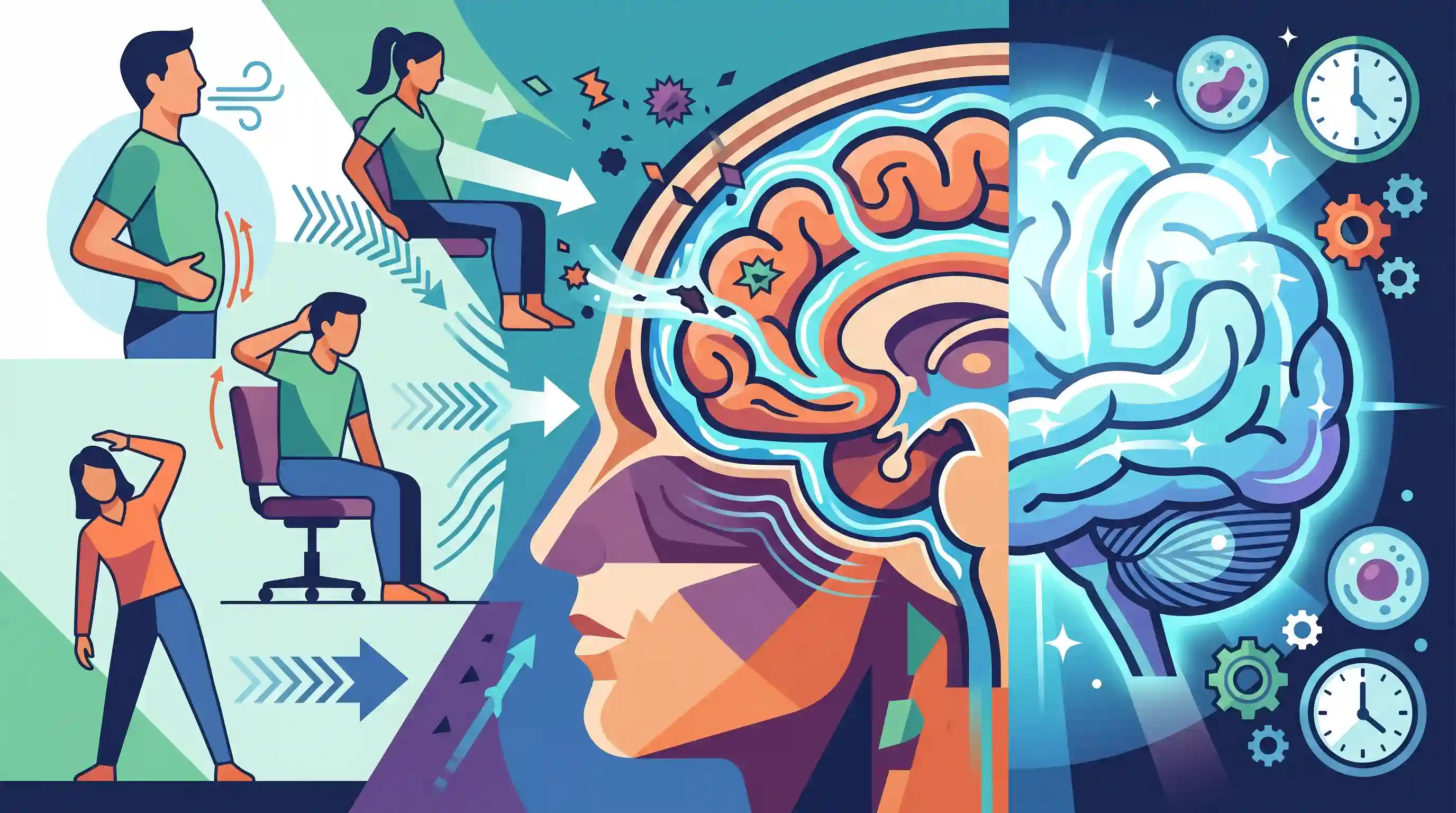
A recent study published in Nature demonstrates that physical movements—even minor ones like abdominal contractions from breathing or adjusting posture—help cleanse the brain. These movements generate subtle pressure shifts that cause the brain to move gently, facilitating the flow of cerebrospinal fluid over its surface. This fluid washes away metabolic waste, thereby maintaining brain homeostasis. The discovery highlights a key biological mechanism explaining how even minimal exercise can help prevent the toxic buildups associated with neurodegenerative conditions like Alzheimer's disease.
Key Points
- Everyday body movements, including simple abdominal muscle contractions, create pressure changes that gently shift the brain.
- This shifting pushes cerebrospinal fluid across the brain's surface, acting as a natural cleansing system that removes metabolic byproducts.
- The process is essential for maintaining brain homeostasis and preventing the accumulation of toxic elements.
- Even minimal regular physical exercise can play a crucial role in preventing neurodegenerative disorders such as Alzheimer's disease.
Important Terms
Glymphatic System

A brain-wide perivascular network that clears metabolic waste from the central nervous system. It uses cerebrospinal fluid to flush toxins, primarily during sleep and physical activity.
UPSC context
GS Paper III: Science and Technology. Relevant for understanding human physiology and recent breakthroughs in neuro-health research.
Cerebrospinal Fluid (CSF)
A clear, colorless liquid surrounding the brain and spinal cord. It provides mechanical protection, nutrient delivery, and acts as a medium for waste removal through the glymphatic system.
UPSC context
GS Paper III: Science. Essential for understanding internal body systems and metabolic processes.
Neurodegenerative Diseases
A group of progressive disorders, such as Alzheimer’s and Parkinson’s, characterized by the gradual loss of neuron structure or function, often linked to toxic protein buildup.
UPSC context
GS Paper II: Health. Important for discussions on public health, aging populations, and preventive healthcare policies.
Alzheimer’s Disease
The most common neurodegenerative disorder, causing progressive memory loss and cognitive decline. It is associated with the accumulation of amyloid-beta plaques and tau proteins in brain tissue.
UPSC context
GS Paper II and III: Health and S&T. A key focus area for geriatric care and medical innovation.
Homeostasis
The process by which biological systems maintain a stable internal environment despite external changes. In the brain, this involves balancing fluid levels and clearing metabolic toxins.
UPSC context
GS Paper III: Science. A fundamental concept in biology and human anatomy.
Prelims Trap
"Metabolic waste in the human brain is cleared primarily by the conventional lymphatic system."
The central nervous system lacks a conventional lymphatic system. It relies instead on the glymphatic system and Cerebrospinal Fluid (CSF) to flush out neurotoxins.
Static Concepts Connected
What is the role of Cerebrospinal Fluid (CSF) and the Glymphatic System?
- Cerebrospinal Fluid (CSF): A clear liquid produced in the brain's ventricles that cushions the brain and spinal cord, providing mechanical and immunological protection.
- Glymphatic system: The central nervous system's specialized macroscopic waste clearance network that actively utilizes CSF to flush out accumulated neurotoxins.
- Waste clearance: This system sweeps away metabolic byproducts and misfolded proteins (like amyloid-beta) that are strongly associated with cognitive decline.
What characterizes neurodegenerative diseases like Alzheimer's?
- Neuronal loss: These diseases involve the progressive, largely irreversible degeneration and death of neurons in the central nervous system.
- Protein accumulation: They are primarily triggered by the toxic buildup of misfolded proteins (like tau and amyloid plaques) disrupting cellular function.
- Public health impact: Currently incurable, they present a massive challenge for healthcare systems globally as aging populations increase.
Cross-Topic Patterns
Geriatric health and demographic transition
As India's life expectancy rises, preventing Alzheimer's via accessible lifestyle interventions becomes critical to mitigating the massive future socioeconomic burden of geriatric healthcare.
Circadian rhythms and brain homeostasis
Movement-based clearance complements sleep-driven clearance. UPSC has previously tested circadian rhythms; the glymphatic system's activation during deep sleep links strongly to this physiological theme.

Expect a multi-statement biology question linking the glymphatic system, Cerebrospinal Fluid (CSF), and Alzheimer's disease pathology.
Linked PYQs · 3
Linked PYQs · 3
- 2021PrelimsGS1
Magnetite particles, suspected to cause neurodegenerative problems, are generated as environmental pollutants from which of the following? 1. Brakes of motor vehicles 2. Engines of motor vehicles 3. Microwave stoves within homes 4. Power plants 5. Telephone lines Select the correct answer using the code given below.
- 2022MainsGS3
The increase in life expectancy in the country has led to newer health challenges in the community. What are those challenges and what steps need to be taken to meet them?
- 2020MainsGS2
In order to enhance the prospects of social development, sound and adequate health care policies are needed particularly in the fields of geriatric and maternal health care. Discuss.
