Science Diplomacy for Quantum Computing Governance
Source:The Hindu ↗
Why It Matters
The intersection of emerging technologies like quantum computing with international relations ('science diplomacy') is a crucial area for civil services, as administrators must increasingly navigate complex tech governance, global security paradigms, and international regulatory frameworks.
Summary
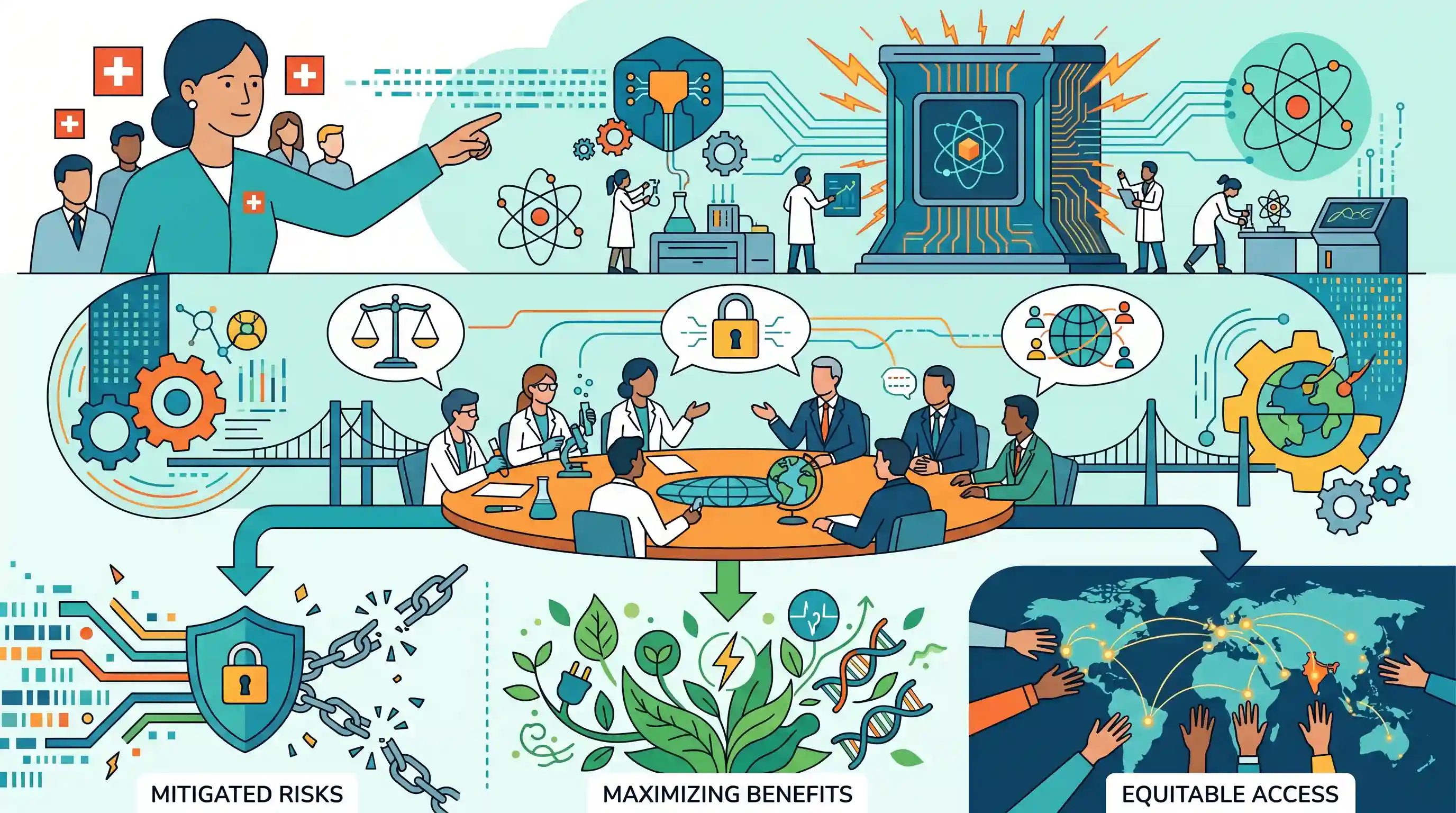
Marilyne Andersen, head of a Swiss foundation, advocates for robust science diplomacy to navigate the rapid advancements in quantum computing. She stresses that scientists and diplomats must engage in proactive dialogue to anticipate the ethical, societal, and geopolitical impacts of such emerging technologies. By fostering early collaboration, global policymakers can develop anticipatory regulatory frameworks that maximize the benefits of quantum computing while mitigating potential security risks and ensuring equitable global access.
Key Points
- Emphasizes the critical need for 'anticipatory science diplomacy' to manage the rapid evolution of quantum computing.
- Advocates for proactive and ongoing dialogues between scientific communities and diplomats to bridge the gap between technological innovation and policy-making.
- Highlights that early engagement can help formulate international frameworks to address the ethical, geopolitical, and security implications of emerging technologies before they become unmanageable.
- Focuses on ensuring equitable access to technological breakthroughs while mitigating potential risks to global stability.
Important Terms
Geneva Science and Diplomacy Anticipator (GESDA)

A Swiss-based foundation established to anticipate scientific breakthroughs and bridge the gap between global laboratories and diplomatic governance to address future societal challenges.
UPSC context
GS Paper 2: Important International Institutions; GS Paper 3: Science & Technology governance and emerging tech impacts.
Science Diplomacy
The intersection of international relations and scientific research, involving three pillars: using science to inform foreign policy, building international partnerships through science, and leveraging diplomacy to support global research.
UPSC context
GS Paper 2: Bilateral and global groupings; GS Paper 3: Technology's role in global diplomacy and everyday life.
Quantum Computing
Advanced computing that uses quantum-mechanical phenomena like superposition and entanglement to process information in qubits, enabling exponentially faster calculations than classical computers for complex problems.
UPSC context
GS Paper 3: Awareness in the field of Computers and IT; critical for cybersecurity and National Security.
Qubit
The fundamental unit of quantum information. Unlike a classical bit (0 or 1), it can exist in multiple states simultaneously due to superposition, forming the basis of quantum computing power.
UPSC context
GS Paper 3: Basics of IT and S&T; tests conceptual understanding of emerging technologies.
Open Quantum Institute (OQI)
A flagship GESDA initiative designed to ensure equitable global access to quantum computing and focus its applications on achieving the UN Sustainable Development Goals (SDGs).
UPSC context
GS Paper 2: International efforts for global welfare; GS Paper 3: Technology-led inclusive growth.
National Quantum Mission (NQM)
India’s dedicated flagship mission (launched in 2023) to nurture R&D in quantum technologies and develop intermediate-scale quantum computers, positioning India as a global leader in the field.
UPSC context
GS Paper 3: Government policies for indigenous technology development and S&T achievements.
Prelims Trap
GESDA is a specialized agency of the United Nations responsible for global quantum computing governance.
GESDA (Geneva Science and Diplomacy Anticipator) is an independent Swiss foundation, not a UN agency. It focuses on anticipatory science diplomacy, not binding global regulations.
Static Concepts Connected
How do quantum computers differ fundamentally from classical computing models?
- Qubits vs Bits: Classical computers use binary bits (0 or 1), while quantum computers use qubits, which can represent both states simultaneously.
- Superposition: The ability of a quantum system to be in multiple states at once, enabling exponential parallel processing capabilities.
- Entanglement: A quantum phenomenon where qubits become linked so that the state of one instantly dictates the state of another, regardless of distance.
What are the three recognized dimensions of Science Diplomacy in international relations?
- Science in diplomacy: Informing foreign policy objectives, treaties, and international negotiations with robust scientific advice and evidence.
- Diplomacy for science: Using diplomatic action and bilateral agreements to facilitate international scientific cooperation and fund large-scale projects.
- Science for diplomacy: Utilizing scientific partnerships and academic exchanges to build trust and improve relationships between nations facing political tensions.
Cross-Topic Patterns
Quantum computing's internal security threat
Anticipatory diplomacy addresses the "Q-Day" threat, where quantum computers might break classical RSA encryption, explicitly bridging S&T innovation with national cybersecurity preparedness.
Tech alliances reshaping multilateral geopolitics
Like the Quad's critical/emerging tech working groups, India's engagement with GESDA and the Raisina SDI reflects a strategic pivot toward shaping global norms before tech matures.

Expect a Prelims question merging quantum principles (superposition/entanglement) with global governance initiatives like GESDA.
Linked PYQs · 2
Linked PYQs · 2
- 2022PrelimsGS1
Which one of the following is the context in which the term "qubit" is mentioned ?
- 2025PrelimsGS1
Consider the following statements: I. It is expected that Majorana 1 chip will enable quantum computing. II. Majorana 1 chip has been introduced by Amazon Web Services (AWS). III. Deep learning is a subset of machine learning. Which of the statements given above are correct?
