Pangenome mapping of Asian rice for climate resilient crops
Source:The Hindu ↗
Why It Matters
Genomic mapping and applied biotechnology directly impact agricultural productivity. The distinction between a standard reference genome and a pangenome is a potential Prelims concept, while the application of genetic sequencing in crop improvement and food security is highly relevant for GS3 Science & Technology and Agriculture.
Summary
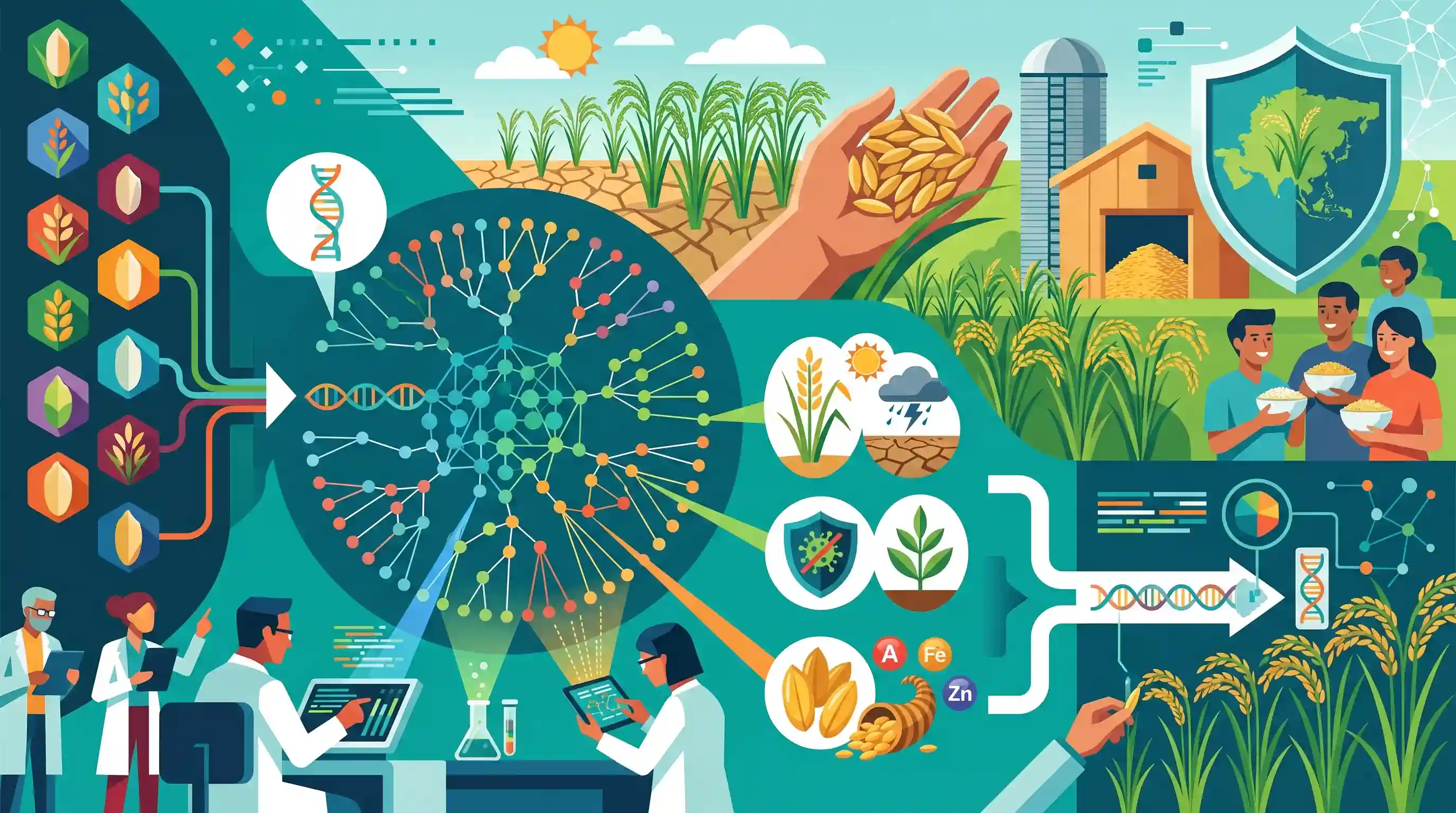
Scientists have created the first 'pangenome' for Asian rice, effectively mapping the complete genetic diversity across all its cultivated strains. Unlike a traditional reference genome that maps only a single individual, a pangenome captures both the core genes shared universally and the variable genes present only in specific sub-populations. This extensive genetic repository enables researchers to identify hidden traits related to climate resilience, disease resistance, and nutritional quality. The breakthrough represents a significant advancement in agricultural biotechnology, equipping breeders with the precise tools needed to develop high-yielding, robust rice varieties necessary to secure food supply amidst ongoing climate change.
Key Points
- A 'pangenome' represents the entire set of genes across all strains of a species, overcoming the limitations of using a single reference genome.
- The Asian rice pangenome maps the extensive genetic diversity across its various sub-species, including indica and japonica.
- This comprehensive genetic database allows scientists to pinpoint variable genes responsible for crucial traits like drought tolerance, disease resistance, and improved yield.
- The breakthrough promises to accelerate precision breeding and applications of biotechnology in agriculture.
- Developing hardier and more productive rice varieties is essential for adapting to climate change and ensuring global food security.
Prelims Trap
"A pangenome is a highly advanced reference genome sequenced from a single, highly resilient individual of a species."
A pangenome is fundamentally different from a reference genome because it maps the entire genetic diversity across multiple strains of a species, rather than relying on a single individual.
Static Concepts Connected
How does a Pangenome differ from a Reference Genome?
- Reference Genome: Mapped as a linear sequence, it relies entirely on the genetic makeup of a single individual of a species.
- Pangenome: Captures the entire genetic diversity of a species, including universally shared core genes and strain-specific variable genes.
- Graph Visualisation: Visualised as a graph where nodes represent core sequences and internodes represent structural genetic variations among different strains.
What are the main differences between Indica and Japonica rice?
- Indica: Widely grown in tropical and subtropical regions; generally produces longer, non-sticky grains.
- Japonica: Cultivated in cooler temperate zones; yields shorter, stickier grains with lower amylose content.
Cross-Topic Patterns
Genomics + Climate-Smart Agriculture
Pangenomes map climate-resilient traits (like drought tolerance), directly supporting initiatives like the National Mission for Sustainable Agriculture by enabling precision breeding for food security.
Genetic Mapping + CRISPR-Cas9
A pangenome reveals exactly which variable genes confer disease resistance, acting as a structural library for gene-editing tools like CRISPR-Cas9 to develop high-yielding, resilient crops.

Expect a multi-statement question in Prelims contrasting a pangenome with a reference genome, linked to climate-smart agriculture.
Linked PYQs · 4
Linked PYQs · 4
- 2017PrelimsGS1
With reference to agriculture in India, how can the technique of 'genome sequencing', often seen in the news, be used in the immediate future? 1. Genome sequencing can be used to identify genetic markers for disease resistance and drought tolerance in various crop plants. 2. This technique helps in reducing the time required to develop new varieties of crop plants. 3. It can be used to decipher the host-pathogen relationships in crops. Select the correct answer using the code given below:
- 2019MainsGS3
How can biotechnology help to improve the living standards of farmers?
- 2021MainsGS3
What are the research and developmental achievements in applied biotechnology? How will these achievements help to uplift the poorer sections of the society?
- 2017MainsGS3
What are the major reasons for declining rice and wheat yield in the cropping system? How crop diversification is helpful to stabilise the yield of the crops in the system?
