El Nino Classification Standards and Global Climate Energy Imbalance
Source:The Hindu ↗
Why It Matters
Changes in the frequency, intensity, and classification of ENSO events due to global warming are crucial for forecasting global weather patterns, including the Indian Monsoon, and understanding the accelerating impacts of climate change.
Summary
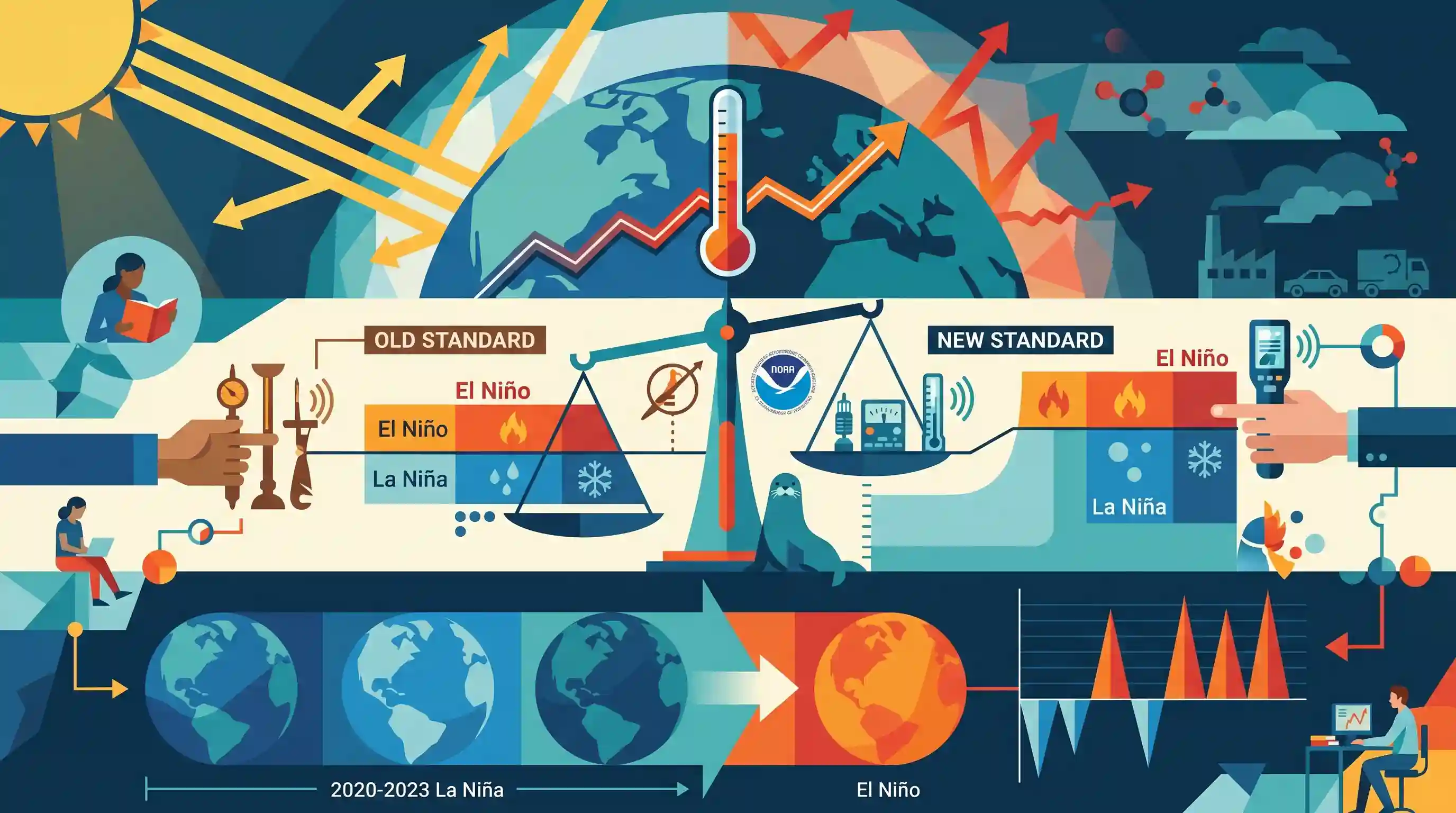
The U.S. National Oceanic and Atmospheric Administration (NOAA) has altered its classification standards for El Nino and La Nina to account for rapidly rising global temperatures. Due to warmer ocean baselines, fewer warming events will now meet the threshold for El Nino, while more will be categorized as La Nina. Additionally, a new study attributes recent spikes in global temperatures to Earth's growing energy imbalance, largely driven by human-induced climate change and the transition from a heat-trapping "triple-dip" La Nina (2020-2023) to a warming El Nino cycle.
Key Points
- NOAA has updated its criteria for identifying El Nino and La Nina events due to rising global temperatures; the warmer baseline means more events will qualify as La Nina and fewer as El Nino.
- Earth experienced a rare "triple-dip" La Nina from 2020 to 2023, which trapped heat by reducing the amount of energy the planet emitted into space.
- A recent study attributes about 75% of the 2022 increase in Earth's energy imbalance to the combination of human-caused climate change and the shift from a cooling La Nina to a warming El Nino.
- This trapped heat and energy imbalance help explain the sharp, continued spike in Earth's average temperatures observed from 2023 through 2025.
Important Terms
El Niño-Southern Oscillation (ENSO)

A periodic climate pattern involving fluctuating ocean temperatures and atmospheric pressure in the equatorial Pacific, consisting of warm El Niño and cool La Niña phases.
UPSC context
GS Paper I/III; critical for understanding Indian Monsoon variability and global climate patterns.
Relative Oceanic Niño Index (RONI)
NOAA's updated index that compares local sea-surface temperatures to the broader tropical ocean average to filter out background global warming from ENSO signals.
UPSC context
GS Paper III (Environment); relevant for how climate indicators are updated in response to global warming.
Earth’s Energy Imbalance (EEI)
The net difference between incoming solar radiation and outgoing heat energy, where a positive value indicates the planet is gaining heat, mostly stored in oceans.
UPSC context
GS Paper III (Environment); a vital indicator for tracking the rate and scale of global warming.
Triple-dip La Niña
An exceptional climatic event where La Niña conditions persist for three consecutive northern hemisphere winters, significantly affecting global weather and precipitation patterns.
UPSC context
GS Paper I (Geography); specific current affairs phenomenon impacting Indian monsoons and regional air quality.
National Oceanic and Atmospheric Administration (NOAA)
A U.S. scientific agency that monitors climate and oceans; its definitions for ENSO phases are used as benchmarks by meteorological departments worldwide.
UPSC context
General Studies (Science & Technology); provides global data essential for climate change and disaster forecasting.
Prelims Trap
"Under NOAA's new criteria, global ocean warming will result in more events being classified as El Niño."
Because the new RONI standard adjusts for a warmer global ocean baseline, fewer events meet the relative threshold for El Niño. More will qualify as La Niña.
Static Concepts Connected
What are the fundamental mechanics of El Niño and La Niña?
- El Niño: Weakened trade winds allow warm water to shift eastward towards South America, reducing nutrient upwelling and generally suppressing the Indian Southwest Monsoon.
- La Niña: Strengthened trade winds push warm water further west towards Asia, causing intense upwelling of cool water in the eastern Pacific and often boosting the Indian Monsoon.
- Measurement: Historically, ENSO was tracked via the Oceanic Niño Index (ONI) using a fixed 30-year historical baseline of the Niño 3.4 region.
How does Earth's Energy Imbalance (EEI) relate to greenhouse gases?
- Definition: The net difference between incoming short-wave solar radiation and outgoing long-wave thermal radiation radiating back into space.
- Positive Imbalance: Anthropogenic greenhouse gases trap outgoing long-wave radiation, creating a positive EEI. The world's oceans absorb over 90% of this excess trapped heat.
- La Niña's Heat Trap: By bringing cool water to the Pacific surface, La Niña actually reduces outgoing long-wave emissions, perversely acting as a lid that traps excess systemic heat on Earth.
Cross-Topic Patterns
ENSO + Indian Monsoon predictability
The shift from ONI to RONI alters historical ENSO tracking, which may complicate IMD's monsoon forecasting models that rely heavily on historical Pacific sea surface temperature anomalies.
Ocean Heat Content + Cyclone Intensification
The rising global tropical ocean baseline that necessitated this NOAA change also reflects rising Ocean Heat Content (OHC), the primary fuel for the rapid intensification of tropical cyclones globally.

Prelims 2026 will likely test if La Niña increases Earth's Energy Imbalance by trapping systemic heat via reduced long-wave emissions.
Linked PYQs · 4
Linked PYQs · 4
- 2011PrelimsGS1
La Nina is suspected to have caused recent floods in Australia. How is La Nina different from El Nino? 1. La Nina is characterised by unusually cold ocean temperature in equatorial Indian Ocean whereas El Nino is characterised by unusually warm ocean temperature in the equatorial Pacific Ocean. 2. El Nino has adverse effect on south-west monsoon of India, but La Nina has no effect on monsoon climate. Which of the statements given above is/are correct?
- 2017PrelimsGS1
With reference to 'Indian Ocean Dipole (IOD)' sometimes mentioned in the news while forecasting Indian monsoon, which of the following statements is/are correct? 1. IOD phenomenon is characterised by a difference in sea surface temperature between tropical Western Indian Ocean and tropical Eastern Pacific Ocean. 2. An IOD phenomenon can influence an El Nino's impact on the monsoon. Select the correct answer using the code given below:
- 2014MainsGS1
Most of the unusual climatic happenings are explained as an outcome of the El-Nino effect. Do you agree?
- 2022MainsGS3
Discuss global warming and mention its effects on the global climate. Explain the control measures to bring down the level of greenhouse gases which cause global warming, in the light of the Kyoto Protocol, 1997.
