Campaign Promotes Climate Resilient Agriculture in Bihar
Source:icar ↗
Why It Matters
This joint scientific and local-governance effort highlights the ground-level implementation of sustainable agricultural practices, crop diversification, and monsoon-contingent strategy formulation in Bihar, which is highly prone to climate variability and rainfall fluctuations.
Summary
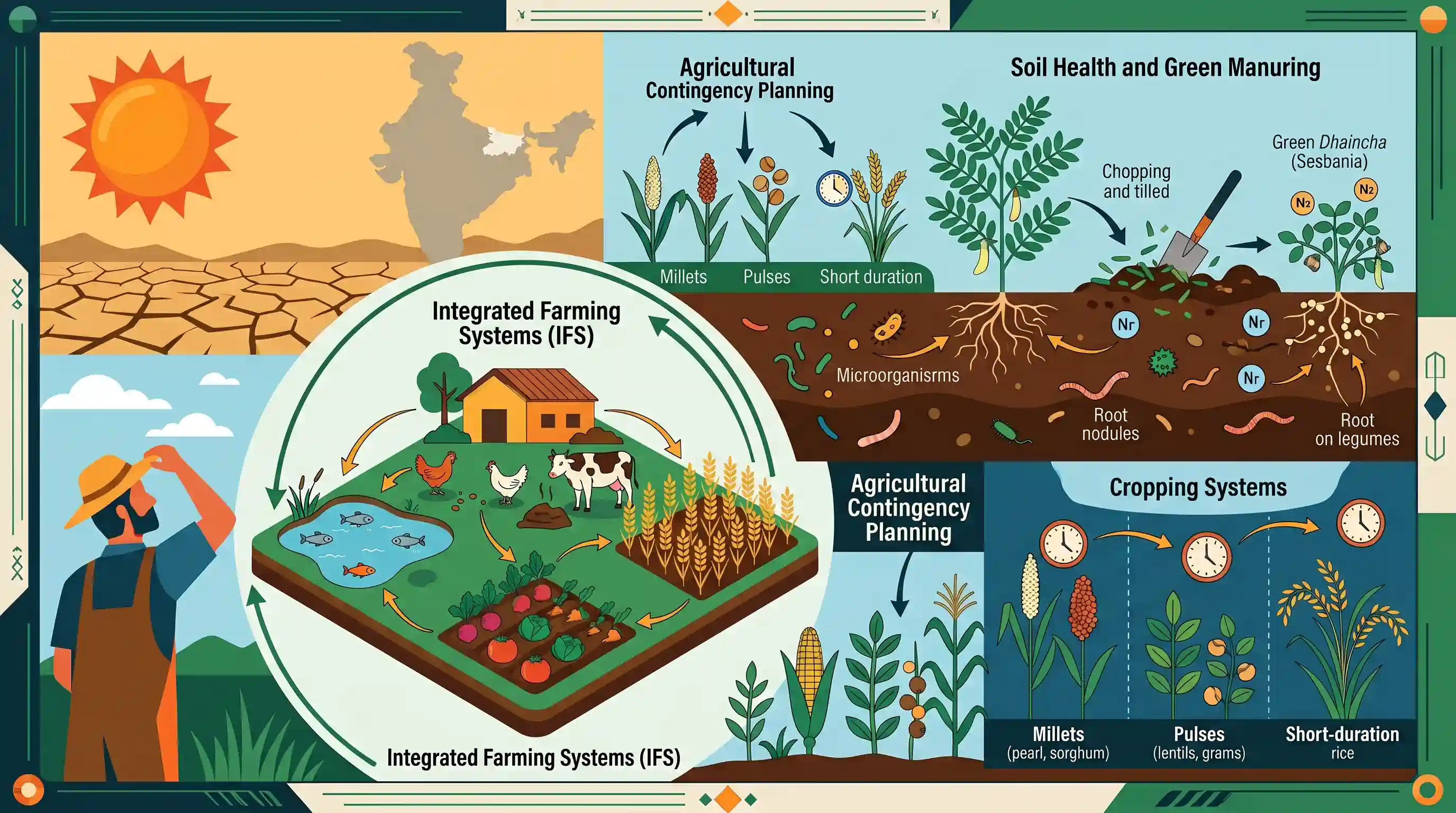
Under the nationwide 'Khet Bachao Abhiyan-2026', ICAR-MGIFRI, Motihari, and Siswa Purvi Gram Panchayat of East Champaran, Bihar, organized a farmer training program to promote climate-resilient agriculture, soil health, and Integrated Farming Systems (IFS). The initiative highlighted soil health conservation, green manuring via Dhaincha (Sesbania), biological nitrogen fixation via legumes, and contingency crop planning (utilizing millets, pulses, and short-duration rice varieties) to tackle El Niño-induced monsoon uncertainties and secure rabi yields.
Key Points
- Under the nationwide 'Khet Bachao Abhiyan–2026', a Farmer Training-cum-Kisan Gosthi was jointly organized by ICAR-MGIFRI and Siswa Purvi Gram Panchayat in Motihari, East Champaran, Bihar.
- The campaign focuses on soil health conservation, promoting balanced fertilizer use, biofertilizers, biopesticides, and crop diversification.
- The role of green manuring using Dhaincha (Sesbania) was emphasized for enhancing soil organic matter, microbial activity, and nutrient-use efficiency before rice transplantation.
- To counter El Niño-like conditions and weak monsoon scenarios, farmers were advised on contingency crop planning, including a focus on moisture-resilient pulses, oilseeds, and Shri Anna (millets).
- In case of delayed rice transplantation (up to mid-August), the use of short-duration rice varieties (90–120 days) was recommended to avoid delayed sowing and resultant yield penalties in succeeding rabi crops like wheat and maize.
- The campaign highlighted the inclusion of green gram and other legumes in cropping systems to enhance biological nitrogen fixation and reduce chemical fertilizer dependence.
Important Terms
Pradhan Mantri Fasal Bima Yojana (PMFBY)

A centrally sponsored crop insurance scheme launched in 2016, offering comprehensive financial protection to farmers against non-preventable agricultural risks from pre-sowing to post-harvest stages.
UPSC context
GS Paper II (Government Schemes) & Paper III (Agriculture); evaluates knowledge of social security, risk mitigation, and agricultural economy.
Kisan Credit Card (KCC) Scheme
A credit delivery mechanism introduced in 1998 to provide farmers with timely, affordable, and flexible short-term institutional credit for cultivation, post-harvest, and allied activities.
UPSC context
GS Paper III (Indian Economy & Agriculture); tests familiarity with agricultural credit mechanisms, financial inclusion, and rural banking.
Agricultural Technology Management Agency (ATMA)
A district-level autonomous society launched in 2005 that integrates research, extension, and farmers to promote decentralized, technology-driven, and farmer-accountable agricultural practices.
UPSC context
GS Paper II (Governance) & Paper III (Technology Missions); tests bottom-up agricultural extension, technology transfer, and institutional frameworks.
Indian Council of Agricultural Research (ICAR)
An autonomous apex body under the Ministry of Agriculture and Farmers Welfare, established in 1929, coordinating agricultural research, education, and extension across India.
UPSC context
GS Paper III (Science & Technology/Agriculture); tests awareness of agricultural institutions, food security, and research-led technology development.
Khet Bachao Abhiyan
A state-wide campaign in Bihar launched to counter El Niño-induced monsoon uncertainties, promote balanced fertilizer use, crop diversification, natural farming, and soil health conservation.
UPSC context
GS Paper III (Agriculture & Climate Change); tests regional climate adaptation, cropping pattern shifts, and sustainable resource management under climate stress.
ICAR-Mahatma Gandhi Integrated Farming Research Institute (MGIFRI)
A Motihari-based ICAR institute established to develop location-specific, profitable, and climate-resilient Integrated Farming System (IFS) models, particularly for flood-prone and waterlogged ecosystems.
UPSC context
GS Paper III (Agriculture & Environment); evaluates models of integrated farming, sustainable livelihood, and regional agro-ecological disaster management.
Prelims Trap
Delayed kharif paddy transplantation only impacts paddy yields, having no structural bearing on subsequent rabi crops if irrigation is assured.
Late kharif harvesting delays rabi sowing, exposing crops like wheat to terminal heat stress during spring grain-filling, causing severe yield losses regardless of irrigation.
Static Concepts Connected
What are the core ecological benefits of Integrated Farming Systems (IFS)?
- Waste-to-resource cycle: Utilizes waste of one enterprise as input for another (e.g., dung for compost, crop residues for fodder), reducing input costs.
- Climate resilience: Diversifies income streams across crops, livestock, and agroforestry, buffer-proofing farmers against mono-crop failure from erratic monsoons.
- Soil health: Continuous organic recycling maintains soil microbial activity, organic carbon levels, and natural nutrient cycles.
How does green manuring (e.g., Sesbania/Dhaincha) enhance soil fertility?
- Nitrogen fixation: Symbiotic association with Rhizobium bacteria fixes atmospheric nitrogen, directly reducing chemical urea requirements.
- Organic carbon buildup: Decomposition of succulent green biomass adds humic substances, improving soil structure and water-retention capacity.
- Nutrient mining prevention: Deep taproots retrieve vital nutrients from subsoil layers, making them available to shallow-rooted succeeding crops.
Cross-Topic Patterns
Gram Panchayats + Climate adaptation
Locally led adaptation via PRIs bridges the gap between scientific institutions and farms, manifesting democratic decentralization in frontline climate action.
Crop physiology + Agrarian economy
Delayed kharif sowing triggers rabi terminal heat stress, highlighting why agricultural contingency planning is vital to safeguard national food security.

Agro-climatic zoning coupled with contingency cropping and green manuring is likely to feature as a conceptual Prelims question by 2026.
Linked PYQs · 5
Linked PYQs · 5
- 2024-EBPSC_PRELIMSGS1
What is the contribution of agriculture in the Gross Domestic Product (GDP) of Bihar?
- 2024-IBPSC_PRELIMSGS1
In which district of Bihar, wheat crop production is maximum?
- 2020BPSC_PRELIMSGS1
The Government of India conferred the Krishi Karman Award to Bihar State on 2nd January, 2020. This award was given for
- 2025BPSC_PRELIMSGS1
Most of the Bihar comes under which of the following climate type?
- 2018BPSC_PRELIMSGS1
Most of the area in Bihar is covered by
