Agricultural Biosecurity Threats and Pest Management
Source:The Hindu ↗
Why It Matters
Biosecurity in agriculture, the management of invasive alien species (like the Fall Armyworm), and the transition toward biological pest control are crucial GS3 Environment and Agriculture topics. Furthermore, India's historically low R&D spending compared to global peers directly limits technological advancement, a key theme in GS3 Science & Technology and Economy. The disproportionate impact of agricultural shocks on women and marginalized farmers is highly relevant for GS2 Social Justice and GS3 Inclusive Growth.
Summary
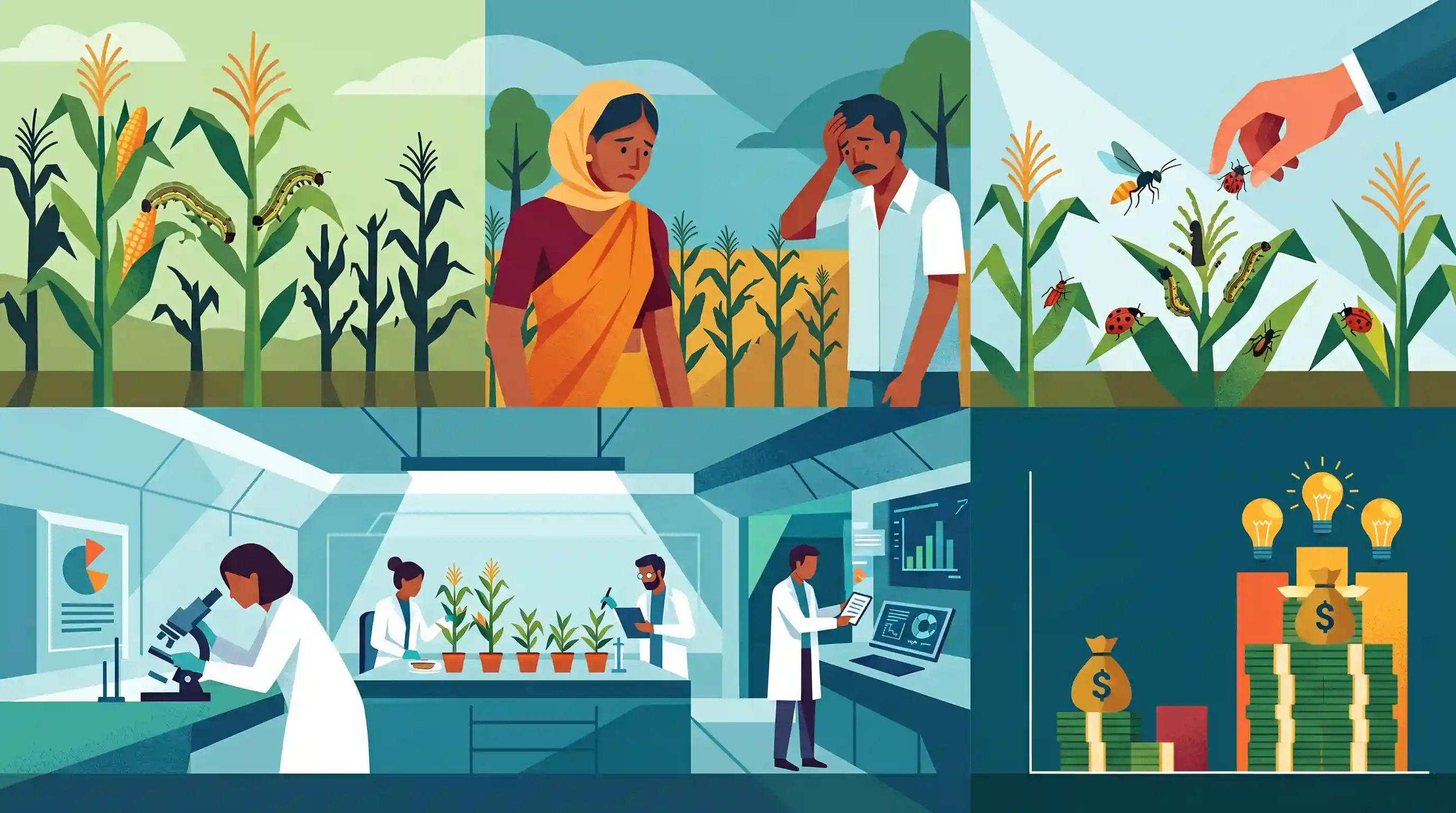
Agricultural scientists have emphasized the urgent need for India to develop robust preparedness and action plans against biosecurity threats, such as the invasive Fall Armyworm (FAW). First detected in India in 2018, FAW highlights the vulnerability of crops and the disproportionate impact of plant health outbreaks on women and marginalised farmers. Experts advocate for sustainable biological control methods over chemical pesticides to manage such pests. Furthermore, they pointed out that India's low Research and Development (R&D) expenditure—currently at just 0.6% of GDP—hampers the development of innovative agricultural solutions compared to global leaders.
Key Points
- Agricultural scientists emphasize the urgent need for India to develop an action plan against major biosecurity threats and crop pathogens.
- The Fall Armyworm (FAW), first detected in Shivamogga in 2018, exemplifies the severe threat posed by invasive pests to Indian agriculture.
- Women farmers and marginalised communities disproportionately bear the socioeconomic impact of significant plant health outbreaks.
- Experts strongly advocate for using biological control agents instead of excessive chemical pesticides to sustainably manage pests like FAW.
- India's Research and Development (R&D) expenditure is critically low at just 0.6% of its GDP, significantly lagging behind the US (6.25%) and China (2.1%).
Important Terms
Fall Armyworm (FAW)

A highly invasive, polyphagous pest (Spodoptera frugiperda) first detected in India in 2018. It primarily targets maize but can devastate over 80 different crop species.
UPSC context
GS Paper 3: Agriculture/Environment. Tests knowledge of invasive species, food security threats, and integrated pest management (IPM) strategies.
Biosecurity
A strategic, integrated approach to managing biological risks to human, animal, and plant life. In agriculture, it involves preventing the introduction and spread of invasive pests and diseases.
UPSC context
GS Paper 3: Agriculture/Disaster Management. Evaluates understanding of food safety, quarantine protocols, and safeguarding biodiversity against biological threats.
ICAR-National Bureau of Agricultural Insect Resources (NBAIR)
A premier Bengaluru-based ICAR institution acting as the nodal agency for collecting, documenting, and utilizing agriculturally important insects for sustainable pest management and biological control.
UPSC context
GS Paper 3: Science & Technology/Agriculture. Tests awareness of institutional frameworks for agricultural research and non-chemical pest management.
Borlaug Institute of South Asia (BISA)
A non-profit international research institute established in 2011 by CIMMYT and ICAR. It focuses on doubling food production through climate-resilient technologies and improved seed varieties in South Asia.
UPSC context
GS Paper 3: Agriculture/Food Security. Relates to international collaborations for a 'Second Green Revolution' and South Asian regional food stability.
Biological Control
A method of controlling pests such as insects, mites, weeds, and plant diseases using other organisms. It relies on predation, parasitism, or herbivory as a sustainable alternative to chemical pesticides.
UPSC context
GS Paper 3: Environment/Agriculture. Focuses on sustainable farming practices, reducing chemical toxicity, and maintaining ecological balance in croplands.
Keladi Shivappa Nayaka University of Agricultural and Horticultural Sciences (KSNUAHS)
An integrated agricultural university located in Shivamogga, Karnataka. It was the state's first university to combine agriculture, horticulture, and forestry sciences under one purview.
UPSC context
GS Paper 3: Agriculture. Significant for its role in identifying the first FAW case in India and regional R&D leadership.
Prelims Trap
Fall Armyworm (FAW) is an endemic Indian pest that exclusively attacks maize crops.
FAW is an invasive alien species (native to the Americas), first reported in India in 2018. It is highly polyphagous, feeding on over 80 plant species.
Static Concepts Connected
What are the primary mechanisms of biological pest control in agriculture?
- Predators: Natural enemies, such as ladybird beetles and lacewings, that actively hunt and consume target agricultural pests.
- Parasitoids: Insects like Trichogramma wasps that lay their eggs inside or on the host pest (eggs/larvae), ultimately killing it from the inside out.
- Pathogens: Microorganisms such as fungi, bacteria (e.g., Bacillus thuringiensis), and viruses used as targeted bio-pesticides to infect and suppress pest populations sustainably.
What defines the framework of Agricultural Biosecurity in India?
- Core Objective: Protecting crops, livestock, and the environment from the introduction of transboundary diseases, invasive alien species (IAS), and potential agro-terrorism.
- Institutional Framework: The M.S. Swaminathan Task Force recommended establishing a centralized National Agricultural Biosecurity System (NABS) to manage multidimensional agricultural threats.
Cross-Topic Patterns
Invasive pests + Climate change vectors
Changing climatic conditions and shifting isotherms are expanding the geographical viability of transboundary pests, escalating risks to domestic food and nutritional security.
GERD stagnation + Anusandhan NRF
India's critically low R&D spending (0.6% of GDP) forms the exact baseline justification for establishing the recent Anusandhan National Research Foundation (ANRF) to crowd-in private funding.

Invasive pests like FAW, linked with national agricultural biosecurity policy, form a high-probability multi-statement question for 2026.
Linked PYQs · 4
Linked PYQs · 4
- 2023PrelimsGS1
'Invasive Species Specialist Group' (that develops Global Invasive Species Database) belongs to which one of the following organizations?
- 2019MainsGS3
How can biotechnology help to improve the living standards of farmers?
- 2020MainsGS3
How is science interwoven deeply with our lives? What are the striking changes in agriculture triggered off by the science-based technologies?
- 2022MainsGS3
What is Integrated Farming System ? How is it helpful to small and marginal farmers in India?
