Scientific temper is essential for environmental protection
Source:The Hindu ↗
Why It Matters
The recent decriminalization of offenses under the Environment (Protection) Act, 1986 is a major regulatory shift relevant for GS3 (Environment) and GS2 (Governance). Additionally, the intersection of Fundamental Duties (Article 51A), scientific temper, and environmental conservation provides excellent fodder for GS4 (Environmental Ethics) and Essay papers.
Summary
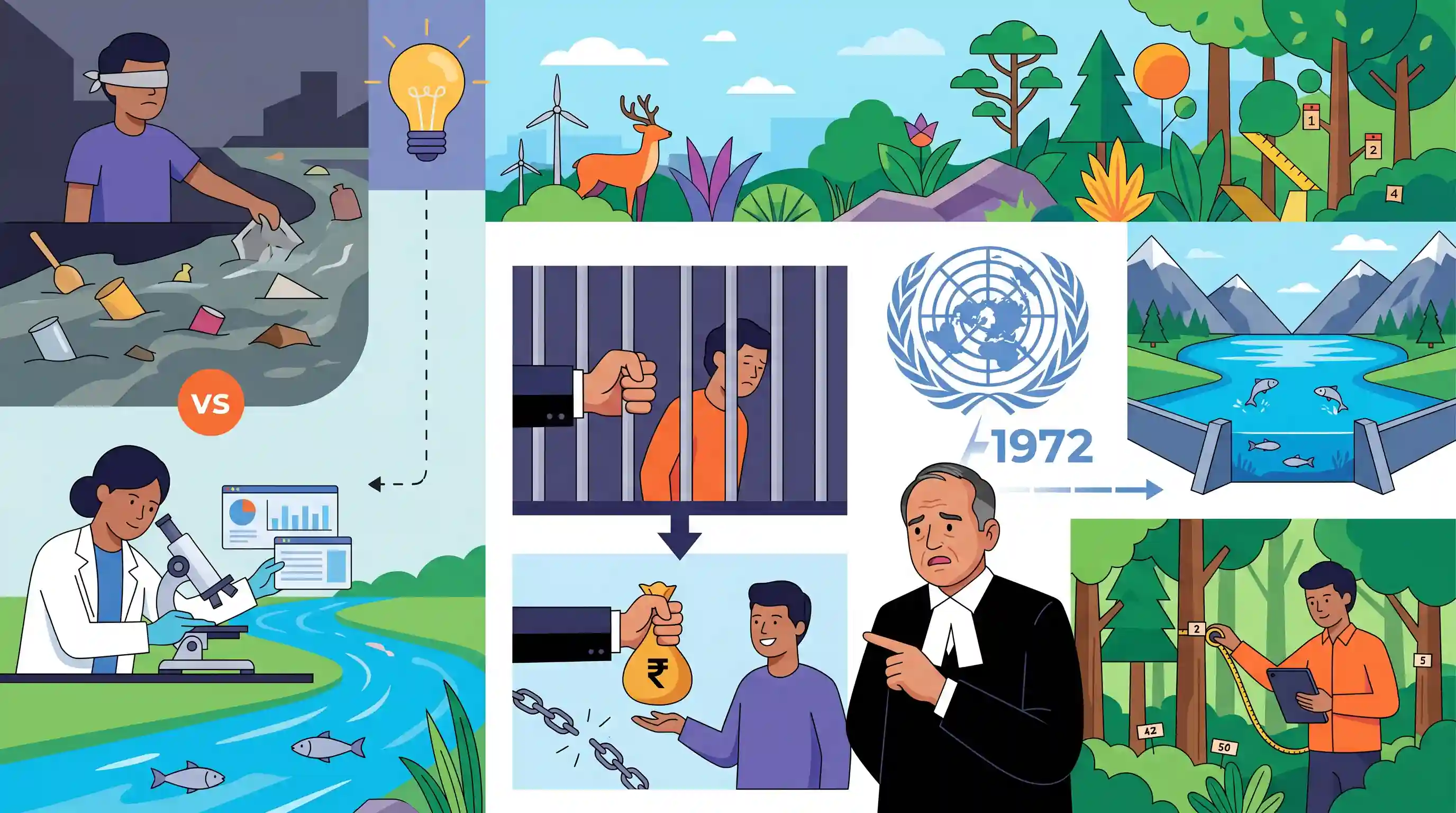
Former Supreme Court Judge Abhay S. Oka stressed that cultivating a scientific temper, as outlined in Article 51A (Fundamental Duties) of the Indian Constitution, is vital for protecting the environment. He warned that blind adherence to certain unscientific religious practices often leads to severe ecological harm, such as river pollution, while clarifying that a scientific temper does not mean opposing faith. Crucially, Oka criticized a recent 2023 amendment to the Environment (Protection) Act, 1986, which decriminalized offenses under Section 15 by substituting prison terms with monetary fines, thereby diluting the law's deterrent effect. He also highlighted the legacy of the 1972 Stockholm Conference and called for regular tree censuses and the strict preservation of waterbodies.
Key Points
- Former SC Judge Abhay S. Oka emphasized that developing a scientific temper, as mandated by Article 51A of the Constitution, is crucial for environmental protection.
- He cautioned that blindly following certain religious practices (like polluting rivers during festivals) causes ecological harm, and that scientific temper involves questioning unscientific actions, not opposing faith itself.
- Oka strongly criticized the 2023 amendment to Section 15 of the Environment (Protection) Act, 1986, which replaced imprisonment with monetary penalties, arguing it removes a vital deterrent against environmental crimes.
- He advocated for proactive ecological measures, including conducting a tree census every five years and strictly preventing the disappearance of waterbodies.
Important Terms
Environment (Protection) Act, 1986

An "umbrella" legislation enacted under Article 253 to protect and improve the environment. It grants the Central Government wide-ranging powers to set standards and regulate hazardous substances following the Bhopal Gas Tragedy.
UPSC context
GS Paper III (Environment); key framework for environmental governance and regulatory standards in India.
Jan Vishwas (Amendment of Provisions) Act, 2023
A 2023 legislation that amended 42 Central Acts, including the EPA 1986, to decriminalize minor offenses. It substitutes many prison terms with monetary penalties to promote "ease of doing business."
UPSC context
GS Paper II (Governance) & GS Paper III; tests knowledge of recent legal reforms affecting environmental enforcement.
Scientific Temper
Enshrined in Article 51A(h), it is the duty of every citizen to develop a spirit of inquiry, humanism, and reform, using rational reasoning to evaluate traditional practices and beliefs.
UPSC context
GS Paper II (Constitution) & GS Paper IV (Ethics); emphasizes rational citizenship and social reform.
1972 United Nations Conference on the Human Environment
The first major international conference on environmental issues, which established the "Stockholm Declaration." It catalyzed the creation of India's environment ministry and key laws like the EPA 1986.
UPSC context
GS Paper III (Environment); historic turning point in global and Indian environmental policy.
Article 51A (Fundamental Duties)
Found in Part IVA of the Constitution, these are non-justiciable moral obligations for citizens. Article 51A(g) specifically mandates the protection and improvement of the natural environment.
UPSC context
GS Paper II (Polity); foundational concept regarding citizen responsibilities toward the State and nature.
Prelims Trap
"The Jan Vishwas Act 2023 exempts environmental offenders under the EPA 1986 from statutory penalties."
The Act removes prison sentences (decriminalization) but does NOT remove penalties; it substitutes them with severe administrative monetary fines (₹1 lakh to ₹15 lakh).
Static Concepts Connected
What are the specific Fundamental Duties regarding the environment and science?
- Article 51A(g): Mandates citizens to protect and improve the natural environment, including forests, lakes, rivers, and wildlife.
- Article 51A(h): Obligates citizens to develop the scientific temper, humanism, and the spirit of inquiry and reform.
- Judicial usage: While non-justiciable directly, the Supreme Court routinely uses these duties to uphold the constitutional validity of environmental protection laws.
What is the constitutional basis of the Environment (Protection) Act, 1986?
- Article 253: Empowers Parliament to enact laws for the entire country to implement international treaties, even superseding the State List.
- Stockholm Conference: The EPA 1986 was enacted under Article 253 to implement the decisions of the 1972 United Nations Conference on the Human Environment.
Cross-Topic Patterns
Decriminalization vs Environmental Ethics
The Jan Vishwas Act links corporate governance (ease of doing business) with ecological ethics, debating whether administrative fines can deter corporate polluters as effectively as prison sentences.
Duties shaping environmental jurisprudence
While non-justiciable, the Supreme Court frequently pairs Article 51A(g) with Article 21 (Right to Life) to enforce strict environmental protections and mandate state-led ecological actions.

Expect a Prelims question on the Jan Vishwas Act linking EPA 1986 decriminalization with Article 253 and Article 51A duties.
Linked PYQs · 4
Linked PYQs · 4
- 2015MainsGS4
What is meant by 'environmental ethics'? Why is it important to study? Discuss any one environmental issue from the viewpoint of environmental ethics.
- 2019PrelimsGS1
Consider the following statements : The Environment Protection Act, 1986 empowers the Government of India to 1. state the requirement of public participation in the process of environmental protection, and the procedure and manner in which it is sought 2. lay down the standards for emission or discharge of environmental pollutants from various sources Which of the statements given above is/are correct?
- 2022PrelimsGS1
Which one of the following has been constituted under the Environment (Protection) Act, 1986?
- 2015PrelimsGS1
"To uphold and protect the Sovereignty, Unity and Integrity of India" is a provision made in the
