Uttarakhand Science Technology and Innovation Policy Implementation
Source:garhwalpost ↗
Why It Matters
The establishment of India's fifth Science City in Dehradun and the rollout of Uttarakhand's first Science, Technology and Innovation Policy are critical steps for the state's modernization. It is highly relevant for UKPSC PCS Prelims questions focusing on state-specific scientific initiatives, government policies, and administrative centres.
Summary
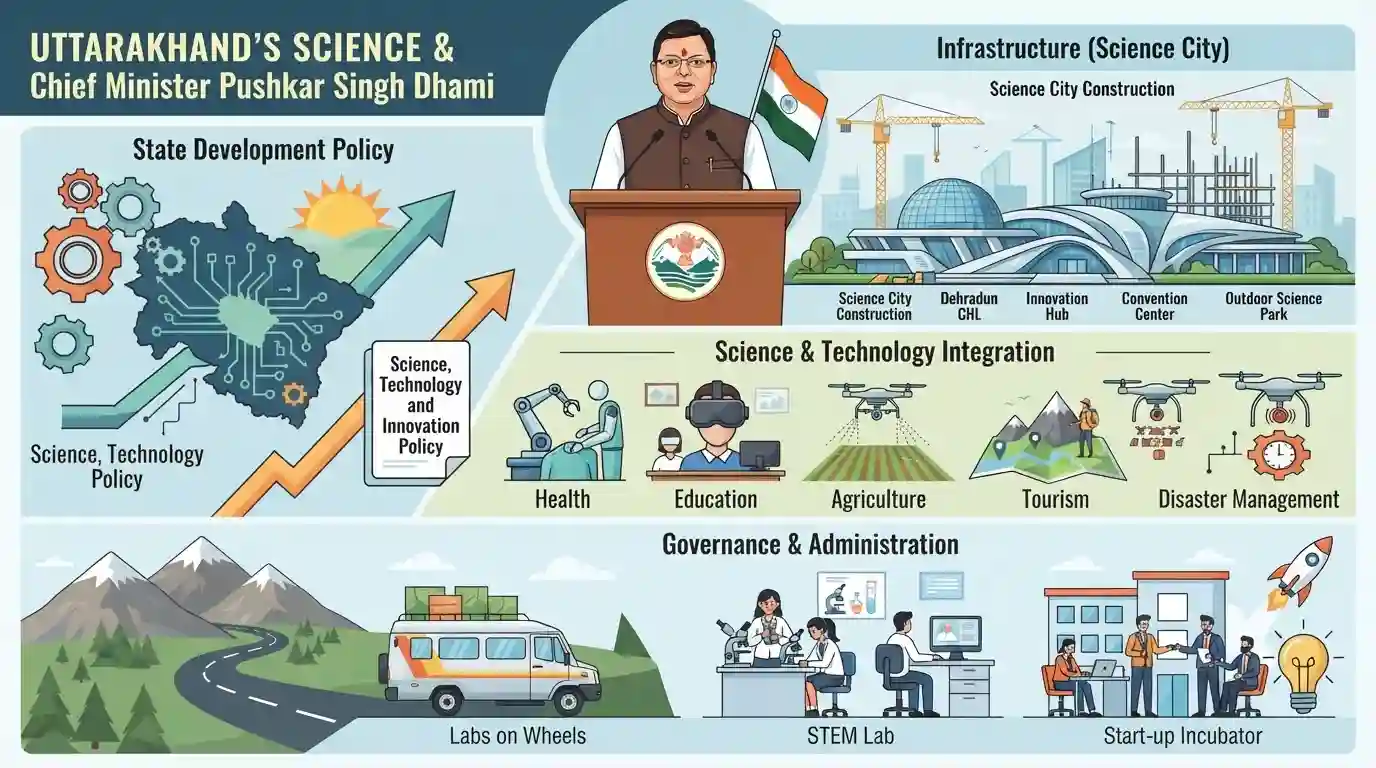
Chief Minister Pushkar Singh Dhami emphasized the foundational role of science, technology, and innovation in the state's development at an event in Dehradun. Organised by UCOST and Pioneer Newspaper Group, the programme highlighted the implementation of Uttarakhand's first Science, Technology and Innovation Policy. Dhami announced the ongoing construction of India's fifth Science City in Dehradun. The state government aims to become a leader in technological integration by utilizing AI, robotics, drones, and semiconductors in vital sectors such as health, education, agriculture, tourism, and disaster management. Expansion of facilities like Labs on Wheels, STEM labs, and start-up incubators reflects the government's commitment to nurturing a strong startup and research ecosystem in Uttarakhand.
Key Points
- Chief Minister Pushkar Singh Dhami addressed the programme 'Mainstreaming Science, Technology and Innovation for a prosperous Uttarakhand'.
- The event was jointly organised by UCOST and Pioneer Newspaper Group in Dehradun.
- Uttarakhand is implementing its first Science, Technology and Innovation Policy.
- India's fifth Science City is being constructed in Dehradun to boost scientific temper and research.
- The state is actively integrating AI, robotics, drones, and semiconductors across sectors like agriculture, disaster management, healthcare, and education.
- Facilities like Science and Innovation Centres, Labs on Wheels, STEM labs, and patent information centres are being expanded in the state.
Important Terms
Science, Technology and Innovation Policy (STIP) 2026

Uttarakhand's policy designed to accelerate research, innovation, and technology-led development, with a focus on converting youth into job creators and integrating advanced technologies like AI and robotics across key sectors.
UPSC context
GS Paper 3: Science and Tech, state development policies. Tests knowledge of regional innovation systems and sustainable technology integration.
Uttarakhand State Council for Science & Technology (UCOST)
An autonomous scientific body of the Government of Uttarakhand that promotes research, scientific temper, technology-driven education, and grassroots coordination of local developmental projects.
UPSC context
GS Paper 3: Institutional framework of Science and Tech. Tests understanding of regional scientific institutions and socio-economic planning.
Science City, Dehradun
India’s fifth Science City, being developed in Dehradun under the Scheme for Promotion of Culture of Science to foster scientific temper, research, and interactive learning.
UPSC context
GS Paper 3: Scientific infrastructure. Tests knowledge of public infrastructure projects aimed at scientific temper and human capital development.
Labs on Wheels
A UCOST initiative deploying specialized mobile science and computer vans to remote districts, providing rural public school students with hands-on experiential learning and laboratory experiments.
UPSC context
GS Paper 2: Education and Governance; GS Paper 3: S&T. Tests knowledge of grassroots initiatives to bridge educational resource gaps.
Prelims Trap
The Science City projects in India are centrally funded and implemented solely by the Ministry of Science and Technology.
The National Council of Science Museums (NCSM), which co-develops Science Cities under the SPOCS scheme, is an autonomous body under the Ministry of Culture, not Science and Technology.
Static Concepts Connected
What is the Scheme for Promotion of Culture of Science (SPOCS)?
- Nodal Authority: Administered by the Union Ministry of Culture through the National Council of Science Museums (NCSM).
- Core Objective: Aims to portray S&T growth and cultivate scientific temper among public by setting up Science Cities, Science Centres, and Innovation Hubs.
- Funding Pattern: Typically operates on a 50:50 cost-sharing ratio between the Central government and State/UT governments.
What is the constitutional basis of scientific temper in India?
- Article 51A(h): Article 51A(h) mandates every citizen to develop "scientific temper, humanism and the spirit of inquiry and reform."
- Constitutional Source: Introduced via the 42nd Amendment Act in 1976 under Part IV-A of the Constitution of India.
Cross-Topic Patterns
Central cultural schemes driving S&T outreach
Shows how non-S&T ministries (like Culture) drive S&T outreach through public infrastructure, blending federal center-state capital-sharing models with regional development.
GI, IP and Traditional Himalayan Knowledge
Uttarakhand's STIP 2026 seeks to protect local, high-altitude botanical knowledge via patent support, bridging Intellectual Property Rights (IPR) with indigenous ecological wisdom.

UPSC may test the institutional setup of science popularization, trapping students on Ministry of Culture's role in establishing Science Cities.
Linked PYQs · 2
Linked PYQs · 2
- 2024UKPSC_PRELIMSGS1
Headquarters of which of the following is located in Dehradun, the Capital of Uttarakhand ?
- 2025UKPSC_PRELIMSGS1
Which of the following is incorrectly matched about Central Government Institutes located in Uttarakhand?
