Recent Breakthroughs in Quantum Computing and Biotechnology
Source:The Hindu ↗
Why It Matters
UPSC frequently tests candidates on their awareness of emerging technologies (like quantum computing and biotechnology) and their practical applications. Understanding these developments is crucial for tackling both Prelims MCQs on scientific concepts and Mains questions on the role of technology in India's growth and global scientific advancements.
Summary
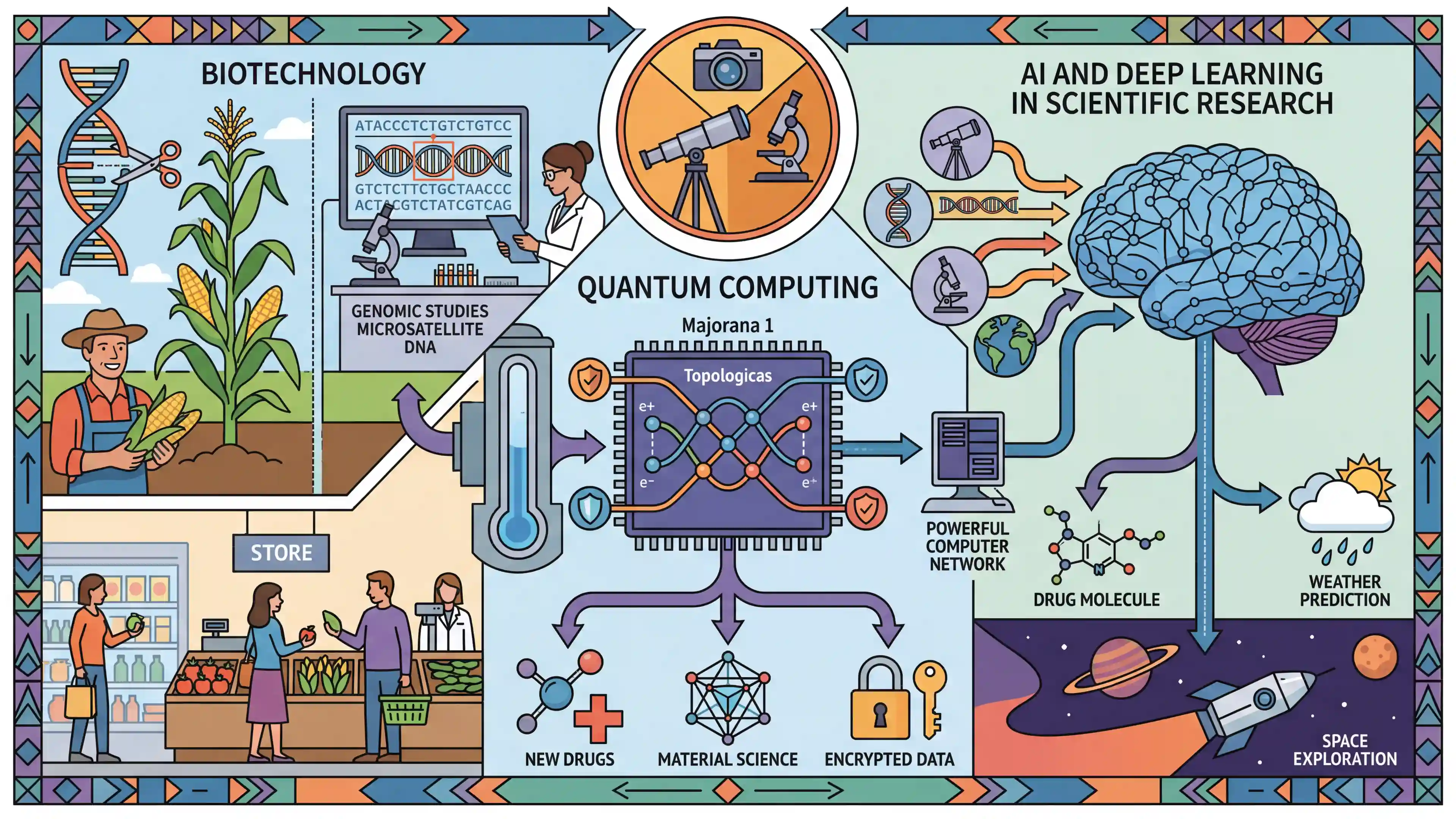
The March 15, 2026 edition of Science Snapshots highlights recent advancements across multiple scientific domains. It covers significant developments in biotechnology, including new applications of genetic modification in crops and genomic studies utilizing microsatellite DNA. In the field of computing, the article discusses the progression of quantum computing technologies—specifically advancements related to qubits and specialized hardware like the Majorana 1 chip for topological quantum computing. It also notes the growing intersection of deep learning and artificial intelligence in accelerating scientific research and data analysis.
Key Points
- Recent breakthroughs in biotechnology involve the use of genetic modification (such as Bt technologies) and microsatellite DNA to study evolutionary relationships and improve crop resilience.
- Advancements in quantum computing are accelerating, with a focus on the manipulation of qubits to achieve exponential processing speeds compared to classical computers.
- The development of specialized quantum hardware, such as Microsoft's Majorana 1 chip, is paving the way for topological quantum computing with better error-correction.
- Artificial intelligence and deep learning models are increasingly being integrated into scientific research to process massive datasets and accelerate discoveries across disciplines.
Important Terms
Majorana 1 Chip

A quantum processing unit developed by Microsoft utilizing topological qubits. It aims to achieve fault-tolerant computing by leveraging stable Majorana zero modes in a specialized "topoconductor" material architecture.
UPSC context
GS Paper III (Science & Tech); tests awareness of emerging computing hardware and global quantum research leadership.
Topological Quantum Computing
A quantum computing model that uses exotic quasiparticles (anyons) to perform calculations. It provides "hardware-level" error resistance, offering a more stable and scalable alternative to traditional superconducting quantum architectures.
UPSC context
GS Paper III (Science & Tech); relevant for "Awareness in IT/Computers" and quantum stability challenges.
Microsatellite DNA
Short, repetitive DNA sequences (2-6 base pairs) used as genetic markers. Due to high individual variability, they are used for DNA fingerprinting, forensics, and tracing evolutionary lineages.
UPSC context
GS Paper III (Biotechnology); a high-frequency topic (Prelims 2023) regarding genetic analysis and evolutionary biology.
Qubit
The basic unit of quantum information. Unlike classical bits (0 or 1), qubits leverage superposition to exist in both states simultaneously, enabling exponential processing power for specific complex tasks.
UPSC context
GS Paper III (Science & Tech); fundamental term in quantum mechanics (appeared in Prelims 2022).
Deep Learning
A subset of Artificial Intelligence using multi-layered artificial neural networks. It mimics human brain processing to identify complex patterns in vast unstructured datasets like images, speech, or genomic data.
UPSC context
GS Paper III (Science & Tech); central to AI developments and its research applications.
Prelims Trap
"Microsatellite DNA is primarily utilized for the genetic modification of agricultural crops."
False. Microsatellite DNA consists of non-coding sequences used for DNA fingerprinting and studying evolutionary relationships, not for creating transgenic crops. Bt technology is used for modification.
Static Concepts Connected
What are the foundational principles distinguishing Quantum Computing?
- Superposition: Unlike classical bits, Qubits can exist in multiple states (0 and 1) simultaneously, enabling massive parallel calculations.
- Entanglement: Qubits become intricately linked so that the state of one instantly determines the state of another, regardless of distance.
- Topological computing: An advanced approach (using Majorana particles) that stores information in the topology of the system, making it highly resistant to environmental noise (decoherence).
What is Microsatellite DNA and how is it applied?
- Short Tandem Repeats: They are short, highly repetitive sequences of non-coding DNA. Because they mutate rapidly, their lengths vary greatly between individuals.
- Primary Applications: They act as vital genetic markers used in DNA profiling, forensic analysis, population genetics, and tracing evolutionary relationships.
Cross-Topic Patterns
Quantum Tech + Cybersecurity and Encryption
The shift towards stable Majorana quantum chips threatens current RSA encryption standards, tying directly to India's National Quantum Mission and future cyber-defense frameworks.
Biotechnology + Agricultural Economy and IPR
The evolution of Bollgard (Bt) traits intersects with Intellectual Property Rights (IPR), patent laws, and the regulation of seed monopolies in India's agricultural economy.

Match-the-following pairs featuring emerging terms like 'Majorana zero modes', 'Microsatellites', and 'ANNs' are highly likely in 2026.
Linked PYQs · 4
Linked PYQs · 4
- 2021PrelimsGS1
Bollgard I and Bollgard II technologies are mentioned in the context of
- 2023PrelimsGS1
'Microsatellite DNA' is used in the case of which one of the following?
- 2022PrelimsGS1
Which one of the following is the context in which the term "qubit" is mentioned ?
- 2025PrelimsGS1
Consider the following statements: I. It is expected that Majorana 1 chip will enable quantum computing. II. Majorana 1 chip has been introduced by Amazon Web Services (AWS). III. Deep learning is a subset of machine learning. Which of the statements given above are correct?
