Emerging Technologies in Quantum Computing and Biotechnology
Source:The Hindu ↗
Why It Matters
Science snapshots provide critical fodder for the UPSC Preliminary examination, which frequently tests terms in news like 'qubits', 'membrane bioreactors', and 'GM crops'. Furthermore, Mains GS-3 expects candidates to understand the practical applications of emerging technologies in solving everyday problems like the freshwater crisis or food security.
Summary
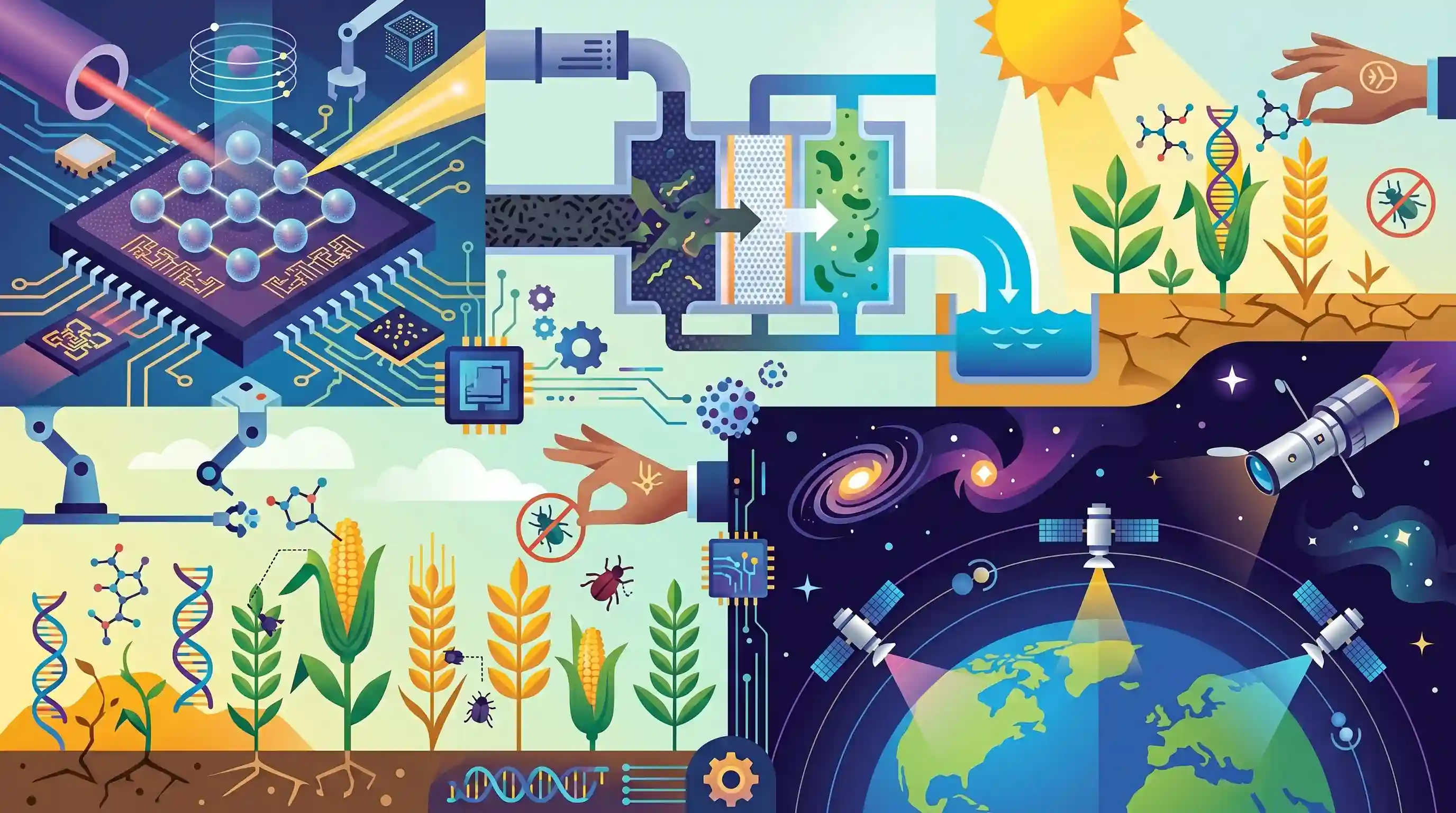
This compilation of recent science developments highlights key advancements across multiple domains. In quantum computing, new methods to stabilize qubits are bringing practical quantum machines closer to reality. In the environmental sector, advanced membrane bioreactors offer a novel technological solution to the escalating freshwater crisis by enabling highly efficient wastewater treatment. The field of biotechnology is advancing with next-generation genetically modified crops aimed at improving resilience against climate change and pests. Additionally, space agencies like ISRO and NASA continue to push the boundaries of Earth observation and deep-space astrophysics.
Key Points
- Advancements in quantum computing have led to increased stability in qubits, potentially accelerating applications in cryptography and complex modeling.
- New innovations in membrane bioreactors have shown promise in addressing global freshwater shortages by improving wastewater treatment efficiency.
- Biotechnological developments continue to focus on creating drought and pest-resistant genetically modified crop varieties to ensure food security.
- Space technology updates highlight the ongoing collaborative efforts of ISRO and NASA in earth observation and deep space exploration.
Important Terms
Qubits

The fundamental unit of information in quantum computing that exists in multiple states simultaneously (superposition), unlike classical binary bits.
UPSC context
GS-III: IT & Computers. Tests awareness of frontier technologies and India’s National Quantum Mission.
Membrane Bioreactor (MBR)
A high-efficiency wastewater treatment system combining biological degradation with membrane filtration (micro/ultra-filtration) to produce superior-quality recycled water.
UPSC context
GS-III: Environment & Conservation. Relevant for sustainable urban water management and pollution control technologies.
Genetically Modified (GM) Crops
Agricultural plants whose DNA is altered via genetic engineering to introduce specific traits like pest resistance, herbicide tolerance, or climate resilience.
UPSC context
GS-III: Biotechnology & Agriculture. Crucial for food security debates and biosafety regulations under GEAC.
ISRO
India's national space agency responsible for developing indigenous launch vehicles, satellites, and interplanetary missions for societal and scientific progress.
UPSC context
GS-III: Space Technology. Essential for studying indigenization of technology and India’s global space milestones.
NASA
The independent U.S. federal agency conducting civilian space programs, aerospace research, and international collaborative missions like Earth observation.
UPSC context
GS-III: Space Technology. Relevant for understanding international space cooperation and global technological benchmarks.
Prelims Trap
"Qubits function exactly like regular binary bits (0 or 1) but process data much faster."
Qubits do not function like traditional binary bits; they use superposition to represent 0 and 1 simultaneously, rather than just processing deterministically.
Static Concepts Connected
What are the unique capabilities of the NASA-ISRO Synthetic Aperture Radar (NISAR)?
- Dual Frequency: Utilizes both L-band and S-band radar frequencies, a world first, allowing it to penetrate dense forest canopies.
- Precision Observation: Capable of tracking subtle changes in Earth's ecosystems, dynamic surfaces, and ice masses down to the centimetre level.
- Primary Application: It is an Earth observation satellite, crucial for understanding climate change, natural hazards, and agricultural biomass, not a deep-space probe.
How do Membrane Bioreactors (MBRs) function in wastewater treatment?
- Technological Integration: MBRs integrate conventional biological degradation of wastewater with advanced microfiltration or ultrafiltration membranes.
- Space Efficiency: They eliminate the need for secondary clarifiers/settling tanks, resulting in a highly compact system suitable for dense urban areas.
- High-Quality Output: Produces highly purified effluent that can be directly reused for industrial or agricultural purposes, addressing freshwater scarcity.
Cross-Topic Patterns
Quantum Computing & Cyber Warfare
Post-quantum cryptography directly links to the GS3 internal security syllabus. UPSC increasingly frames emerging tech questions around vulnerabilities in critical infrastructure and data sovereignty.
Biotech in Climate-Smart Agriculture
Next-gen drought-resistant GM crops connect to GS3 agriculture, intersecting with debates on GEAC regulatory frameworks, food security, and climate-resilient farming techniques.

A 2026 prelims question is highly likely to mix quantum computing fundamentals (superposition/entanglement) with cryptographic applications.
Linked PYQs · 4
Linked PYQs · 4
- 2024PrelimsGS1
"Membrane Bioreactors" are often discussed in the context of:
- 2021PrelimsGS1
Bollgard I and Bollgard II technologies are mentioned in the context of
- 2022PrelimsGS1
Which one of the following is the context in which the term "qubit" is mentioned ?
- 2024MainsGS3
The world is facing an acute shortage of clean and safe freshwater. What are the alternative technologies which can solve this crisis? Briefly discuss any three such technologies citing their key merits and demerits.
