New Seismic Hazards and Ancient DNA Discoveries Highlighted in Science
Source:The Hindu ↗
Why It Matters
Understanding delayed seismic hazards improves disaster management protocols. Similarly, studying wildlife behavioral shifts due to war and the evolutionary origins of diseases like plague offer critical insights into environmental conservation and public health preparedness.
Summary
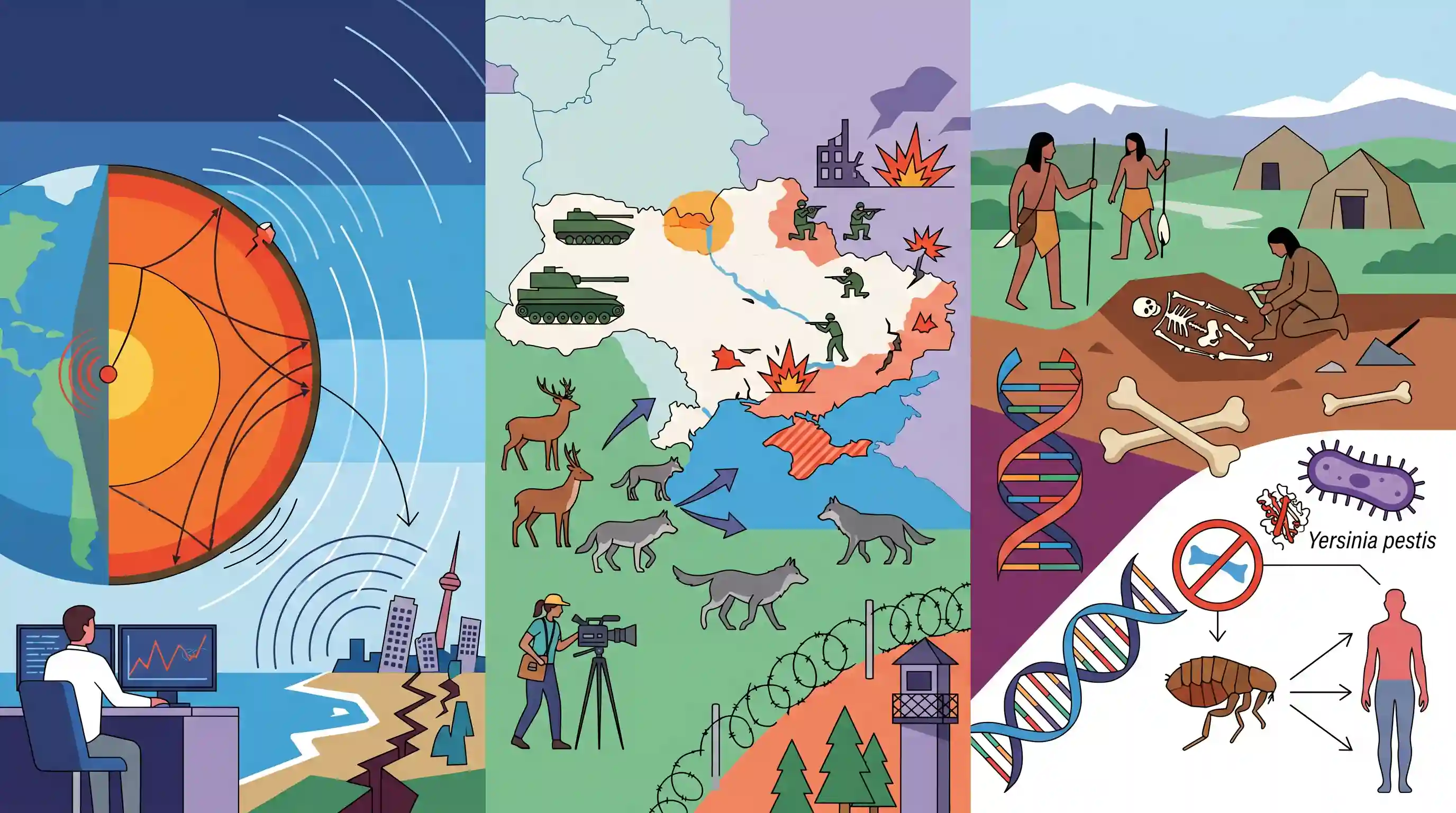
The article highlights three distinct scientific discoveries. First, a study on the 2011 Japan earthquake reveals that ScS seismic waves, which reflect off the Earth's core, caused delayed ground shifts, representing a newly identified seismic risk. Second, ongoing conflict in Ukraine is significantly altering the behavior of wildlife within the Chornobyl Exclusion Zone, forcing animals to avoid military sites. Finally, analysis of ancient DNA from Siberia shows that a plague outbreak infected hunter-gatherers over 5,500 years ago, indicating the disease predates agricultural societies, though this early strain lacked the genetic mutation necessary for transmission via flea bites.
Key Points
- A new seismic hazard was identified following the 2011 Japan earthquake, where ScS waves bouncing off the Earth\'s core triggered ground shifts 15 minutes after the primary shock.
- Camera trap footage from the Chornobyl Exclusion Zone shows wildlife populations modifying their behavior to avoid human conflict and military activity, disrupting previous recovery efforts.
- Ancient DNA analysis of 5,500-year-old remains near Lake Baikal indicates that plague was widespread among hunter-gatherer populations before the dawn of agriculture.
- The ancient plague strain infected nearly 39% of the surveyed individuals but lacked the gene required for flea-bite transmission, relying instead on different mechanisms of spread.
Prelims Trap
Ancient plague outbreaks relied on flea bites for transmission and only emerged after the dawn of agriculture.
Ancient DNA reveals that early plague strains predated agricultural societies and completely lacked the genetic mutation necessary for flea-bite transmission.
Static Concepts Connected
How do different seismic body waves behave inside the Earth?
- P-waves: Primary longitudinal waves that can travel through solid, liquid, and gas, but undergo refraction at the Earth's core boundary.
- S-waves: Secondary transverse waves that only travel through solids, creating a distinct shadow zone beyond 103° from an earthquake's epicenter.
- ScS waves: Shear waves that travel through the mantle, reflect off the liquid outer core-mantle boundary, and return to the surface.
What are the key applications of Paleogenetics?
- Pathogen evolution: Traces the origins and mutation timelines of ancient pathogens, revealing how diseases like the plague adapted to new transmission vectors over millennia.
- Human origins: Maps ancient population migrations, genetic bottlenecks, and interbreeding events with archaic hominins by analyzing DNA from ancient bones and teeth.
- Domestication tracking: Identifies when, where, and how plants and animals were first domesticated by humans before the dawn of modern agriculture.
Cross-Topic Patterns
Ecological costs of geopolitical conflict
The Ukraine war disrupting Chornobyl's unintended wildlife haven highlights the growing intersection of International Relations and Environmental Conservation, a recurring theme in recent UPSC exams.
Paleogenetics tracking ancient disease vectors
Linking prehistoric hunter-gatherer DNA near Lake Baikal to the evolution of plague vectors connects Biotechnology directly to Anthropology and historical public health.

Expect a Prelims statement mixing basic seismic wave behavior (shadow zones) with the newly identified ScS wave delayed-slip hazards.
Linked PYQs · 5
Linked PYQs · 5
- 2023PrelimsGS1
With reference to the Earth's atmosphere, which one of the following statements is correct?
- 2025PrelimsGS1
Consider the following statements : Statement I: Scientific studies suggest that a shift is taking place in the Earth's rotation and axis. Statement II: Solar flares and associated coronal mass ejections bombarded the Earth's outermost atmosphere with tremendous amount of energy. Statement III : As the Earth's polar ice melts, the water tends to move towards the equator. Which one of the following is correct in respect of the above statements?
- 2022PrelimsGS1
If a major solar storm (solar flare) reaches the Earth, which of the following are the possible effects on the Earth? 1. GPS and navigation systems could fail. 2. Tsunamis could occur at equatorial regions. 3. Power grids could be damaged. 4. Intense auroras could occur over much of the Earth. 5. Forest fires could take place over much of the planet. 6. Orbits of the satellites could be disturbed. 7. Shortwave radio communication of the aircraft flying over polar regions could be interrupted. Select the correct answer using the code given below:
- 2025MainsGS3
Mineral resources are fundamental to the country's economy and these are exploited by mining. Why is mining considered an environmental hazard? Explain the remedial measures required to reduce the environmental hazard due to mining.
- 2016MainsGS3
Rehabilitation of human settlements is one of the important environmental impacts which always attracts controversy while planning major projects. Discuss the measures to be adopted to mitigate the impact of the recent incidents of cloudbursts in many places of Uttarakhand.
