Emerging Technologies and Biotechnology Research Breakthroughs
Source:The Hindu ↗
Why It Matters
For UPSC candidates, keeping abreast of current scientific developments is crucial for GS Paper 3. Understanding the applications of AI, nuances of space launch vehicles, and fundamental biotechnological concepts are frequently tested areas in both Prelims and Mains.
Summary
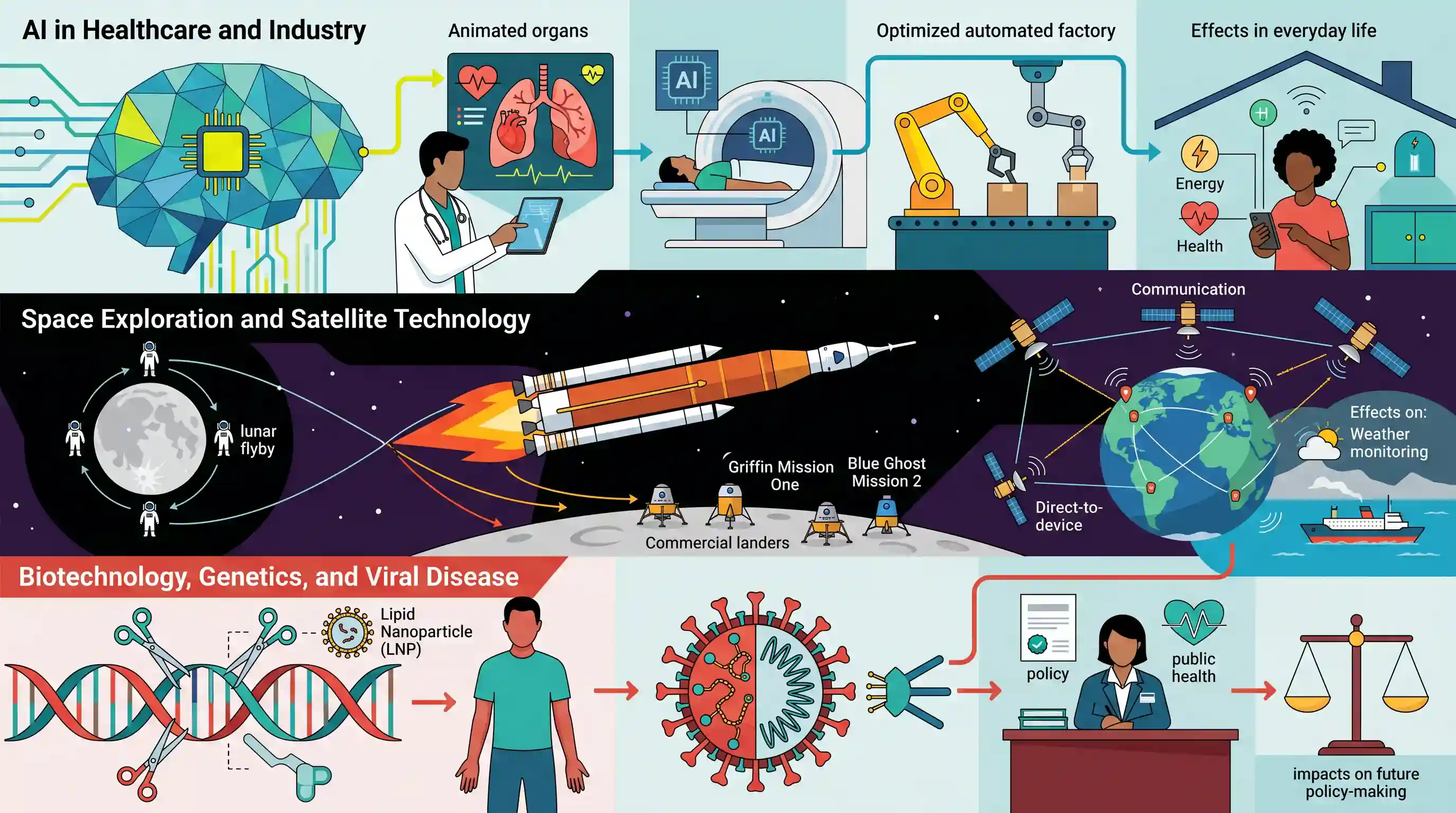
The 'Science Snapshots' roundup for February 2026 highlights recent breakthroughs and ongoing research across multiple scientific domains. Key areas of focus include the expanding practical applications of Artificial Intelligence in healthcare and industry, updates on global space exploration and satellite launch vehicle technologies, and critical advancements in biotechnology related to genetic research and viral disease mechanisms. These developments underscore the rapid pace of scientific innovation and its profound implications for technological progress, public health, and future policy-making.
Key Points
- Artificial Intelligence (AI) continues to advance, showing significant capabilities in applications such as disease diagnosis and reducing industrial electricity consumption.
- Updates on space technology highlight the evolving capabilities of satellite launch vehicles, emphasizing the distinction between polar and geosynchronous orbits.
- Biotechnological developments remain a focus, with ongoing research into genetic markers like microsatellite DNA and mechanisms of viral disease spread (e.g., ACE2 receptors).
- The integration of emerging technologies demands continuous monitoring for both potential benefits in public health and challenges requiring regulatory foresight.
Important Terms
ISRO

India's primary space agency, responsible for space exploration, satellite development, and pioneering missions like Chandrayaan and Gaganyaan.
UPSC context
GS Paper 3 (S&T); tests India's space achievements, mission specifics, and technological self-reliance.
NASA
The United States' federal agency for civilian space programs, aeronautical research, and a frequent collaborator with India on missions like NISAR.
UPSC context
GS Paper 3 (S&T); tests awareness of global space benchmarks and international scientific partnerships.
World Health Organization (WHO)
A specialized UN agency coordinating international public health, setting global standards for healthcare, and monitoring disease outbreaks.
UPSC context
GS Paper 2/3 (IR/Health); tests understanding of global health governance and disease management policies.
Artificial Intelligence (AI)
The simulation of human intelligence by machines, used in healthcare for diagnostics and industry for automation.
UPSC context
GS Paper 3 (S&T); focuses on technology applications, ethics, and impacts on the digital economy.
Biotechnology
A field of science involving the use of living organisms or systems to develop medical, agricultural, and industrial products.
UPSC context
GS Paper 3 (S&T); tests knowledge of genetic engineering, public health advancements, and agricultural sustainability.
Satellite Launch Vehicle (SLV)
Specialized rockets designed to deploy satellites and other payloads into specific Earth orbits or deep space.
UPSC context
GS Paper 3 (S&T); tests indigenous rocketry (PSLV, GSLV) and India's commercial space expansion.
Prelims Trap
Microsatellite DNA plays a crucial role in coding for essential structural proteins in the human body.
Microsatellite DNA consists of repetitive *non-coding* sequences. It does not code for proteins but is highly variable, making it ideal for genetic profiling.
Static Concepts Connected
What distinguishes PSLV from GSLV in India's space program?
- Target Orbits: PSLV targets Low Earth/Polar orbits for Earth observation; GSLV targets Geosynchronous orbits for heavier communication satellites.
- Vehicle Stages: PSLV uses a four-stage (solid-liquid) system, while GSLV employs a three-stage system featuring an upper indigenous cryogenic stage.
What is 'Microsatellite DNA' and what are its primary applications?
- Non-coding nature: They are short, repetitive, non-coding DNA sequences that do not participate in protein synthesis.
- High variability: Their high mutation rate creates significant variability, making them unique identifiers for individuals or populations.
- Utility: They serve as critical genetic markers for DNA fingerprinting, kinship analysis, and tracking evolutionary relationships.
Cross-Topic Patterns
AI + climate emission targets
AI's capability to optimize industrial operations and reduce electricity consumption directly supports India's COP26 Panchamrit targets for emission intensity reduction.
Biotechnology + agricultural economics
Developing climate-resilient crops links biotechnology directly to agricultural economics, food security, and protecting rural livelihoods against climate shocks.

Expect a 'match the following' question in 2026 linking biological terms (ACE2, Microsatellites, mRNA) to their practical applications.
Linked PYQs · 4
Linked PYQs · 4
- 2020PrelimsGS1
With the present state of development, Artificial Intelligence can effectively do which of the following? 1. Bring down electricity consumption in industrial units 2. Create meaningful short stories and songs 3. Disease diagnosis 4. Text-to-Speech Conversion 5. Wireless transmission of electrical energy Select the correct answer using the code given below:
- 2019MainsGS3
How can biotechnology help to improve the living standards of farmers?
- 2018PrelimsGS1
With reference to India's satellite launch vehicles, consider the following statements: 1. PSLVs launch the satellites useful for Earth resources monitoring whereas GSLVs are designed mainly to launch communication satellites. 2. Satellites launched by PSLV appear to remain permanently fixed in the same position in the sky, as viewed from a particular location on Earth. 3. GSLV Mk III is a four-staged launch vehicle with the first and third stages using solid rocket motors; and the second and fourth stages using liquid rocket engines. Which of the statements given above is/are correct?
- 2021PrelimsGS1
The term 'ACE2' is talked about in the context of
