Regulatory Restrictions on School Naming Conventions
Source:Indian Express ↗
Why It Matters
Highlights the ongoing challenge of regulating private, self-financed educational institutions in India. The practice of using grandiose names to justify steep fee hikes is widespread; addressing this touches upon core UPSC themes like the commercialization of education, the need for independent regulatory mechanisms (as highlighted in NEP 2020), and safeguarding citizens (parents) from misleading marketing in public goods like education.
Summary
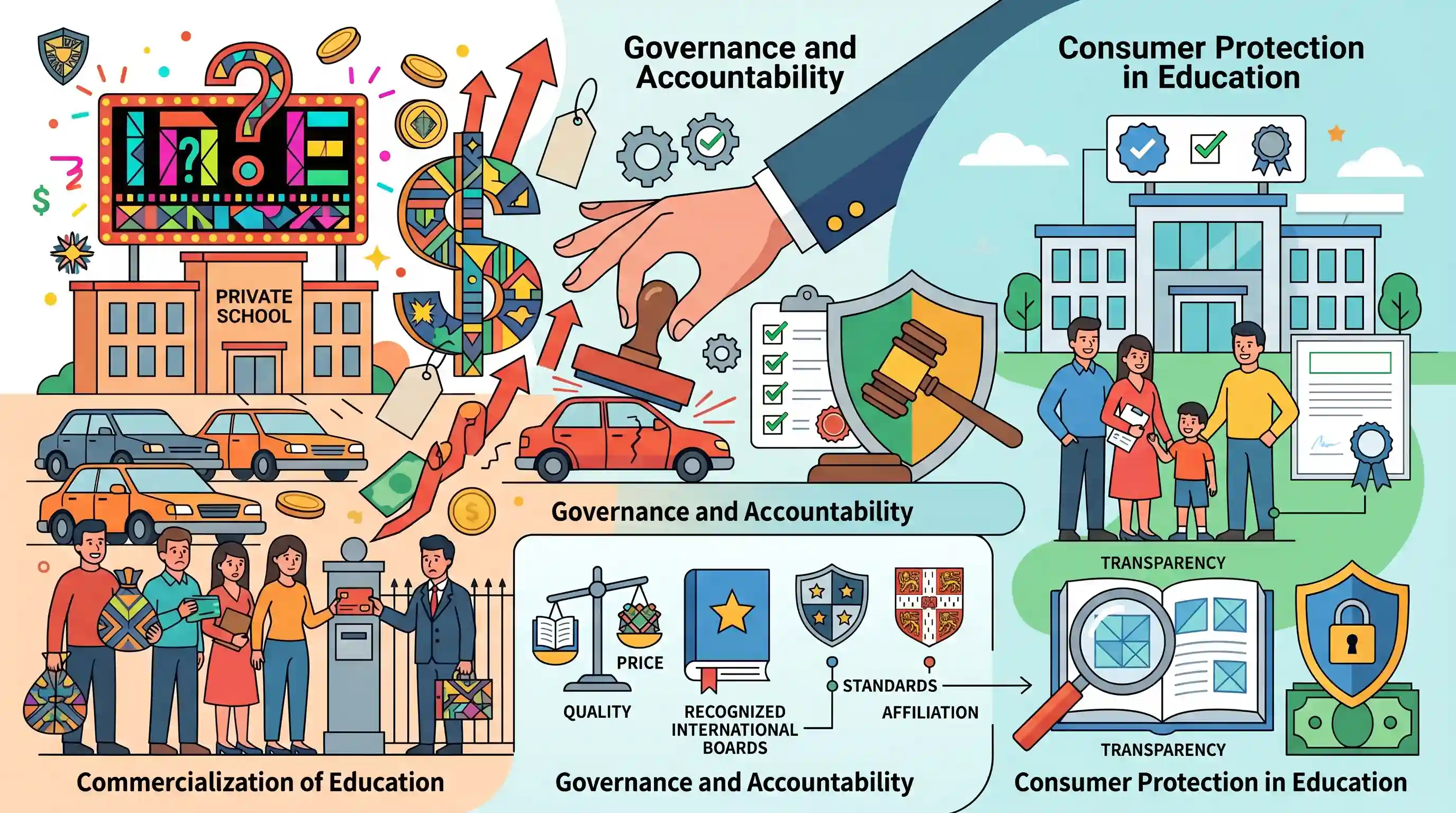
The Maharashtra government has introduced strict eligibility criteria prohibiting schools from arbitrarily using terms like 'International' or 'Global' in their names. Moving forward, educational institutions must be officially affiliated with recognized international boards (such as IB or Cambridge) and meet specific academic standards to utilize such nomenclature. This regulatory measure is designed to curb the commercialization of school education, where private institutions often use deceptive branding to attract admissions and justify exorbitant fees without providing a commensurate curriculum. The directive aims to ensure transparency, protect parents from misleading claims, and promote genuine quality and accountability in the education sector.
Key Points
- The Maharashtra government has barred schools from arbitrarily using terms like 'International' or 'Global' in their names without meeting specific eligibility criteria.
- Schools must now be legitimately affiliated with recognized international educational boards (such as IB or Cambridge) to use such nomenclature.
- The regulation aims to curb the commercialization of education, preventing private schools from using deceptive branding to charge exorbitant fees.
- The move enhances transparency for parents, ensuring they are not misled by marketing gimmicks, and enforces standard quality controls over self-financed educational institutions.
Important Terms
Right to Education (RTE) Act, 2009

A 2009 legislation making free and compulsory education a fundamental right for children aged 6–14 under Article 21A, establishing minimum norms for all schools.
UPSC context
GS2: Education/Social Justice. Fundamental for understanding state mandates, private school reservations (25%), and basic school recognition norms.
National Education Policy (NEP) 2020
A comprehensive 2020 framework aiming to transform India's education system by 2040, focusing on universal access, quality, and transparent regulation of public and private institutions.
UPSC context
GS2: Government Policies. Tests knowledge of structural reforms, regulatory bodies like SSSA, and standard-setting across diverse school boards.
Commercialization of Education
The trend of treating education as a profit-driven business, often involving exploitative fees and deceptive branding, which the state seeks to regulate for public interest.
UPSC context
GS1/GS2: Social Issues/Education. Important for discussing the balance between private sector participation and equitable, transparent access to schooling.
State School Standards Authority (SSSA)
A proposed independent state-level body under NEP 2020 to ensure all schools meet minimal professional and quality standards through public disclosure and transparency.
UPSC context
GS2: Governance/Education. Relevant to administrative reforms aimed at curbing misleading school titles and ensuring accountability.
International Baccalaureate (IB)
A global non-profit foundation providing standardized international curricula; its affiliation is often a prerequisite for schools to legally use 'International' in their branding.
UPSC context
GS2: Education. Relevant for comparative study of global vs. national educational standards and the regulation of elite private schooling.
Cambridge Assessment International Education
A globally recognized provider of international qualifications and curricula (like IGCSE), used as a benchmark for validating the 'International' status of Indian schools.
UPSC context
GS2: Education. Tests understanding of international curriculum integration and the state's role in verifying academic claims made by schools.
Prelims Trap
"Academic equivalence of foreign boards like IB in India is granted by the Ministry of Education or CBSE."
The academic equivalence of foreign qualifications and international school boards in India is evaluated and granted by the Association of Indian Universities (AIU), not the MoE or CBSE.
Static Concepts Connected
How is legislative jurisdiction over education divided in India?
- Concurrent List: Education was transferred from the State List to the Concurrent List (Entry 25) via the 42nd Constitutional Amendment Act of 1976.
- State Regulation: State governments retain executive authority to draft rules for school recognition, fee structures, and administrative governance within their territory.
- Dual Control: While the Centre frames national policies (e.g., NEP), state laws govern day-to-day school regulation, leading to varied inter-state policies.
How does the Consumer Protection Act (2019) regulate educational institutions?
- Misleading Ads: False claims of "international" status or guaranteed placements are actionable under the definition of "misleading advertisements" (Section 2(28)).
- CCPA Authority: The Central Consumer Protection Authority (CCPA) has the suo-motu power to investigate and penalize schools and coaching centers for deceptive marketing.
- Consumer Rights: It treats students/parents as consumers, protecting them from predatory fee structures justified by unverified cosmetic branding.
Cross-Topic Patterns
NEP 2020 + Financial Transparency
NEP 2020 mandates 'not-for-profit' auditing for educational institutions, linking state-level fee regulations directly to national policy goals against the commercialization of education.
Ed-tech Regulation + CCPA Guidelines
Deceptive branding by physical schools parallels the recent CCPA crackdown on misleading success-claims and predatory marketing by ed-tech platforms and coaching institutes.

Expect a Prelims statement confusing the regulatory authority of AIU for foreign boards with CBSE, or testing CCPA's jurisdiction over schools.
Linked PYQs · 4
Linked PYQs · 4
- 2015MainsGS2
The quality of higher education in India requires major improvements to make it internationally competitive. Do you think that the entry of foreign educational institutions would help improve the quality of higher and technical education in the country? Discuss.
- 2015MainsGS2
For achieving the desired objectives, it is necessary to ensure that the regulatory institutions remain independent and autonomous. Discuss in the light of the experiences in recent past.
- 2020MainsGS2
National Education Policy 2020 is in conformity with the Sustainable Development Goal-4 (2030). It intends to restructure and reorient education system in India. Critically examine the statement.
- 2022MainsGS2
The Right of Children to Free and Compulsory Education Act, 2009 remains inadequate in promoting incentive-based system for children's education without generating awareness about the importance of schooling. Analyse.
