Hill council polls in Ladakh amid local demands for Sixth Schedule
Source:The Hindu ↗
Why It Matters
It highlights the friction between decentralized administrative frameworks like autonomous hill councils and the larger demands for constitutional safeguards, statehood, and tribal protection in sensitive border regions like Ladakh.
Summary
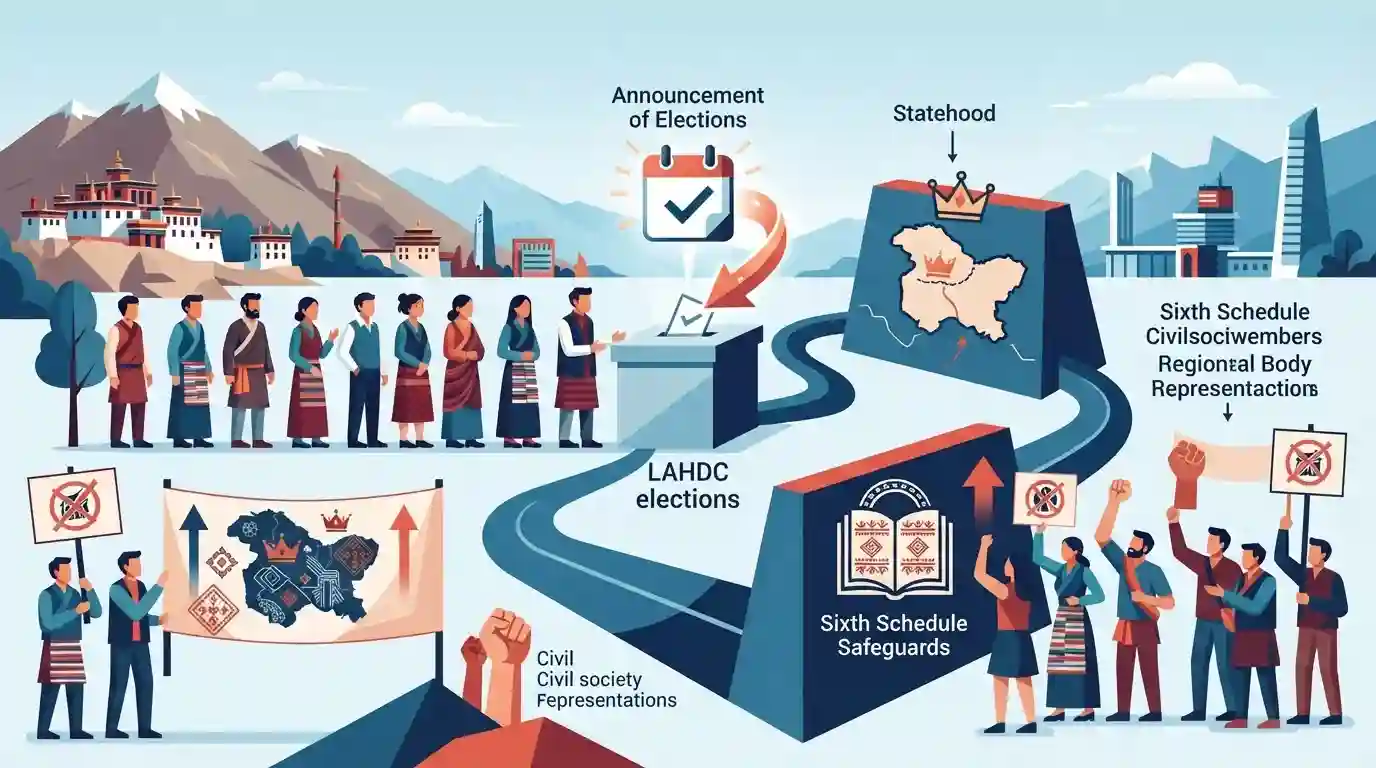
The announcement of elections for the Ladakh Autonomous Hill Development Council has failed to appease protesting civil society groups and regional bodies who continue to demand full statehood and constitutional safeguards under the Sixth Schedule for the Union Territory.
Key Points
- The schedule for elections to the Ladakh Autonomous Hill Development Council (LAHDC) has been announced, with polling set for December 4.
- Civil society groups and political bodies in Ladakh continue to protest despite the election announcement, demanding constitutional safeguards under the Sixth Schedule and statehood.
- Protesters argue that hill council elections do not fulfill broader aspirations for comprehensive legislative and land rights protection in the Union Territory.
Important Terms
Sixth Schedule

Provisions under Article 244(2) and the Fifth/Sixth Schedule of the Constitution that establish Autonomous District and Regional Councils with legislative, judicial, and executive powers to protect the tribal populations and cultures of Assam, Meghalaya, Tripura, and Mizoram.
UPSC context
UPSC GS Paper II: Polity and Governance (Scheduled and Tribal Areas, Federalism). Tests understanding of regional autonomy and constitutional safeguards for tribal populations.
Constitution of India Article 244
Article 244 of the Indian Constitution provides for the administration of Scheduled Areas and Tribal Areas through the provisions set out in the Fifth and Sixth Schedules, ensuring decentralized tribal self-governance.
UPSC context
UPSC GS Paper II: Indian Constitution—Historical Underpinnings, Evolution, Features, Amendments, Significant Provisions, and Basic Structure.
Ladakh Autonomous Hill Development Council
Statutory district-level autonomous bodies established to provide decentralized local self-governance, socio-economic planning, and cultural preservation in the mountainous regions of Ladakh.
UPSC context
UPSC GS Paper II: Governance, Decentralization, and Local Self-Government. Important for analyzing autonomous administrative structures in Union Territories.
Prelims Trap
The Ladakh Autonomous Hill Development Council (LAHDC) is established under the Sixth Schedule of the Indian Constitution.
LAHDCS are statutory bodies created via legislative acts (Ladakh Autonomous Hill Development Council Act), not constitutional bodies under the Sixth Schedule of the Constitution.
Static Concepts Connected
What are the key constitutional differences between the Sixth Schedule and Autonomous Hill Development Councils (LAHDCs)?
- Origin: Constitutional Basis: Sixth Schedule (Article 244) applies to tribal areas in Assam, Meghalaya, Tripura, and Mizoram, whereas LAHDCs are created via ordinary legislative enactments.
- Powers: Legislative Powers: ADCs under Sixth Schedule possess substantive rule-making and legislative powers over land, forests, and social customs, which LAHDCs generally lack.
- Judicial Role: Judicial Authority: Sixth Schedule councils can constitute village councils or courts for trial of suits between tribes; LAHDCs do not have equivalent judicial powers.
Cross-Topic Patterns
Sixth Schedule vs UT Governance in Border States
The demand for Sixth Schedule protections in Ladakh mirrors similar ecological and tribal movements in Arunachal Pradesh and Manipur, testing the balance between regional autonomy and national security frameworks in border regions.
Asymmetrical Federalism and Union Territory Governance
Ladakh's tribal rights agitation highlights the friction between central integration of Union Territories and local constitutional demands, a recurring theme in India's asymmetrical federalism.

Sixth Schedule provisions (Article 244) vs LAHDC powers will likely feature in a statement-based polity question on local autonomy.
Linked PYQs · 3
Linked PYQs · 3
- 2024MainsGS2
Analyse the role of local bodies in providing good governance at local level and bring out the pros and cons merging the rural local bodies with the urban local bodies.
- 2022MainsGS2
To what extent, in your opinion, has the decentralisation of power in India changed the governance landscape at the grassroots?
- 2026PrelimsGS1
Consider the following statements about the provisions pertaining to the Scheduled Castes and the Scheduled Tribes in India : 1. Provisions regarding the administration of the Tribal Areas in the States of Assam, Meghalaya, Tripura and Mizoram are given in the Fifth Schedule of the Constitution of India. 2. Some tribes of India are entitled to exemption from paying Income Tax on certain incomes. 3. The Constitution of India provides for reservation of seats in Panchayats for women belonging to the Scheduled Castes and the Scheduled Tribes. Which one of the following conclusions based on the above statements is correct ?
