Maharashtra Anganwadi Preschool Curriculum and NEP Implementation
Source:Indian Express ↗
Why It Matters
The shift provides a practical case study for UPSC Mains on the implementation of NEP 2020 and ECCE. It exemplifies how existing welfare infrastructure (Anganwadis) can be reoriented to address foundational learning deficits, linking early childhood education directly to long-term human resource development.
Summary
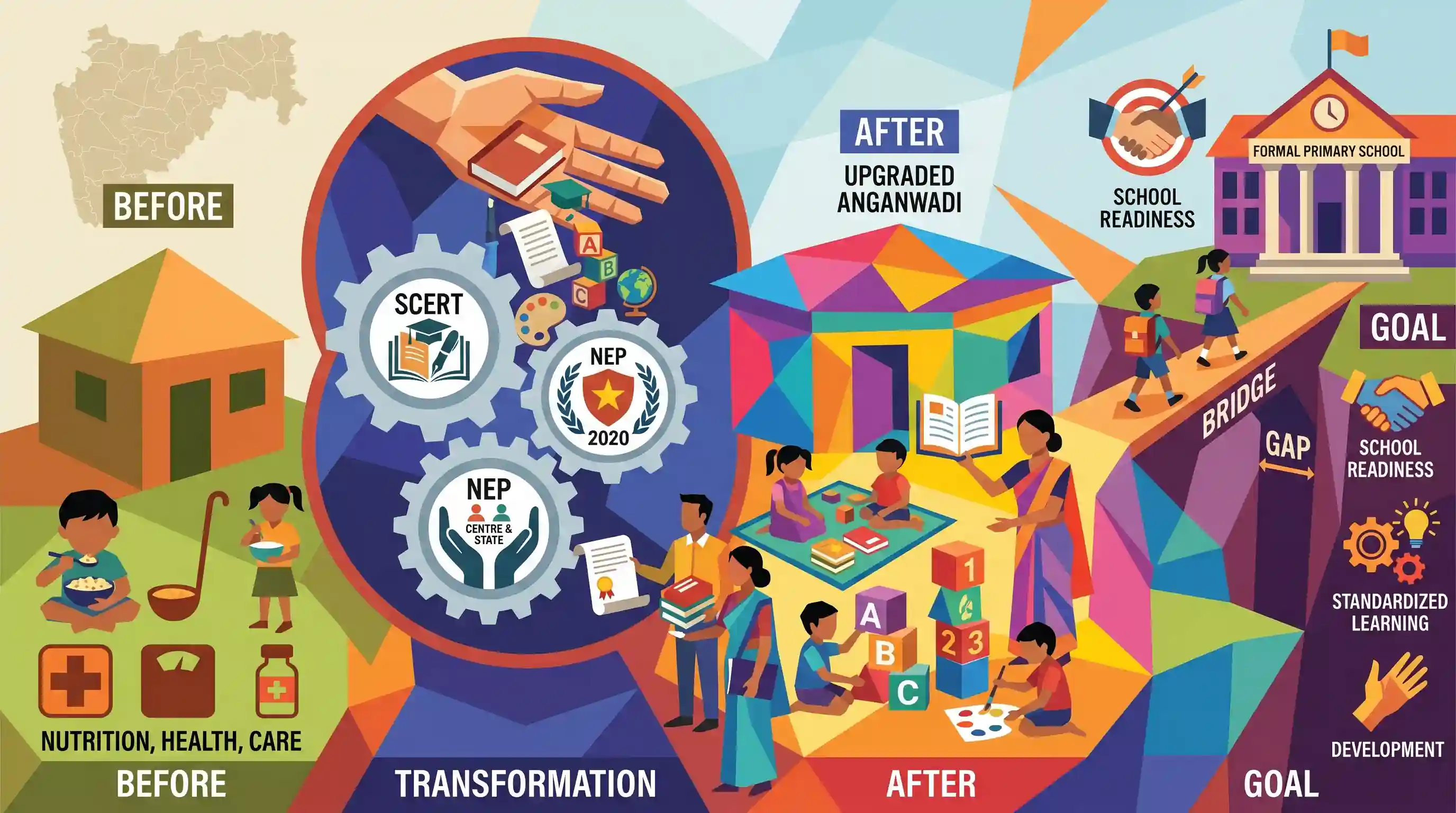
The Maharashtra State Council of Educational Research and Training (SCERT) has developed a comprehensive curriculum and set of educational books for Anganwadis to formalize preschool education. Historically functioning primarily as centers for child nutrition and health, Anganwadis will now integrate foundational Early Childhood Care and Education (ECCE) in strict alignment with the National Education Policy (NEP) 2020. This systemic shift aims to bridge the gap between traditional childcare and formal primary schooling, ensuring standardized learning outcomes and better school readiness for young children across the state.
Key Points
- The Maharashtra SCERT has finalized a dedicated curriculum and books to introduce formal pre-primary education in Anganwadis.
- This move aligns with the National Education Policy (NEP) 2020, which stresses the importance of Early Childhood Care and Education (ECCE).
- Traditionally focused on nutrition and health under the WCD department, Anganwadis are now transitioning to serve as foundational learning centers for young children.
- The initiative aims to standardize preschool education, ensuring that rural and marginalized children acquire essential school-readiness skills before entering primary school.
Important Terms
National Education Policy (NEP) 2020

A comprehensive framework transforming India's education system, introducing a 5+3+3+4 structure that incorporates preschool (ages 3-6) into formal schooling and emphasizes foundational literacy and numeracy.
UPSC context
GS II: Government policies for education; tests knowledge of structural reforms and pedagogical shifts in the Indian education system.
Integrated Child Development Services (ICDS)
A flagship centrally sponsored scheme launched in 1975 providing a package of six services—including nutrition, health, and non-formal pre-school education—to children under six and their mothers.
UPSC context
GS II: Welfare schemes for vulnerable sections; tests understanding of social sector interventions targeting maternal and child health.
State Council of Educational Research and Training (SCERT)
A state-level academic body responsible for curriculum development and teacher training; in Maharashtra, it has localized the national 'Aadharshila' framework for Anganwadi preschool education.
UPSC context
GS II: Education and Human Resources; tests awareness of state institutions' roles in implementing national educational mandates.
Early Childhood Care and Education (ECCE)
The foundational stage of learning for children aged 3-6, focusing on play-based pedagogy and holistic development to ensure school readiness, now integrated into the formal education structure.
UPSC context
GS II: Social Sector/Education; central to topics like 'Foundational Literacy and Numeracy' and human resource development.
Anganwadi
A rural childcare center established under ICDS, serving as the frontline delivery unit for nutrition and now evolving into a formal preschool under NEP 2020.
UPSC context
GS II: Health and Education; tests knowledge of grassroots delivery mechanisms for social welfare and human development.
Women and Child Development (WCD) Department
The nodal government agency responsible for implementing the ICDS program and overseeing Anganwadi operations, working in convergence with the Education Department for ECCE.
UPSC context
GS II: Statutory/Regulatory bodies and Social Sector; tests understanding of inter-departmental convergence in governance.
Prelims Trap
Pre-school education (ages 3-6) is a legally binding Fundamental Right under the Right to Education (RTE) Act, 2009.
ECCE (0-6 years) is a DPSP under Article 45. Article 21A and the RTE Act mandate education strictly for ages 6-14. RTE Section 11 only suggests states 'may' provide preschools; it is not justiciable.
Static Concepts Connected
How is child education constitutionally divided across Fundamental Rights, Duties, and DPSPs?
- Article 21A (FR): Mandates the State to provide free and compulsory education to all children in the age group of 6 to 14 years.
- Article 45 (DPSP): Directs the State to endeavor to provide Early Childhood Care and Education (ECCE) for all children until they complete the age of six years.
- Article 51A(k) (FD): Places a fundamental duty on parents or guardians to provide opportunities for education to their children between the ages of 6 and 14 years.
What is the core mandate of Anganwadi Centres under the ICDS scheme?
- Original Mandate: Launched in 1975 under the Ministry of Women and Child Development (WCD) to combat child hunger and malnutrition.
- Six Core Services: Supplementary nutrition, immunization, health check-ups, referral services, preschool non-formal education, and nutrition/health education.
- Modern Evolution: Under Saksham Anganwadi and Poshan 2.0, centers are being upgraded into formal foundational early learning hubs, aligning with NEP 2020.
Cross-Topic Patterns
NEP 2020 meets Saksham Anganwadi & Poshan 2.0
Transforming Anganwadis from nutrition-focused WCD centers to foundational learning hubs requires unprecedented inter-ministerial convergence between the Education and Women & Child Development ministries.
Federalism in executing Article 45 DPSP
State-level initiatives like Maharashtra's SCERT curriculum demonstrate decentralized operationalization of national policies, bridging the gap between non-binding DPSP goals and localized grassroots delivery.

Expect a multi-statement question distinguishing ECCE under Article 45/NEP from justiciable elementary education under Article 21A/RTE.
Linked PYQs · 3
Linked PYQs · 3
- 2020MainsGS2
National Education Policy 2020 is in conformity with the Sustainable Development Goal-4 (2030). It intends to restructure and reorient education system in India. Critically examine the statement.
- 2016MainsGS2
Examine the main provisions of the National Child Policy and throw light on the status of its implementation.
- 2023MainsGS2
The crucial aspect of development process has been the inadequate attention paid to Human Resource Development in India. Suggest measures that can address this inadequacy.
