SCB Medical College fire and public healthcare safety lapses
Source:The Hindu ↗
Why It Matters
The tragedy highlights severe gaps in disaster preparedness and fire safety within critical public infrastructure, specifically large public hospitals. It raises important governance questions regarding the accountability of hospital administrations, regulatory compliance, and the state's responsibility to protect highly vulnerable populations (ICU patients) from man-made disasters.
Summary
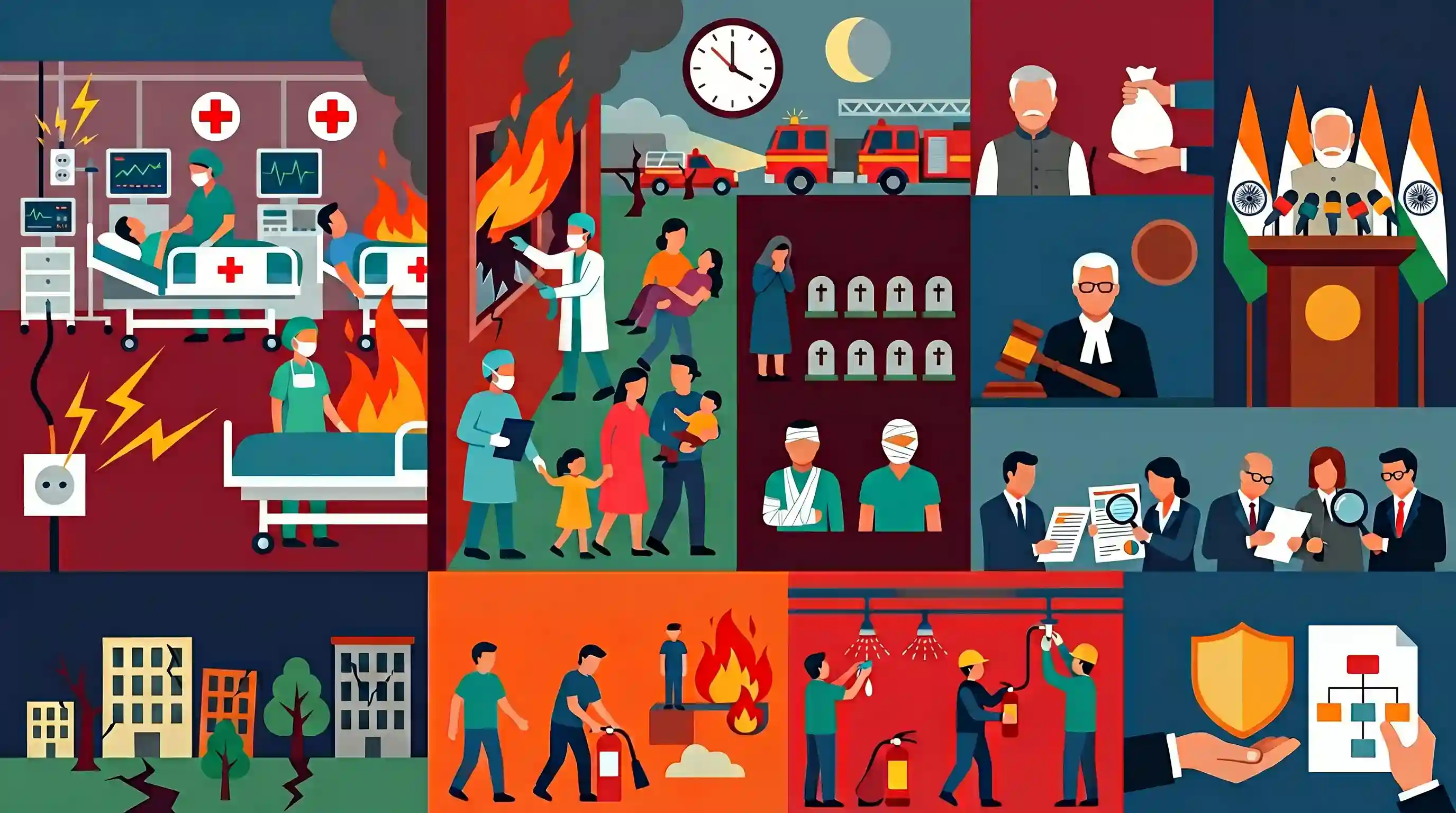
On March 16, 2026, a massive fire, reportedly caused by an electrical short circuit, erupted in the trauma care ICU of SCB Medical College Hospital in Cuttack, Odisha, resulting in the deaths of 10 patients and injuring 11 staff members. Emergency response faced significant delays, prompting immediate rescue action from hospital staff and patients' relatives. In response, the Odisha Government announced an ex-gratia of ₹25 lakh for victims' families, ordered a judicial probe headed by retired district judge Laxmidhar Biswal, and set up a high-level fact-finding committee. The incident has drawn widespread condolences from national leaders and underscores critical vulnerabilities in public healthcare infrastructure.
Key Points
- A major fire at Cuttack's SCB Medical College Hospital killed 10 patients and injured 11 staff members.
- The blaze originated in the trauma care ICU due to a suspected electrical short circuit.
- Delayed arrival of fire tenders forced hospital personnel and relatives to initiate emergency rescue operations themselves.
- Odisha CM Mohan Charan Majhi ordered a judicial probe led by retired district judge Laxmidhar Biswal and formed a fact-finding committee.
- Ex-gratia compensation was announced by the State Government (₹25 lakh) and the Prime Minister’s National Relief Fund (₹2 lakh).
Important Terms
Commissions of Inquiry Act, 1952

A 1952 law enabling the Central or State governments to appoint committees to investigate matters of public importance, granting them civil court powers for evidence collection and witness summoning.
UPSC context
GS Paper 2: Statutory bodies and executive power; tests understanding of administrative accountability and the legal framework for public investigations.
Prime Minister's National Relief Fund (PMNRF)
A non-statutory trust established in 1948, funded by voluntary public contributions to provide immediate relief for victims of natural disasters, major accidents, and medical emergencies.
UPSC context
GS Paper 3: Disaster Management; tests knowledge of financial relief mechanisms and the distinction between statutory and non-statutory funds.
Judicial Commission of Inquiry
A fact-finding body typically led by a sitting or retired judge, appointed under the 1952 Act to impartially investigate public tragedies and provide non-binding recommendations.
UPSC context
GS Paper 2: Governance and Transparency; relevant for discussing executive-judicial interface and mechanisms for addressing systemic failures.
SCB Medical College Hospital
Established in 1944 in Cuttack, it is one of India's oldest and largest tertiary care public hospitals, serving as a critical healthcare hub for Odisha and neighboring states.
UPSC context
GS Paper 2: Issues relating to Health; serves as a case study for public healthcare infrastructure, safety standards, and regional medical significance.
Biju Janata Dal (BJD)
A regional political party in Odisha, currently the primary opposition; its role in the incident emphasizes legislative oversight and demands for administrative accountability in healthcare governance.
UPSC context
GS Paper 2: Political parties and pressure groups; highlights the role of opposition in ensuring executive accountability during public crises.
Ex-gratia
A compensatory payment made by the government out of moral obligation or goodwill rather than a legal requirement, often provided to victims of disasters or accidents.
UPSC context
GS Paper 3: Disaster Management; tests understanding of state-led rehabilitation and immediate financial assistance strategies following tragedies.
Prelims Trap
Fire services and enforcement of the National Building Code (NBC) fall under the concurrent jurisdiction of the Union and State governments.
Fire services are exclusively a State subject and a municipal function under the 12th Schedule (Article 243W). The NBC (2016) is purely a recommendatory guideline, not a central statutory mandate.
Static Concepts Connected
How is the governance of Fire Services structured in India?
- State Subject: Fire services are fundamentally a State subject. Under Article 243W, states are empowered to devolve this function to Urban Local Bodies (Municipalities) via the 12th Schedule.
- NBC Role: The National Building Code (NBC) 2016 provides standardized fire safety guidelines, but its legal enforcement relies entirely on its integration into State and municipal building bylaws.
- NDMA Guidelines: The NDMA issues specific 'Guidelines on Hospital Safety' mandating audits and evacuation drills, though field-level compliance enforcement remains the duty of local municipal authorities.
What are the core characteristics of the Prime Minister's National Relief Fund (PMNRF)?
- Trust Status: It was constituted as a trust and is sustained entirely by voluntary public contributions, receiving no budgetary support from the government.
- Outside CFI: The fund does not form part of the Consolidated Fund of India (CFI) and is therefore not subject to a mandatory statutory audit by the CAG.
- Tax Exemption: All contributions to the PMNRF are eligible for a 100% tax deduction under Section 80G of the Income Tax Act.
Cross-Topic Patterns
Hospitals as Critical Infra
Frequent ICU fires highlight the clash between oxygen-enriched medical environments and poor electrical load management in aging public health infrastructure, testing NDMA’s vulnerability analysis frameworks.
Judicial Probes vs Accountability
Establishing judicial probes under the Commissions of Inquiry Act, 1952 is standard post-disaster SOP, yet findings are legally non-binding, often reducing institutional accountability to mere ex-gratia compensation payouts.

Expect a GS3 mains question linking NDMA hospital safety guidelines with the failure of Urban Local Bodies to enforce building codes.
Linked PYQs · 3
Linked PYQs · 3
- 2019MainsGS3
Vulnerability is an essential element for defining disaster impacts and its threat to people. How and in what ways can vulnerability to disasters be characterized? Discuss different types of vulnerability with reference to disasters.
- 2021MainsGS2
“Besides being a moral imperative of a Welfare State, primary health structure is a necessary precondition for sustainable development.” Analyze.
- 2024MainsGS4
“The 'Code of Conduct' and 'Code of Ethics' are the sources of guidance in public administration. There is code of conduct already in operation, whereas code of ethics is not yet put in place. Suggest a suitable model for code of ethics to maintain integrity, probity and transparency in governance.”
