Decentralized Climate Adaptation Strategies for Grassroots
Source:The Hindu ↗
Why It Matters
Bridges two major UPSC themes: GS3 (Environment/Disaster Management) and GS2 (Local Governance/Decentralisation). Understanding how to operationalize national climate policies via Panchayati Raj Institutions is vital for answering questions on disaster resilience, climate justice, and the practical challenges of grassroots governance.
Summary
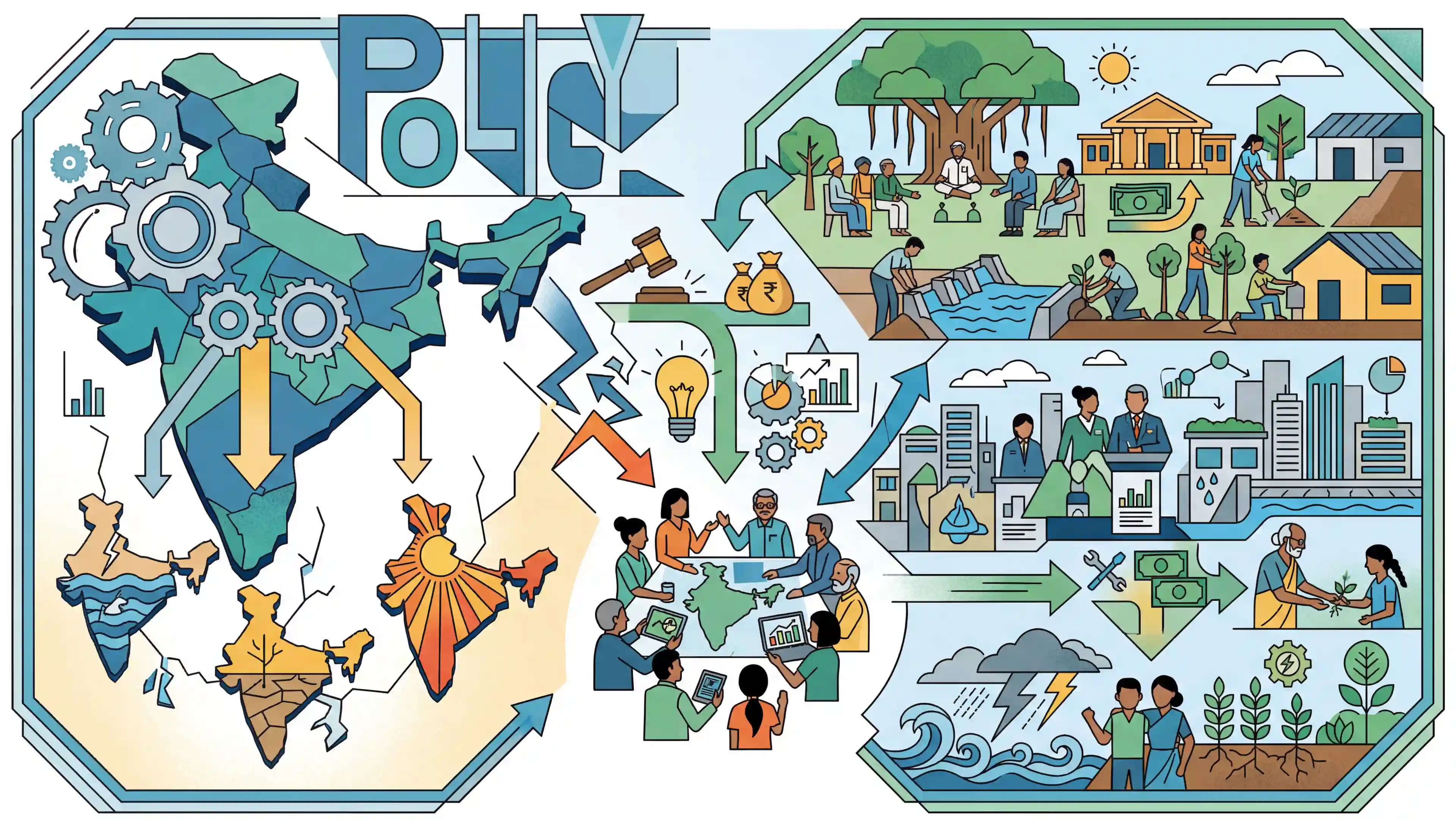
The article advocates for the urgent transition of climate adaptation strategies from broad, national policy frameworks to actionable implementation at the grassroots level. Because climate vulnerabilities manifest uniquely across different geographies, top-down approaches often fall short. The piece emphasizes the importance of empowering local self-governance institutions—such as Panchayats and Urban Local Bodies—with decentralized planning authority, climate finance, and technical capacity. By converging climate adaptation objectives with existing rural development schemes like MGNREGA and tapping into traditional community knowledge, India can build robust, bottom-up disaster resilience and ensure sustainable livelihood security against accelerating climate risks.
Key Points
- Climate change impacts are highly localized, necessitating a shift from top-down policy frameworks to bottom-up, community-led adaptation strategies.
- Empowering local governance structures (Panchayats and municipalities) with adequate climate finance, technical expertise, and decision-making authority is crucial for building resilience.
- Grassroots adaptation requires integrating climate goals into existing developmental schemes like MGNREGA to build durable, climate-resilient rural infrastructure.
- Leveraging indigenous and traditional knowledge systems can provide sustainable and context-specific solutions for water management and agriculture.
Important Terms
National Action Plan on Climate Change (NAPCC)

India's 2008 strategy for climate action, comprising eight national missions focused on areas like solar energy, water, and forests to balance economic development with environmental sustainability.
UPSC context
GS Paper 3 (Environment); crucial for evaluating India's sectoral strategies for climate mitigation and adaptation.
State Action Plans on Climate Change (SAPCC)
State-level frameworks in India that translate national climate goals into local actions by identifying regional vulnerabilities and prioritizing sector-specific adaptation and mitigation strategies.
UPSC context
GS Paper 3 (Environment); examines the decentralization of climate policy and cooperative federalism in sub-national climate action.
Sendai Framework for Disaster Risk Reduction
A global 2015–2030 agreement aiming to reduce disaster risks and losses. It emphasizes "Building Back Better" and sharing disaster management responsibility between states and local stakeholders.
UPSC context
GS Paper 3 (Disaster Management); tests knowledge of global standards for building community resilience and reducing hazard exposure.
MGNREGA
A social security law guaranteeing 100 days of rural wage employment. It is increasingly used as a climate adaptation tool by funding natural resource management assets like ponds and afforestation.
UPSC context
GS Paper 2 & 3; highlights the convergence of social welfare with environmental sustainability and building rural resilience.
Panchayati Raj Institutions (PRIs)
Constitutional rural local bodies (73rd Amendment) crucial for decentralized governance. They lead community-level climate resilience by managing local resources and executing disaster preparedness plans.
UPSC context
GS Paper 2 (Polity); essential for understanding the role of local institutions in achieving sustainable development and climate resilience.
Urban Local Bodies (ULBs)
Constitutional urban governing bodies (74th Amendment) responsible for city infrastructure. They are vital for managing urban climate risks, such as urban flooding and heat islands.
UPSC context
GS Paper 2 & 3; relevant for building climate-resilient cities and challenges of urban governance in a changing climate.
Prelims Trap
"Climate Change is explicitly listed as a subject under the 11th Schedule of the Constitution."
The 11th Schedule lists agriculture, soil conservation, and water management, but not "Climate Change" explicitly. Aspirants often confuse allied functional subjects with explicit constitutional text.
Static Concepts Connected
Which subjects in the 11th Schedule directly aid local climate adaptation?
- Agriculture & Irrigation: Minor irrigation, water management, and watershed development are crucial for building drought resilience in rural areas.
- Land Conservation: Soil conservation and land improvement help prevent rapid land degradation from extreme weather events.
- Forestry: Social forestry and farm forestry support alternative rural livelihoods and enhance local carbon sequestration.
How does MGNREGA function as an ecological and climate adaptation tool?
- NRM Focus: A significant portion of MGNREGA expenditure is legally mandated to target Natural Resource Management (NRM) and agriculture-allied activities.
- Asset Creation: The scheme shifts focus from temporary relief to building durable, climate-resilient rural infrastructure like check dams and percolation tanks.
- Traditional Knowledge: Reviving traditional water harvesting structures utilizes indigenous knowledge for context-specific adaptation.
Cross-Topic Patterns
MGNREGA + Climate Finance
UPSC frequently links rural employment to environmental outcomes. MGNREGA indirectly acts as India's largest grassroots climate finance mechanism via its Natural Resource Management (NRM) mandate.
Sendai Framework + PRI empowerment
Disaster management has shifted to pre-disaster community resilience. Integrating the Sendai Framework's "Role of Communities" mandate with the 73rd/74th Amendment architecture is a high-probability GS-3 Mains theme.

Expect a Prelims question merging the 11th Schedule's water management entries with MGNREGA's ecological and natural resource outcomes.
Linked PYQs · 5
Linked PYQs · 5
- 2024MainsGS3
What is disaster resilience? How is it determined? Describe various elements of a resilience framework. Also mention the global targets of Sendai Framework for Disaster Risk Reduction (2015–2030).
- 2022MainsGS2
To what extent, in your opinion, has the decentralisation of power in India changed the governance landscape at the grassroots?
- 2024MainsGS2
Analyse the role of local bodies in providing good governance at local level and bring out the pros and cons merging the rural local bodies with the urban local bodies.
- 2020MainsGS3
Discuss the recent measures initiated in disaster management by the Government of India departing from the earlier reactive approach.
- 2024MainsGS3
Flooding in urban areas is an emerging climate-induced disaster. Discuss the causes of this disaster. Mention the features of two such major floods in the last two decades in India. Describe the policies and frameworks in India that aim at tackling such floods.
