Dynastic Politics: Structural Deficits in Indian Party Democracy
Source:Indian Express ↗
Why It Matters
Dynastic politics undermines the core democratic principles of meritocracy and equal opportunity. Understanding the structural weaknesses of political parties and the lack of inner-party democracy is critical for GS2 (Polity and Governance). It highlights the dichotomy between achieving broad demographic representation and failing to foster genuine leadership development at the organizational level.
Summary
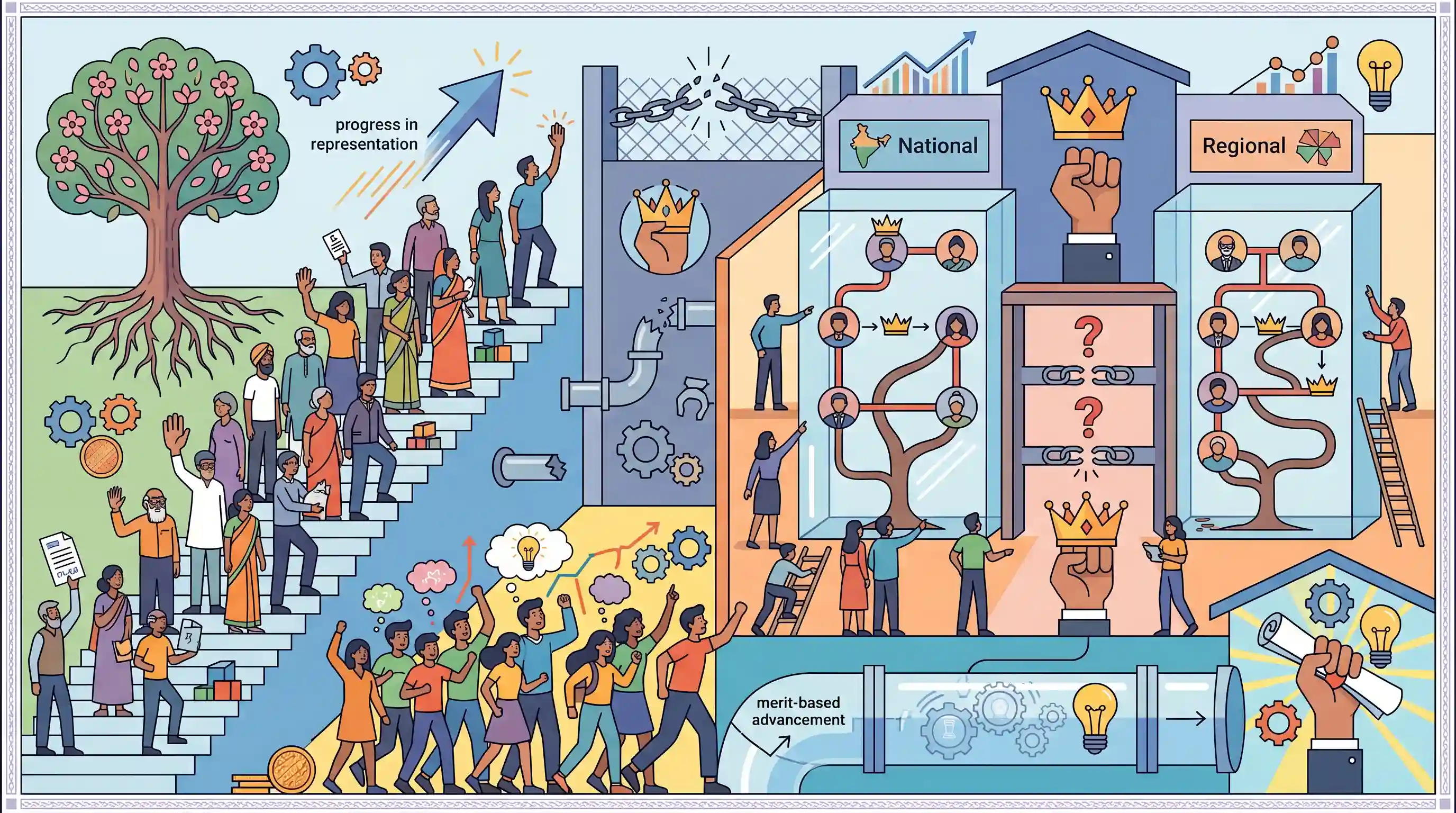
The editorial critically evaluates the pervasive culture of dynastic politics in India across both national and regional political parties, framing it as a symptom of structural failure within party organizations. Although Indian democracy has historically succeeded in broadening representation among marginalized groups, political parties have largely failed to establish internal democracy or build extensive leadership pipelines. Consequently, power remains concentrated within prominent families. The article emphasizes the necessity of merit-based political advancement and internal reforms to effectively engage India's youthful demographic and ensure the long-term viability of these parties.
Key Points
- Dynastic politics is a widespread phenomenon across India's political landscape, with significant percentages of dynast MPs in both national parties (Congress 33.2%, BJP 18.6%) and regional parties.
- Left parties are the notable exception to this trend of dynastic succession.
- While post-Independence democratic deepening successfully integrated marginalized groups (Dalits, Adivasis, OBCs, minorities, women) into the political fold, it failed to democratize party structures.
- Many regional parties born out of social justice movements have structurally failed to build diverse leadership pipelines, centralizing power instead within prominent families.
- There is a pressing need for internal party democracy and merit-based advancement to replace the culture where family association is treated as a political asset rather than a liability.
- With over half of India's population under 30, political parties must reform to provide relatable leadership that emerges from grassroots experience to avoid alienating the youth.
Important Terms
Internal Party Democracy

The practice of selecting leaders and candidates through transparent, competitive elections within a political party, ensuring that power is not concentrated in the hands of a few top leaders.
UPSC context
GS Paper II: Evaluates structural reforms in political parties to ensure transparency, accountability, and fair representation of the electorate.
Dynastic Politics
A political system where leadership positions and electoral tickets are inherited within a specific family, often prioritizing lineage over individual merit or grassroots leadership.
UPSC context
GS Paper II: Tests the impact of hereditary leadership on democratic principles, meritocracy, and the need for internal party reforms.
Regional Parties
Political entities that operate primarily within specific states or regions, focusing on local identities, grievances, and aspirations rather than a pan-India agenda.
UPSC context
GS Paper II: Tests the role of state-level parties in deepening federalism, shaping coalition governments, and articulating local aspirations.
Indian National Congress (INC)
Founded in 1885, it is a broad-based national party that led India’s independence movement; it is often cited in modern debates regarding family-centric leadership.
UPSC context
GS Paper II: Historical role in the freedom struggle and modern challenges regarding leadership transition and internal democratic functioning.
Bharatiya Janata Party (BJP)
A major national party known for its cadre-based, hierarchical structure and Hindutva ideology, which often critiques "parivarwaad" or family-led political dominance in India.
UPSC context
GS Paper II: Examines the functioning of cadre-based parties, their organizational structure, and their critique of family-centric politics.
Samajwadi Party (SP)
A prominent regional party in Uttar Pradesh founded on socialist principles; it is frequently used as a case study for dynastic leadership within regional political organizations.
UPSC context
GS Paper II: Case study for regional socialist politics and the challenges of dynastic dominance within state-level organizations.
Dravida Munnetra Kazhagam (DMK)
A major Dravidian regional party in Tamil Nadu that emphasizes social justice and regional autonomy, currently led by the second and third generations of the Karunanidhi family.
UPSC context
GS Paper II: Illustrates the role of identity-based regionalism and the complexities of dynastic leadership in Tamil Nadu.
Prelims Trap
The Election Commission can deregister a political party if it fails to hold regular internal elections.
Under RPA 1951, ECI registers parties (Sec 29A) but lacks statutory power to deregister them for undemocratic practices. Deregistration is restricted to narrow grounds like fraud.
Static Concepts Connected
What legal framework governs internal democracy of political parties in India?
- Section 29A: RPA 1951 governs party registration but lacks provisions to legally enforce internal democratic elections or penalize non-compliance.
- ECI Limitations: ECI mandates parties to submit their constitutions, but Supreme Court rulings prevent it from deregistering parties for failing to hold internal elections.
- Law Commission Reports: The 170th and 255th reports recommended amending the RPA to introduce a dedicated legal framework regulating internal party functioning.
On what specific grounds can the ECI deregister a political party?
- Fraudulent Registration: If the party obtained its initial registration from the Election Commission through fraud or forged documents.
- Constitutional Disloyalty: If the party alters its internal constitution to reject its stated allegiance to the Constitution of India.
- Unlawful Association: If the party is legally declared an unlawful association by the Union Government under the UAPA.
Cross-Topic Patterns
Social justice vs. internal centralism
Regional parties emerging from post-Mandal movements successfully deepened marginalized representation but paradoxically centralized party control, creating a dichotomy in India's democratic deepening.
Demographics and political barriers
India's massive youth demographic faces systemic barriers to political entry due to dynastic pipelines, stifling grassroots leadership and contradicting the push for youth-led development.

ECI's limitations under Section 29A of the RPA regarding party deregistration is a prime candidate for a multi-statement Prelims question.
Linked PYQs · 3
Linked PYQs · 3
- 2022MainsGS2
“While the national political parties in India favour centralisation, the regional parties are in favour of State autonomy.” Comment.
- 2017MainsGS2
To enhance the quality of democracy in India the Election Commission of India has proposed electoral reforms in 2016. What are the suggested reforms and how far are they significant to make democracy successful?
- 2024MainsGS2
Examine the need for electoral reforms as suggested by various committees with particular reference to "one nation one election" principle.
