Supreme Court Directs Ground-Level SOP to Curb Human Trafficking
Source:The Hindu ↗
Why It Matters
Human trafficking and the plight of missing persons are severe human rights violations and internal security challenges. The Supreme Court's intervention to mandate an SOP highlights the systemic gaps in local policing (relevant to GS2 Governance and Social Justice) and addresses the organized crime aspect of trafficking (GS3). It also serves as a contemporary example of judicial directives prompting executive action.
Summary
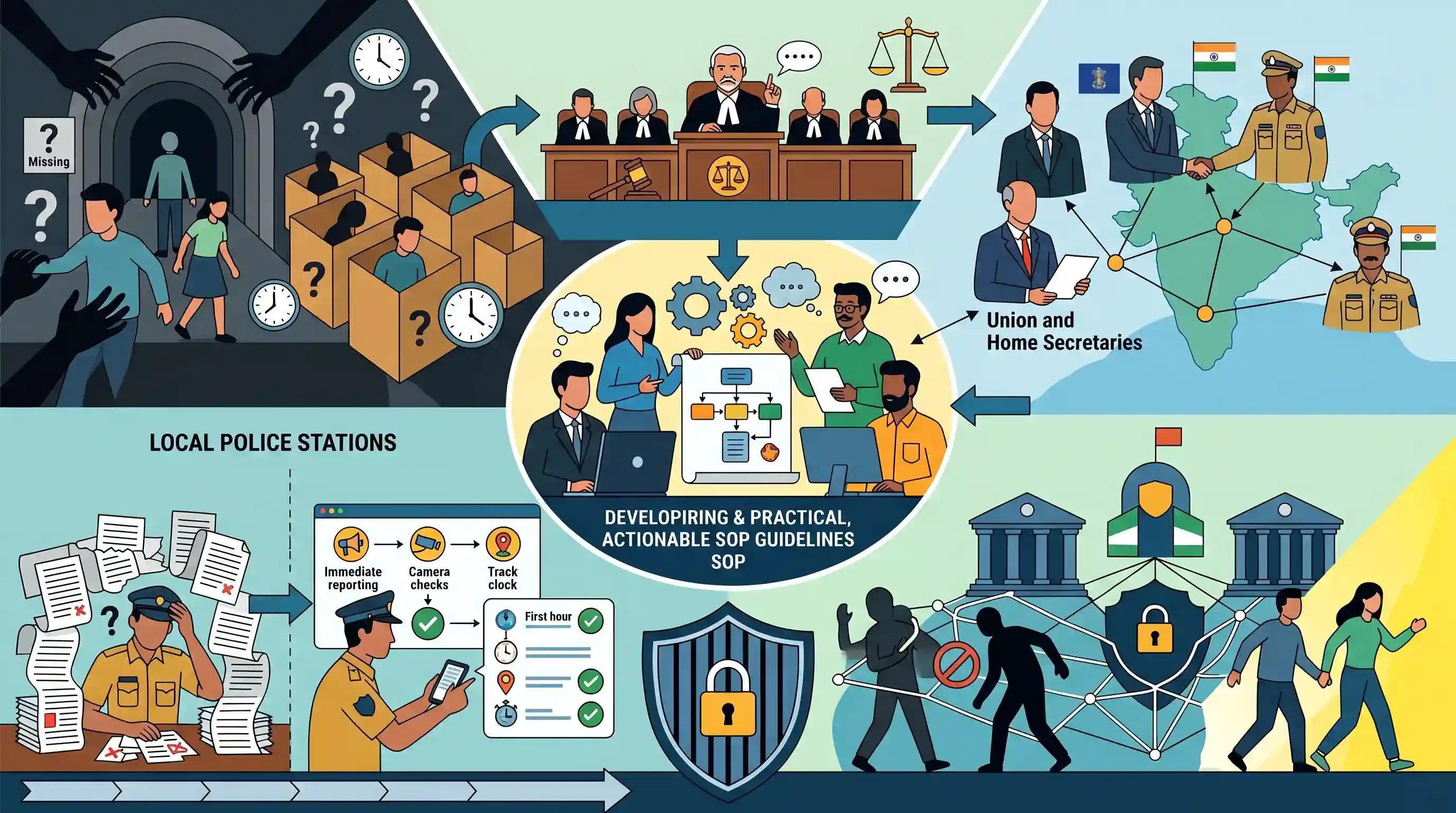
The Supreme Court of India has ordered the creation of a practical, time-bound, and uniform Standard Operating Procedure (SOP) to combat human trafficking, particularly focusing on the crucial early response to missing person complaints. Emphasizing that guidelines must be actionable at the local police station level rather than existing merely on paper, a Bench led by Justice Ahsanuddin Amanullah set up a committee of domain experts to steer the process. The directive mandates cooperation from the Union Home Secretary, State Home Secretaries, and DGPs to frame robust, ground-level protocols, thereby strengthening India's criminal justice framework against organized exploitation.
Key Points
- The Supreme Court directed the drafting of a uniform, practical, and time-sensitive Standard Operating Procedure (SOP) to handle human trafficking and missing persons cases.
- The Court stressed that the SOP must be actionable at the local police station level, ensuring immediate response upon receiving a missing person complaint.
- A specialized committee featuring former IPS officer P.M. Nair, MHA Director Veerendra Kumar Mishra, and ASG S.D. Sanjay was constituted to guide the process.
- The Union Home Secretary, State Home Secretaries, and DGPs have been instructed to engage with the committee and submit specific operational proposals.
Important Terms
Human Trafficking

The recruitment, transportation, or harboring of persons through force, fraud, or deception for exploitation, including forced labor, sexual servitude, or organ removal.
UPSC context
GS Paper II (Vulnerable Sections) and GS Paper III (Internal Security). Tests knowledge of organized crime and constitutional protections.
Standard Operating Procedure (SOP)
A set of step-by-step instructions designed to help law enforcement carry out complex routine operations, such as missing person investigations, efficiently and uniformly.
UPSC context
GS Paper II (Governance/Police Reforms). Focuses on administrative efficiency and the implementation of judicial directives at the grassroots level.
Article 23 of the Indian Constitution
A Fundamental Right in the Indian Constitution that explicitly prohibits trafficking in human beings and forced labor (begar), making violations punishable by law.
UPSC context
GS Paper II (Polity). Essential for answers regarding fundamental rights and the legal shield for vulnerable populations.
Bharatiya Nyaya Sanhita (BNS), 2023
The modern criminal code of India replacing the IPC; Section 143 specifically defines trafficking acts, means, and purposes, ensuring legal continuity against exploitation.
UPSC context
GS Paper II (Legal Reforms). Significant as it represents the recent overhaul of India's colonial-era criminal justice framework.
Anti-Human Trafficking Unit (AHTU)
Specialized police cells at the district and state levels dedicated to rescuing victims, investigating trafficking syndicates, and coordinating inter-state law enforcement.
UPSC context
GS Paper III (Internal Security). Relates to the institutional mechanisms for combatting organized crime and improving police-citizen response.
Judicial Realism
A judicial approach focusing on practical, ground-level enforceability of rulings rather than abstract legal theory, ensuring orders are actionable by local authorities.
UPSC context
GS Paper II (Judiciary). Tests understanding of the Supreme Court’s shift towards ensuring executive accountability and effective rights enforcement.
Prelims Trap
Anti-Human Trafficking Units (AHTUs) are statutory bodies established under the Immoral Traffic (Prevention) Act.
AHTUs are not statutory bodies. They are specialized, district-level police units established via MHA advisories and financially supported by the Nirbhaya Fund.
Static Concepts Connected
How is human trafficking addressed in the Constitution and recent criminal laws?
- Article 23: Prohibits traffic in human beings and forced labor (begar), making it a justiciable Fundamental Right enforceable against both State and private individuals.
- Article 39(e) & (f): Directs the State to ensure that children and youth are protected against exploitation and moral/material abandonment.
- BNS 2023: Section 143 of the BNS replaces IPC Section 370, comprehensively criminalizing trafficking for physical or sexual exploitation, slavery, or organ removal.
What is the institutional framework for combating human trafficking in India?
- AHTUs: District-level dedicated police units funded by the Ministry of Home Affairs (via the Nirbhaya Fund) for ground-level enforcement, intelligence gathering, and victim rescue.
- NIA mandate: The NIA Act was amended in 2019, empowering the National Investigation Agency to investigate and prosecute human trafficking offenses with cross-border or national security implications.
- MHA Nodal Cell: Operates under the MHA to coordinate anti-trafficking efforts, share intelligence, and build capacity among state police forces.
Cross-Topic Patterns
Internal Security + Cyber-enabled trafficking
Modern trafficking increasingly relies on dark web recruitment and crypto payments. Ground-level SOPs will inevitably need to integrate with the Indian Cybercrime Coordination Centre (I4C) mandates to track cyber-enabled trafficking.
Judicial legislation via SOPs
The SC setting up expert committees to draft police operational guidelines is classic judicial activism, echoing its landmark intervention in the Prakash Singh case to force executive action on police reforms.

Expect a mixed Prelims statement linking Article 23 exceptions, the mandate of Anti-Human Trafficking Units, and changes under BNS 2023.
Linked PYQs · 2
Linked PYQs · 2
- 2022MainsGS3
Discuss the types of organised crimes. Describe the linkages between terrorists and organised crime that exist at the national and transnational levels.
- 2020MainsGS2
Judicial Legislation is antithetical to the doctrine of separation of powers as envisaged in the Indian Constitution. In this context justify the filing of large number of public interest petitions praying for issuing guidelines to executive authorities.
