Inclusive Digital Access as Fundamental Right to Life and Liberty
Source:The Hindu ↗
Why It Matters
The judicial expansion of Article 21 to include 'inclusive digital access' is a highly significant constitutional development. It creates direct linkages between digital public infrastructure, e-governance accessibility, and fundamental rights, making it highly relevant for Mains GS2 questions on the scope of Fundamental Rights, vulnerability, and e-governance design.
Summary
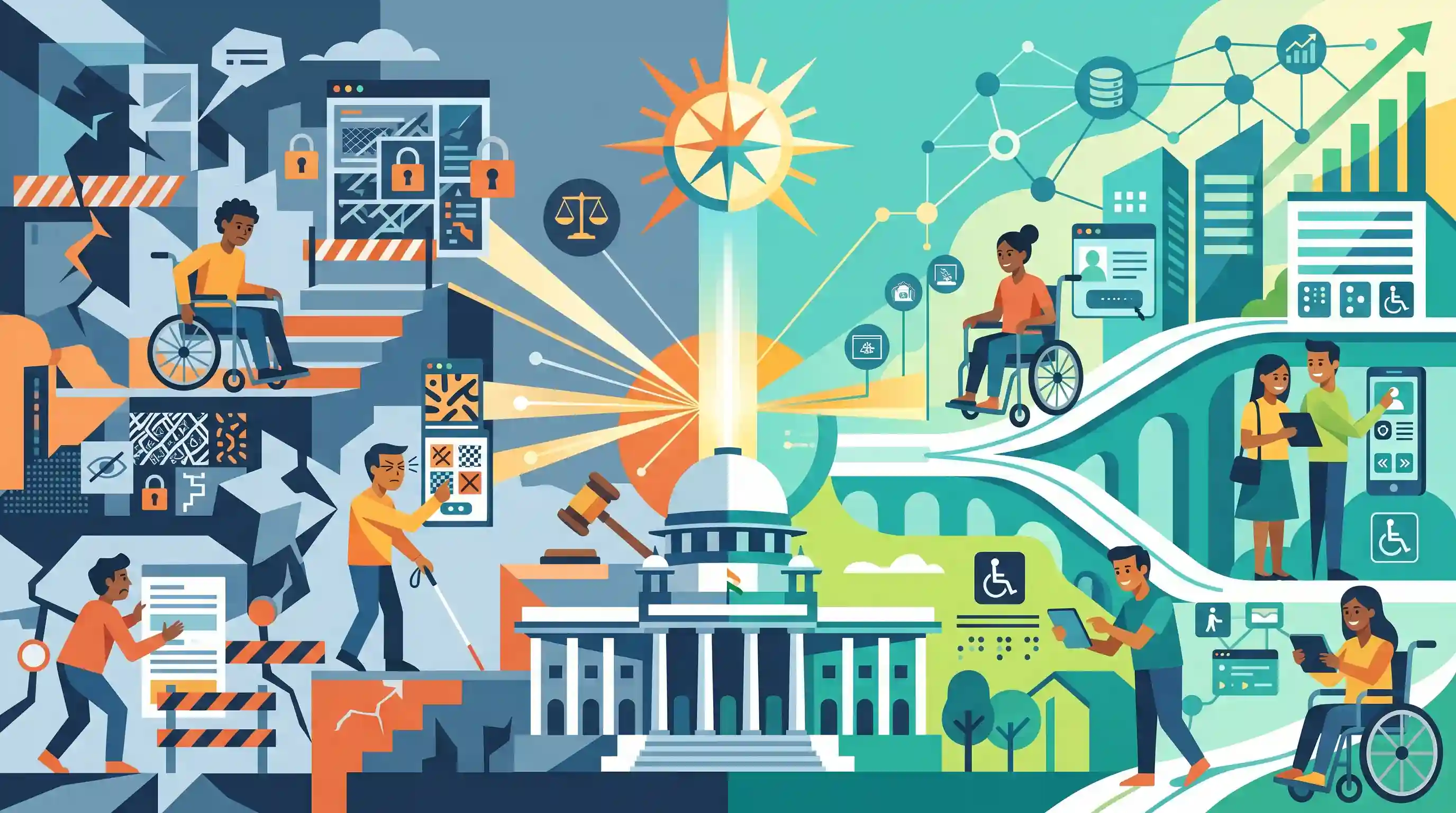
The Supreme Court of India has passed a landmark judgment declaring that inclusive digital access is a fundamental component of the right to life and liberty under Article 21 of the Constitution. The ruling addresses the growing digital divide, emphasizing that inaccessible digital platforms and complex processes like KYC disproportionately marginalize vulnerable populations, including persons with disabilities and acid attack survivors. The Court called for proactive measures to ensure e-governance and digital public infrastructure are designed with universal accessibility in mind, thereby upholding non-discrimination and substantive equality in the digital age.
Key Points
- The Supreme Court ruled that inclusive digital access is an intrinsic part of the fundamental right to life and personal liberty guaranteed under Article 21 of the Constitution.
- The judgment highlighted the necessity of making digital ecosystems, including e-governance and financial services, accessible to marginalized sections.
- It pointed out that inaccessible digital processes, such as rigid KYC norms, disproportionately exclude vulnerable groups like persons with disabilities, the visually impaired, and acid attack survivors.
- The ruling emphasized the need to bridge the digital divide by shifting towards proactive, user-centric technological designs to ensure substantive equality.
Important Terms
Article 21 of the Constitution

Article 21 guarantees the fundamental right to life and personal liberty. Through judicial activism, it has been expanded to include unlisted rights essential for dignity, such as privacy and now digital access.
UPSC context
GS Paper II: Fundamental Rights and Judicial Interpretation. Tests understanding of the evolving scope of 'Right to Life'.
Rights of Persons with Disabilities (RPwD) Act, 2016
A landmark legislation aligning with UNCRPD that recognizes 21 disabilities. It mandates 'universal design' and digital accessibility (Section 42) for all electronic media and ICT services in India.
UPSC context
GS Paper II: Welfare schemes for vulnerable sections. Tests knowledge of statutory frameworks for social justice.
Digital Public Infrastructure (DPI)
Open, interoperable digital systems like Aadhaar and UPI that serve as 'digital rails' for public services. They enable secure identity, payments, and data exchange at a societal scale.
UPSC context
GS Paper III: Science & Technology and Economy. Vital for questions on inclusive growth and digital governance.
Substantive Equality
A constitutional principle that focuses on achieving fair outcomes by accounting for historical disadvantages, rather than merely treating everyone identically (formal equality) regardless of their starting point.
UPSC context
GS Paper II: Indian Polity and Social Justice. Crucial for understanding affirmative action and Articles 14-16.
Digital Divide
The socio-economic gap between individuals who have access to modern information and communication technology and those who do not, often exacerbated by disability, poverty, or geography.
UPSC context
GS Paper II/III: Social Justice and Economy. Tests knowledge of barriers to inclusive development and e-governance.
E-governance
The use of ICT to enhance the delivery of government services, improve transparency, and empower citizens through digital platforms, which the Court now mandates must be universally accessible.
UPSC context
GS Paper II: Governance and ICT applications. Central to reforms in public service delivery.
Prelims Trap
"The Right to Inclusive Digital Access is explicitly enshrined in the Constitution of India under Article 21."
Aspirants often confuse judicial interpretations with explicit constitutional text. The Constitution does not expressly mention digital access; it has been implicitly read into Article 21 by the Supreme Court.
Static Concepts Connected
How has the Supreme Court judicially expanded the scope of Article 21?
- Due Process Evolution: The Maneka Gandhi case (1978) established that procedures depriving personal liberty must be just, fair, and reasonable, incorporating substantive 'due process'.
- Derived Fundamental Rights: Article 21 now includes a broad spectrum of rights essential for a dignified life, such as the Right to Privacy, Clean Environment, Livelihood, and Digital Access.
- Proactive State Duty: The interpretation protects citizens not just from arbitrary executive actions, but compels the State to proactively ensure dignified living conditions.
What are the key provisions of the Rights of Persons with Disabilities (RPWD) Act, 2016?
- Expanded Disability Scope: The Act expanded the list of officially recognized disabilities from 7 to 21, including acid attack victims, specific learning disabilities, and Parkinson's disease.
- Employment Reservation: It mandates raising the reservation quota for persons with benchmark disabilities in government establishments from 3% to 4%.
- Mandatory Accessibility: The Act explicitly mandates a barrier-free environment, requiring public buildings, transport, and digital/information systems to be universally accessible.
Cross-Topic Patterns
Digital Public Infrastructure & Substantive Equality
India's push for Digital Public Infrastructure (Aadhaar, UPI) often risks exclusion errors. The SC's ruling mandates that DPI design align with Article 14 (substantive equality) rather than just rapid scaling.
Elevating Article 38(2) Obligations
Bridging the digital divide is transitioning from a mere policy target under Digital India to a constitutional obligation, explicitly linked to minimizing inequalities in facilities under Article 38(2) (DPSP).

Expect a multi-statement Prelims question contrasting Right to Internet (Art 19) vs. Inclusive Digital Access (Art 21) and the RPWD Act.
Linked PYQs · 5
Linked PYQs · 5
- 2024MainsGS2
Right to privacy is intrinsic to life and personal liberty and is inherently protected under Article 21 of the constitution. Explain. In this reference discuss the law relating to D.N.A. testing of child in the womb to establish its paternity.
- 2017MainsGS2
Examine the scope of Fundamental Rights in the light of the latest judgement of the Supreme Court on Right to Privacy.
- 2025MainsGS2
e-governance projects have a built-in bias towards technology and back-end integration than user-centric designs. Examine.
- 2017MainsGS2
Does the Rights of Persons with Disabilities Act, 2016 ensure effective mechanism for empowerment and inclusion of the intended beneficiaries in the society? Discuss.
- 2024PrelimsGS1
Under which of the following Articles of the Constitution of India, has the Supreme Court of India placed the Right to Privacy ?
