Judicial Modification of Arbitral Awards Under Arbitration Act
Source:The Hindu ↗
Why It Matters
The ruling provides critical clarity on the boundaries of judicial intervention in Alternative Dispute Resolution (ADR), impacting India's ease of doing business by ensuring the finality of arbitral awards. It also serves as an important case study on the scope and limits of the Supreme Court's extraordinary powers under Article 142 vis-à-vis statutory law.
Summary
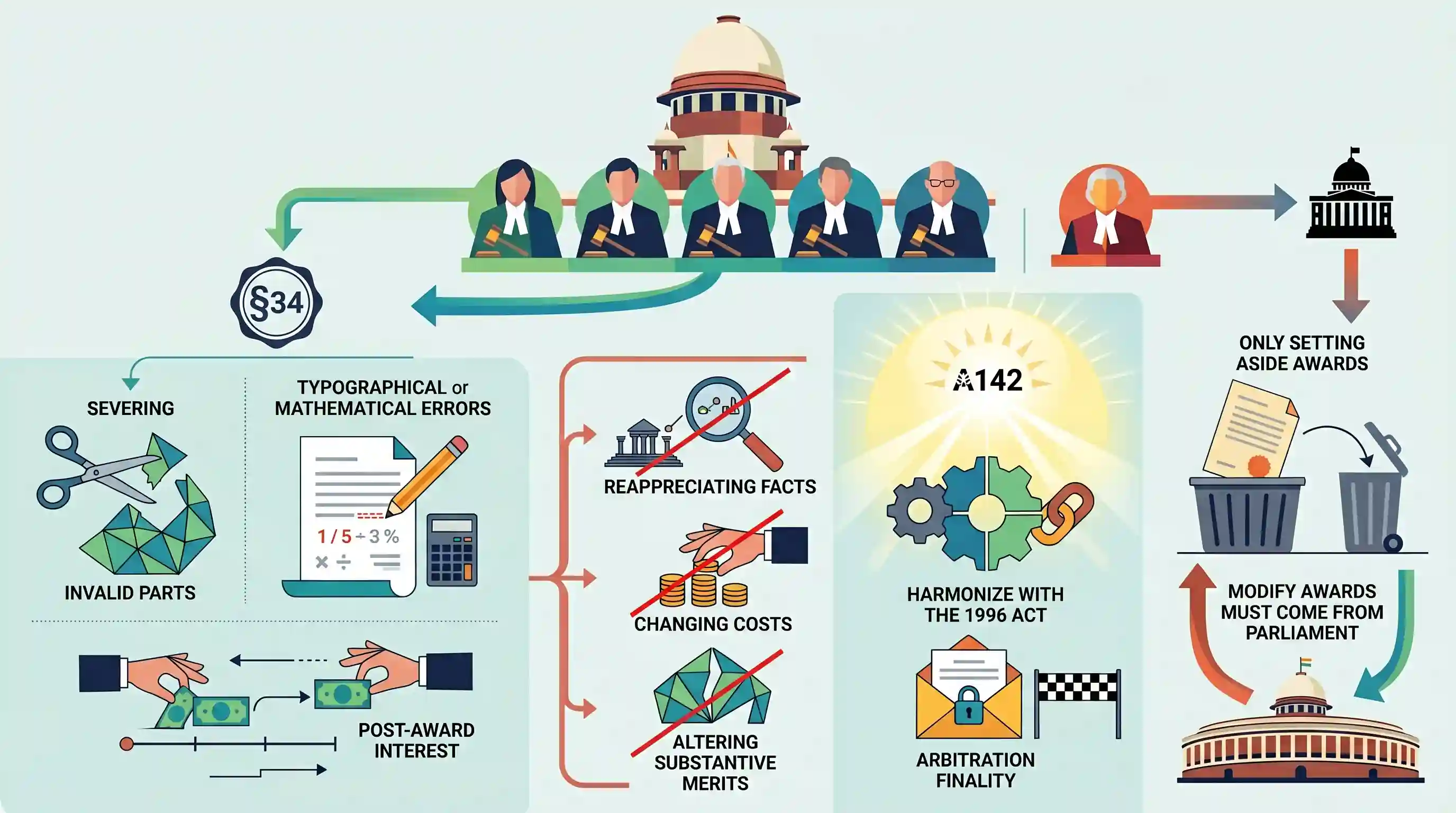
The Supreme Court delivered a landmark 4:1 Constitution Bench ruling affirming that courts possess limited powers to modify arbitral awards under Section 34 of the Arbitration and Conciliation Act, 1996. The majority, led by Chief Justice Sanjiv Khanna, clarified that modifications are restricted to severing invalid parts (the doctrine of severability), correcting typographical or mathematical errors, and adjusting post-award interest. Courts cannot, however, alter the substantive merits, reappreciate facts, or change costs. While acknowledging the Supreme Court's power to do 'complete justice' under Article 142, the judgment emphasized that this power must harmonize with the 1996 Act to preserve the finality of arbitration. In his dissent, Justice K.V. Viswanathan aligned with the Centre's stance, arguing that the statute only permits setting aside awards and that the power to modify must be conferred by Parliament.
Key Points
- A five-judge Constitution Bench held in a 4:1 majority that courts can modify arbitral awards under limited circumstances under Section 34 of the Arbitration and Conciliation Act, 1996.
- Modifications are permitted for severing invalid portions of an award, correcting typographical or computational errors, and altering post-award interest.
- Courts cannot modify awards by reassessing the merits, reappreciating facts, altering costs, or changing the substantive rights determined by the arbitrator.
- CJI Sanjiv Khanna stated that the Supreme Court's inherent power under Article 142 to do 'complete justice' can be used in arbitration matters but must align with the statutory framework of the 1996 Act.
- Justice K.V. Viswanathan dissented, arguing that Section 34 only allows courts to set aside awards, and any power to modify must be explicitly legislated by Parliament.
Important Terms
Arbitration and Conciliation Act, 1996

The primary Indian legislation governing domestic and international commercial arbitration. It aims to provide a speedy, binding dispute resolution mechanism outside the formal court system, reducing judicial backlog.
UPSC context
GS Paper-II: Important for Governance and Alternative Dispute Resolution (ADR) topics regarding judicial efficiency.
Article 142 of the Constitution
A constitutional provision granting the Supreme Court extraordinary power to pass any decree or order necessary for doing 'complete justice' in any case pending before it.
UPSC context
GS Paper-II: Relevant for Judiciary, specifically judicial activism and the concept of 'complete justice' vs. statutory law.
Section 34 of the Arbitration Act
A specific legal provision under the 1996 Act that outlines the limited grounds on which a court can 'set aside' or challenge an arbitral award.
UPSC context
GS Paper-II: Tests understanding of the boundaries of judicial interference in private arbitration processes.
Arbitral Award
The final, binding decision rendered by an arbitral tribunal on the merits of a dispute, which is enforceable in the same manner as a civil court decree.
UPSC context
GS Paper-II: Key technical term for dispute resolution and ease of doing business in India.
Doctrine of Severability
A judicial principle where a court isolates and invalidates only the illegal portions of a contract or award, allowing the valid parts to remain enforceable and intact.
UPSC context
GS Paper-II: A core judicial doctrine related to Article 13 and constitutional interpretation.
Alternative Dispute Resolution (ADR)
Non-litigious methods like arbitration, mediation, and conciliation used to settle disputes. ADR is crucial for reducing the burden on India's formal court system.
UPSC context
GS Paper-II: Explicit syllabus topic under 'Judiciary' and 'Governance' dealing with access to justice.
Prelims Trap
Courts can reassess facts and merits to modify an arbitral award to ensure complete justice.
The Supreme Court explicitly barred courts from reappreciating facts or altering substantive merits, strictly limiting modifications to severing invalid parts or correcting clerical errors.
Static Concepts Connected
What is Article 142 of the Indian Constitution?
- Complete Justice: Empowers the Supreme Court to pass any decree or order necessary for doing complete justice in any cause or matter pending before it.
- Statutory limits: While sweeping in nature, established jurisprudence dictates that Article 142 cannot be invoked to directly contravene substantive statutory provisions.
- Enforceability: Orders passed under this Article are enforceable throughout the territory of India in such manner as prescribed by Parliament.
What are the primary modes of Alternative Dispute Resolution (ADR) in India?
- Arbitration: A binding adjudicatory process where a neutral third party renders an award, governed by the Arbitration and Conciliation Act, 1996.
- Mediation & Conciliation: Non-binding, voluntary processes where a neutral facilitator assists parties in reaching an amicable settlement.
- Lok Adalats: Statutory forums under the Legal Services Authorities Act, 1987, designed to settle pending or pre-litigation disputes amicably.
Cross-Topic Patterns
ADR finality & foreign investment
Limiting judicial interference in arbitral awards aligns with UNCITRAL models, directly boosting foreign investor confidence and bolstering India's Ease of Doing Business metrics.
Article 142 & Statutory harmony
The ruling reiterates a vital constitutional doctrine: the Supreme Court's extraordinary power to do 'complete justice' cannot arbitrarily supplant or override explicit legislative frameworks.

Expect a 2026 Prelims question testing the limitations of Article 142 'complete justice' alongside ADR finality and the UNCITRAL framework.
Linked PYQs · 3
Linked PYQs · 3
- 2015MainsGS2
What are the major changes brought in the Arbitration and Conciliation Act, 1996 through the recent Ordinance promulgated by the President? How far will it improve India's dispute resolution mechanism? Discuss.
- 2024MainsGS2
Explain and distinguish between Lok Adalats and Arbitration Tribunals. Whether they entertain civil as well as criminal cases ?
- 2019PrelimsGS1
With reference to the Constitution of India, prohibitions or limitations or provisions contained in ordinary laws cannot act as prohibitions or limitations on the constitutional powers under Article 142. It could mean which one of the following?
