Supreme Court to address Delhi NCR air pollution enforcement
Source:The Hindu ↗
Why It Matters
Highlights the persistent governance challenge of air pollution in metropolitan areas, the ongoing failure of executive authorities to implement environmental protocols, and the crucial role the judiciary plays through active intervention to enforce public health and environmental standards.
Summary
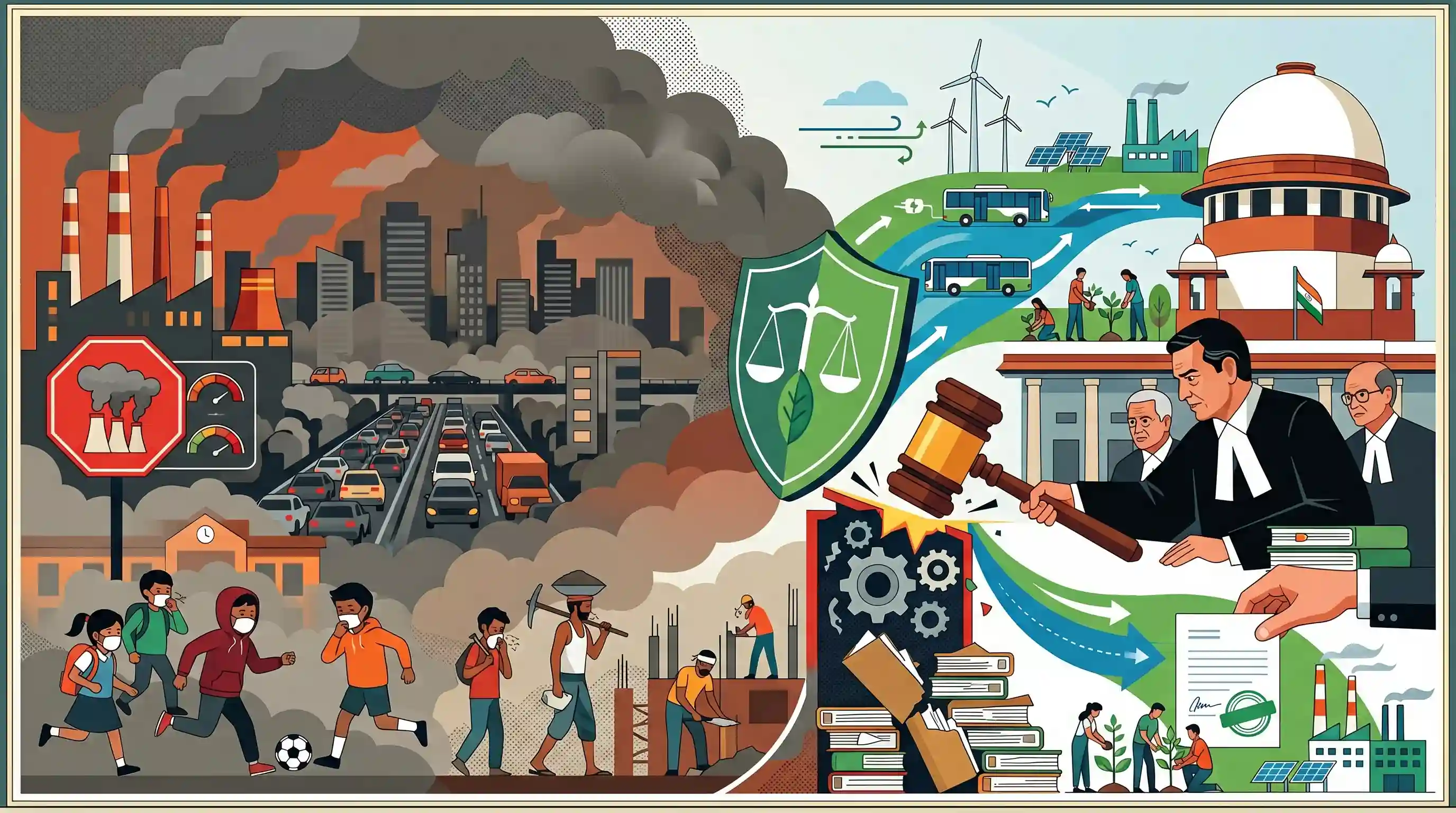
The Supreme Court is set to hear a plea regarding the worsening air pollution crisis in Delhi-NCR on December 17. The Bench, headed by Chief Justice Surya Kant, expressed deep concern over the poor implementation of preventive measures by executive authorities. Amicus curiae Aprajita Singh highlighted that without judicial intervention, authorities neglect existing protocols, pointing to schools continuing outdoor sports despite bans. The Court emphasized the crisis will no longer be treated as a customary winter case, scheduling hearings twice a month to seek comprehensive short- and long-term solutions. With Delhi's AQI hitting a 'severe' 498, the proceedings underscored the urgent need for enforced compliance and the disproportionate impact of toxic air on vulnerable populations like poor labourers.
Key Points
- The Supreme Court scheduled a hearing for December 17 to address the severe air pollution crisis in Delhi-NCR.
- A Bench led by Chief Justice Surya Kant emphasized that the poor implementation of anti-pollution protocols by authorities is the central issue.
- Amicus curiae Aprajita Singh noted that authorities fail to act without direct court orders and that schools are conducting outdoor activities despite guidelines.
- To find both short and long-term solutions, the Court declared it will hear the pollution case twice a month rather than treating it as merely a seasonal winter issue.
- Delhi's Air Quality Index (AQI) reached 498, falling into the 'severe' category, marking one of the most polluted days on record due to low temperatures and weak winds.
- The Court highlighted that severe pollution disproportionately affects vulnerable groups, particularly poor labourers who cannot avoid exposure.
Important Terms
Commission for Air Quality Management (CAQM)

A statutory body established under the 2021 Act to coordinate and oversee air quality management specifically in the National Capital Region (NCR) and adjoining states.
UPSC context
GS Paper III (Environment) and GS Paper II (Statutory Bodies); central to Delhi's air pollution policy governance.
Central Pollution Control Board (CPCB)
A statutory organization (est. 1974) under the Ministry of Environment that provides technical services and sets national standards for air and water quality.
UPSC context
GS Paper II (Governance) and GS III (Pollution); apex technical authority for environmental monitoring in India.
Amicus Curiae
Latin for 'friend of the court'; a neutral legal expert or advocate appointed by the judiciary to assist in resolving complex public interest cases.
UPSC context
GS Paper II (Judiciary); critical in environmental litigations (PILs) where the court requires independent expertise beyond the litigants.
Air Quality Index (AQI)
A color-coded numerical scale (0–500) used by the CPCB to communicate the health impact of daily air pollution levels to the general public.
UPSC context
GS Paper III (Environment); used to trigger emergency measures like GRAP; 'Severe' category (401-500) is a major health concern.
Graded Response Action Plan (GRAP)
An emergency framework of graded measures (Stages I–IV) implemented in Delhi-NCR based on AQI levels to curb peak winter pollution levels.
UPSC context
GS Paper III (Pollution Control); tests knowledge of administrative responses to environmental crises and urban governance.
Judicial Activism
The proactive role of the judiciary in protecting fundamental rights (e.g., Article 21's Right to Clean Air) and ensuring executive accountability in policy implementation.
UPSC context
GS Paper II (Judiciary/Separation of Powers); explains why the Supreme Court intervenes in administrative issues like pollution.
Prelims Trap
GRAP is a pan-India statutory framework invoked by the CPCB across all major Indian cities when AQI is severe.
GRAP is not a nationwide policy. It is a specific emergency framework designed exclusively for the Delhi-NCR region and is enforced by the CAQM.
Static Concepts Connected
What is 'Continuous Mandamus' in Indian environmental jurisprudence?
- Definition: A judicial innovation where courts keep a Public Interest Litigation (PIL) open and issue periodic directions over time to ensure sustained executive compliance.
- Application: Often deployed in complex, systemic failures requiring long-term monitoring, such as the T.N. Godavarman forest case or the Delhi-NCR air pollution crisis.
- Constitutional Basis: Derived from the expansive reading of Articles 32 and 226, utilized by courts to effectively enforce fundamental rights like the Right to a Clean Environment (Article 21).
What is the mandate of the Commission for Air Quality Management (CAQM)?
- Statutory Status: Established under the CAQM Act 2021 to ensure better coordination, research, and resolution of problems surrounding the air quality index in the NCR and adjoining areas.
- Overriding Power: It has exclusive jurisdiction over the NCR. In case of any conflict regarding air quality management, CAQM's orders supersede those of the Central Pollution Control Board (CPCB).
- Multi-State Scope: It coordinates multi-sectoral actions across Delhi, Punjab, Haryana, Rajasthan, and Uttar Pradesh to tackle transboundary pollution like stubble burning.
Cross-Topic Patterns
Judicial Activism vs. Executive Apathy
SC's routine intervention in Delhi's pollution protocols highlights a systemic executive failure, frequently tested in GS2 under the themes of separation of powers, continuous mandamus, and judicial activism.
Pollution as a Social Justice Issue
The disproportionate impact of severe AQI on daily-wage laborers links environmental degradation (GS3) directly to urban poverty, informal economies, and social vulnerability (GS1/GS2).

Expect a 2026 GS-2/3 intersection question evaluating whether statutory bodies like CAQM have failed, necessitating 'continuous mandamus'.
Linked PYQs · 5
Linked PYQs · 5
- 2021MainsGS3
Describe the key points of the revised Global Air Quality Guidelines (AQGs) recently released by the World Health Organisation (WHO). How are these different from its last update in 2005? What changes in India's National Clean Air Programme are required to achieve these revised standards?
- 2022MainsGS3
Discuss in detail the photochemical smog emphasizing its formation, effects and mitigation. Explain the 1999 Gothenburg Protocol.
- 2020MainsGS2
Judicial Legislation is antithetical to the doctrine of separation of powers as envisaged in the Indian Constitution. In this context justify the filing of large number of public interest petitions praying for issuing guidelines to executive authorities.
- 2022MainsGS2
“The most significant achievement of modern law in India is the constitutionalization of environmental problems by the Supreme Court.” Discuss this statement with the help of relevant case laws.
- 2023MainsGS1
Does urbanization lead to more segregation and/or marginalization of the poor in Indian metropolises?
