Supreme Court scrutiny of data protection law impact on transparency
Source:The Hindu ↗
Why It Matters
The conflict between the DPDP Act and the RTI Act touches upon the core constitutional debate of balancing the fundamental right to privacy (Article 21) with the right to information/freedom of speech and expression (Article 19). It is a highly probable topic for GS Paper 2 (Governance, Fundamental Rights).
Summary
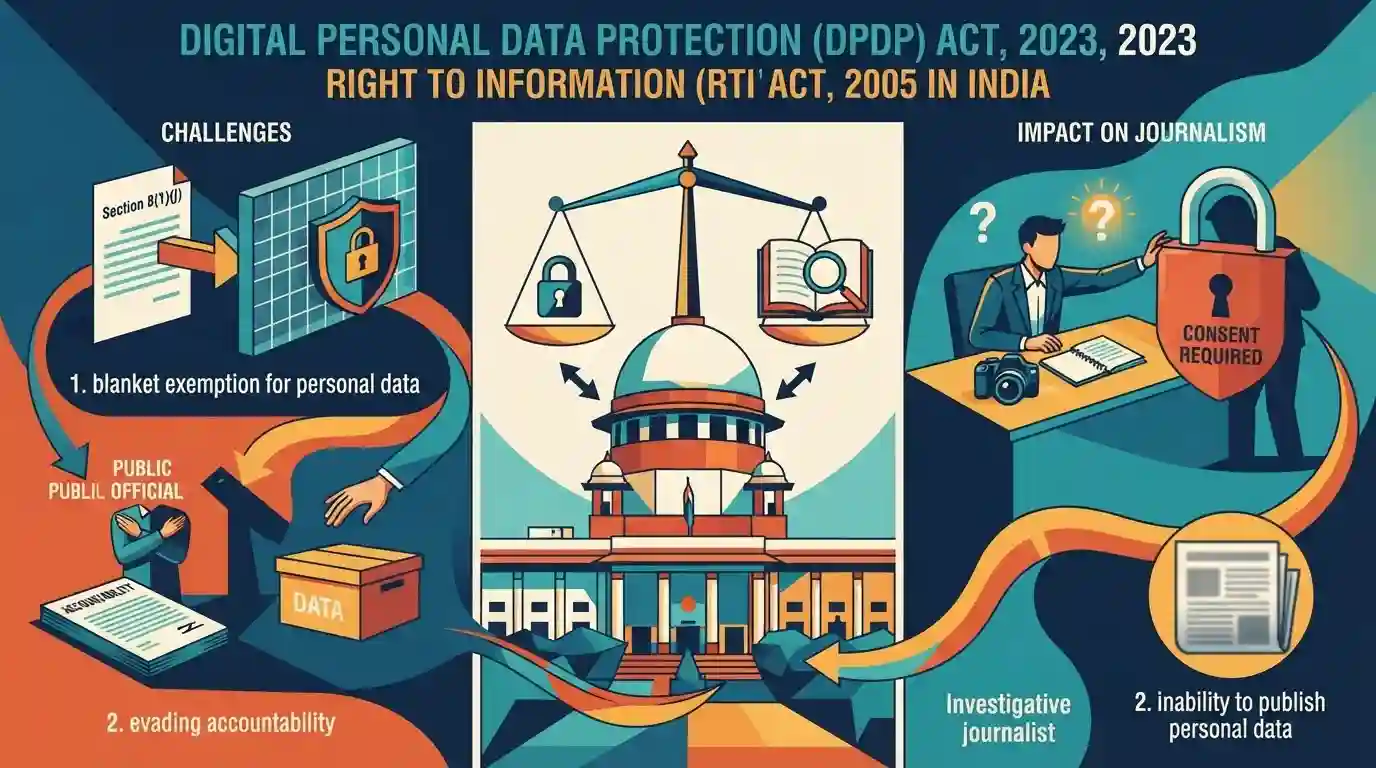
The Supreme Court of India is set to examine the constitutional impact of the Digital Personal Data Protection (DPDP) Act, 2023 on the Right to Information (RTI) Act, 2005 and investigative journalism. Petitions argue that an amendment to Section 8(1)(j) of the RTI Act via the DPDP Act creates a blanket exemption for personal data disclosure, undermining transparency and allowing public officials to evade accountability. Furthermore, the DPDP Act lacks exemptions for journalistic purposes, meaning investigative journalists would require the consent of the individuals they are investigating to publish personal data. The Court acknowledged the tension between transparency and privacy, emphasizing the need to harmonise these two Central legislations.
Key Points
- The Supreme Court has agreed to examine petitions challenging the impact of the Digital Personal Data Protection (DPDP) Act, 2023 on the Right to Information (RTI) Act, 2005.
- Section 44(3) of the DPDP Act amended Section 8(1)(j) of the RTI Act to impose a blanket ban on the disclosure of personal information, removing the previous public interest override.
- Petitioners argue that the DPDP Act flips the right to privacy, using it to shield State functionaries from accountability rather than protecting citizens from the State.
- The petitions also highlight concerns over the Act's chilling effect on investigative journalism, as journalists would need consent from data principals (the subjects of investigation) to publish personal data.
- The Supreme Court stressed the need to harmonise both legislations, noting that RTI promotes transparency while DPDP protects digital privacy.
Important Terms
Digital Personal Data Protection (DPDP) Act, 2023

India's primary data privacy law establishing a framework for processing digital personal data. It balances individual privacy with lawful processing but faces criticism for potentially shielding government information from public scrutiny.
UPSC context
GS Paper 2 (Governance) & GS Paper 3 (Cybersecurity); tests understanding of data governance, privacy rights, and legislative impacts.
Right to Information (RTI) Act, 2005
A landmark law empowering citizens to request records from public authorities. It aims to promote transparency, contain corruption, and ensure government accountability, operationalizing the constitutional right to freedom of speech.
UPSC context
GS Paper 2 (Governance) & GS Paper 4 (Probity); tests institutional mechanisms for transparency and citizen-state engagement.
Section 8(1)(j) of the RTI Act
An RTI provision exempting the disclosure of personal information. The DPDP Act amended this by removing the larger public interest override, creating a blanket exemption that critics argue undermines transparency.
UPSC context
GS Paper 2 (Governance); tests the specific exemptions within transparency laws and how recent amendments dilute accountability.
Right to Privacy (Article 21)
Recognized as a fundamental right under Article 21 by the Supreme Court in the Puttaswamy case (2017). It safeguards individual autonomy but must be balanced against the public's right to know.
UPSC context
GS Paper 2 (Indian Constitution); tests the evolution of fundamental rights and the judicial balancing of privacy versus transparency.
Investigative Journalism
Deep-dive reporting that exposes corruption or abuses of power. It relies on public records, which are threatened by the DPDP Act's lack of exemptions for processing data for journalistic purposes.
UPSC context
GS Paper 2 (Role of Media); tests the importance of a free press in maintaining democratic accountability and governance.
Supreme Court of India
The apex judicial body in India. It acts as the final interpreter of the Constitution and guardian of Fundamental Rights, frequently adjudicating conflicts between competing rights like privacy and transparency.
UPSC context
GS Paper 2 (Judiciary); tests the role of the apex court in constitutional interpretation and protecting democratic pillars.
Prelims Trap
The DPDP Act allows disclosure of personal data under RTI if it serves a larger public interest.
This is false. The DPDP Act 2023 specifically amended Section 8(1)(j) of the RTI Act to remove the 'public interest override,' imposing a blanket ban on personal info disclosure.
Static Concepts Connected
What is the Proportionality Test for privacy restrictions?
- Legality: The action restricting privacy must be backed by a valid, constitutionally sound law.
- Legitimate Aim: There must be a rational nexus between the measure and a legitimate state objective.
- Necessity & Balancing: The measure must be the least restrictive means to achieve the goal, balancing rights adequately.
How is the Right to Information constitutionally protected in India?
- Article 19(1)(a): SC rulings (e.g., Raj Narain case) interpret RTI as implicit in the freedom of speech and expression.
- Article 21: Information is essential for citizens to make informed choices, connecting it to the right to live with dignity.
- RTI Act 2005: It is a statutory right, enacted to operationalize these fundamental constitutional guarantees.
Cross-Topic Patterns
Privacy vs Transparency in Electoral Funding
The SC previously struck down Electoral Bonds to uphold voter RTI (Art 19), showing a pattern of prioritizing democratic transparency over donor privacy. This precedent heavily influences the DPDP-RTI judicial balancing.
Digital regulations chilling Article 19(1)(a)
The lack of journalistic exemptions in the DPDP Act mirrors concerns raised against IT Rules 2021 and the Telegraph Act, highlighting a persistent trend of digital regulations chilling press freedom.

Expect a Mains GS2 question analyzing the friction between Art 19(1)(a) (RTI/Media) and Art 21 (Privacy) via the DPDP Act 2023 amendment.
Linked PYQs · 3
Linked PYQs · 3
- 2020MainsGS2
Recent amendments to the Right to Information Act will have profound impact on the autonomy and independence of the Information Commission". Discuss.
- 2024MainsGS2
Right to privacy is intrinsic to life and personal liberty and is inherently protected under Article 21 of the constitution. Explain. In this reference discuss the law relating to D.N.A. testing of child in the womb to establish its paternity.
- 2017MainsGS2
Examine the scope of Fundamental Rights in the light of the latest judgement of the Supreme Court on Right to Privacy.
