Supreme Court Directives on Digital Fraud and Financial Crimes
Source:The Hindu ↗
Why It Matters
With the rapid digitization of financial services, cyber frauds have evolved into organized crime threatening citizens' financial security. The Supreme Court's intervention underscores the urgent need for a cohesive institutional framework—involving law enforcement and banking regulators like the RBI—to curb digital financial crimes and enforce systemic accountability.
Summary
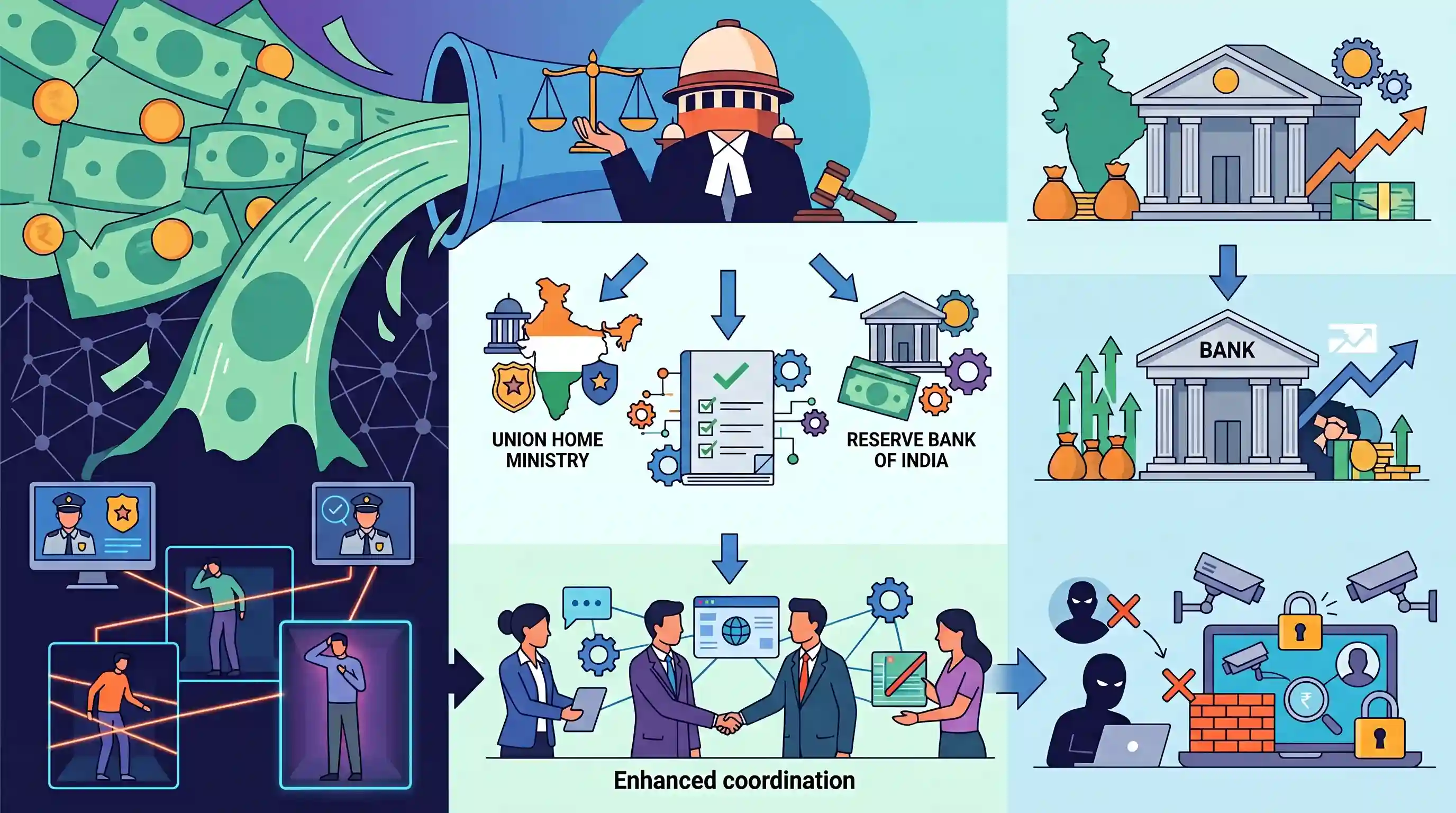
The Supreme Court expressed grave concern over the siphoning of nearly ₹53,000 crore through cyber frauds such as "digital arrests," terming it "absolute robbery or dacoity." Emphasizing the vulnerability of citizens, the Court directed the Union Home Ministry and the RBI to frame a comprehensive Standard Operating Procedure (SOP) to ensure effective inter-agency coordination and prevent swift transfer of stolen funds via bank accounts. The Court criticized banks for operating strictly in "business mode" while ignoring the misuse of their platforms, demanding enhanced accountability and protective mechanisms for the public.
Key Points
- The Supreme Court termed the siphoning of over ₹52,969 crore through cyber-enabled financial frauds (April 2021–Nov 2025) as absolute robbery or "dacoity."
- The Court highlighted the severe psychological distress caused by tactics like "digital arrests," which have pushed some victims to suicide.
- The Union Home Ministry and the RBI were directed to frame and implement a comprehensive Standard Operating Procedure (SOP) to ensure effective inter-agency coordination.
- The Court criticized banks for operating strictly in "business mode," noting that their systems inadvertently facilitate the swift routing of stolen funds.
- The government is finalizing a memorandum of understanding to share a suspect registry of data and deploy mule account detection tools to block fraudulent transactions.
Important Terms
Digital Arrest

A cyber-extortion tactic where scammers impersonate law enforcement via video/audio calls, falsely accusing victims of crimes and demanding "settlement fees" while keeping them under virtual surveillance.
UPSC context
GS III (Internal Security); highlights emerging cyber-threats, the role of AI/deepfakes in crime, and the need for public digital literacy.
Indian Cyber Crime Coordination Centre (I4C)
A nodal agency under the Ministry of Home Affairs (MHA) designed to provide a unified ecosystem for law enforcement agencies to combat cybercrime in a coordinated manner.
UPSC context
GS III (Internal Security); essential for questions on institutional frameworks, inter-agency coordination, and national cybersecurity strategy.
Standard Operating Procedure (SOP)
A set of step-by-step instructions compiled by an organization to ensure efficiency, uniformity of performance, and compliance with regulations during routine or complex operations.
UPSC context
GS II (Governance); reflects administrative efficiency and the importance of standardized protocols in multi-agency responses to financial crimes.
Reserve Bank of India (RBI)
India's central bank and primary regulatory authority responsible for monetary policy and the supervision of the banking system to ensure financial stability.
UPSC context
GS III (Economy); focuses on its role in banking regulation, consumer protection, and preventing the misuse of financial platforms.
Ministry of Home Affairs (MHA)
The Union ministry responsible for maintaining internal security, public order, and coordinating the national response to organized crime and cyber threats.
UPSC context
GS III (Internal Security); central to topics regarding national security policy, law enforcement coordination, and cybercrime mitigation strategies.
Prelims Trap
"Digital arrests are legally recognized provisions under the IT Act, 2000 for detaining cyber suspects."
"Digital arrest" is purely a cyber-extortion tactic. There is no legal provision for online or virtual arrests under Indian criminal law (BNSS) or the IT Act, 2000.
Static Concepts Connected
What is the mandate and structure of the I4C?
- Nodal Agency: Acts as the nodal point to tackle cybercrime in a coordinated manner under the Ministry of Home Affairs (MHA).
- Key Components: Comprises components like the National Cyber Crime Reporting Portal (NCRP), National Cybercrime Threat Analytics Unit, and the Central Suspect Registry.
- Core Function: Facilitates real-time data sharing and coordination among law enforcement agencies, financial institutions, and intermediaries to track cross-border frauds.
How do "Money Mule" accounts facilitate digital money laundering?
- Definition: A money mule transfers illegally acquired money on behalf of someone else, often unknowingly, in exchange for a commission.
- Operational Mechanism: Fraudsters use compromised KYC or rent accounts from vulnerable individuals to rapidly layer stolen funds and obscure their illicit origin.
- PMLA Violation: Such layering directly violates the Prevention of Money Laundering Act (PMLA) by integrating dirty money into the formal banking system.
Cross-Topic Patterns
Cyber Frauds + PMLA Enforcement
The rapid routing of funds via "mule accounts" tightly links cyber extortion to the Prevention of Money Laundering Act (PMLA), requiring Enforcement Directorate (ED) intervention alongside RBI's banking oversight.
Right to Privacy vs. Stricter KYC norms
Mandating stricter KYC norms and operating Central Suspect Registries to curb financial fraud revives the privacy versus security debate established under the Puttaswamy judgment guidelines.

Expect a multi-statement question combining I4C's mandate, RBI regulations on mule accounts, and the legal non-entity of digital arrests.
Linked PYQs · 3
Linked PYQs · 3
- 2020MainsGS3
Discuss different types of cyber crimes and measures required to be taken to fight the menace.
- 2017MainsGS3
Discuss the potential threats of Cyber attack and the security framework to prevent it.
- 2021MainsGS3
Discuss how emerging technologies and globalisation contribute to money laundering. Elaborate measures to tackle the problem of money laundering both at national and international levels.
