Supreme Court Cognisance of Bar Association High Court Resolution
Source:The Hindu ↗
Why It Matters
The issue touches upon the independence, conduct, and accountability of the judiciary. It highlights the importance of a cordial Bar-Bench relationship for the administration of justice, and serves as an example of the role of bodies like the BCI and SCBA in advocating for professional rights.
Summary
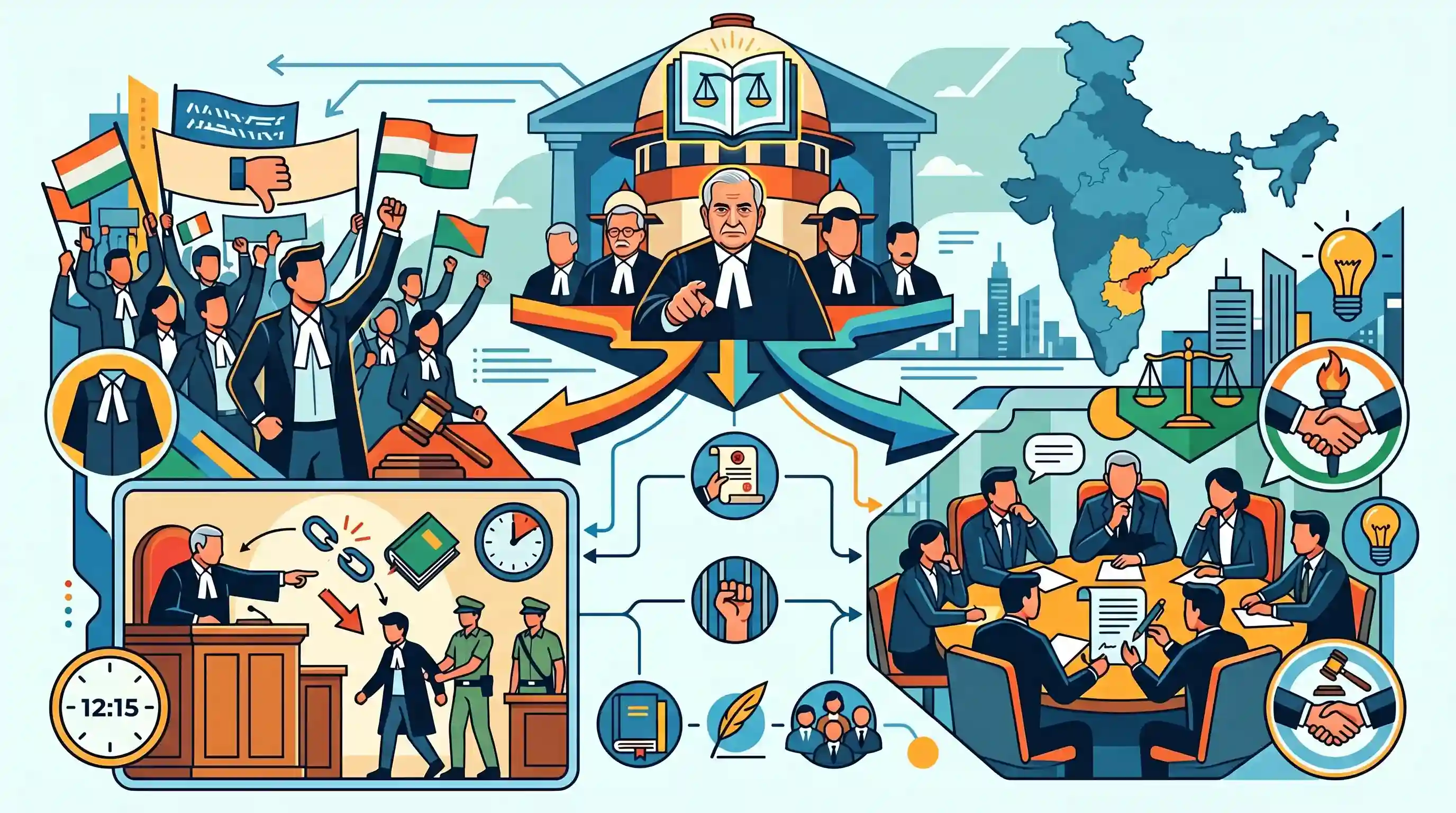
The Supreme Court, led by Chief Justice of India Sanjiv Khanna, has taken cognisance of a resolution passed by the Supreme Court Bar Association (SCBA) regarding an incident in the Andhra Pradesh High Court. A video showed Justice Tarlada Rajasekhar Rao sending a young advocate to one day's judicial custody for a procedural lapse. The SCBA strongly condemned the action, demanding the judge be recalled from duty pending an inquiry. The Bar Council of India (BCI) also expressed concern, urging judicial officers to handle matters with sensitivity to ensure a cordial relationship between the Bar and the Bench. The case brings attention to issues of judicial conduct, the limits of contempt or disciplinary powers against lawyers, and the role of statutory bodies in safeguarding legal professionals.
Key Points
- The Supreme Court took suo motu cognisance of a representation made by the Supreme Court Bar Association (SCBA) concerning an Andhra Pradesh High Court judge.
- The judge allegedly sent a young advocate to judicial custody over a procedural lapse in the courtroom.
- The SCBA strongly condemned the incident, demanding the recall of the judge from judicial duties and an inquiry into his conduct.
- The Bar Council of India (BCI) also weighed in, highlighting the need for judges to show sensitivity and maintain a harmonious relationship with members of the Bar.
- The incident raises important questions regarding the scope of judicial powers, professional conduct, and the checks and balances between the Bench and the Bar.
Important Terms
Supreme Court of India

India’s apex judicial authority and the final interpreter of the Constitution. It functions under Part V (Articles 124-147) and acts as the guardian of fundamental rights.
UPSC context
GS Paper II: Essential for Judiciary topics, specifically its role as a Court of Record and appellate jurisdiction.
High Court
The highest judicial body at the state level. They possess writ jurisdiction under Article 226 and powers of superintendence over all subordinate courts under Article 227.
UPSC context
GS Paper II: Key for state-level judiciary, judicial review, and the single integrated judicial system.
Bar Council of India (BCI)
A statutory body established under the Advocates Act, 1961, to regulate the legal profession and legal education, prescribing standards of professional conduct and etiquette for advocates.
UPSC context
GS Paper II: Relevant for statutory bodies and the regulation of legal professionals.
Contempt of Court
The power of courts (Articles 129 and 215) to punish actions that disrespect judicial authority or obstruct justice, categorized as civil or criminal under the 1971 Act.
UPSC context
GS Paper II: Tests knowledge of judicial independence, accountability, and limits on free speech (Article 19).
Supreme Court Bar Association (SCBA)
A voluntary association representing lawyers practicing before the Supreme Court. Unlike the BCI, it is a society primarily focused on the interests and welfare of its members.
UPSC context
GS Paper II: Professional ethics and the role of civil society/associations in judicial accountability.
Bar and Bench Relationship
The professional interaction between lawyers (Bar) and judges (Bench). A cordial relationship is deemed vital for the fair administration of justice and judicial decorum.
UPSC context
GS Paper IV (Ethics) and GS Paper II: Concerns judicial ethics and the smooth functioning of the legal system.
Prelims Trap
"The Supreme Court and High Courts can suspend a lawyer's practice using their inherent contempt powers."
Under the Advocates Act, 1961, only the Bar Council holds disciplinary jurisdiction to suspend/revoke an advocate's license, not the courts under contempt.
Static Concepts Connected
Who has the authority to suspend or revoke an advocate's license in India?
- Disciplinary jurisdiction: This rests exclusively with the State Bar Councils and the Bar Council of India under the Advocates Act, 1961.
- Court limitations: The Supreme Court and High Courts can punish for contempt under Articles 129/215 but cannot revoke professional licenses (SCBA v. UoI, 1998).
- Court recourse: While courts cannot revoke a license, they can bar an advocate from appearing before them in specific instances to maintain court decorum.
How does the higher judiciary handle internal misconduct without formal impeachment?
- In-House Procedure: Adopted in 1999, this administrative mechanism allows the higher judiciary to internally investigate allegations against judges by a peer committee.
- Remedial actions: If misconduct is found, the Chief Justice can withdraw judicial work from the erring judge or advise them to resign, bypassing complex Article 124(4) impeachment.
Cross-Topic Patterns
Judicial Immunity vs Accountability
The tension between immunity under the Judges (Protection) Act, 1985 and accountability highlights why the judiciary relies on its 1999 In-House Procedure to discipline judges without impeachment.
Constitutional vs Statutory Powers
This incident tests the boundary between inherent constitutional powers (Article 215 contempt jurisdiction) and statutory regulatory mandates (the Bar Council's role under the Advocates Act, 1961).

Contempt powers vs Bar Council jurisdiction (Advocates Act) is a prime candidate for a 'which of the statements are correct' 2026 Prelims Q.
Linked PYQs · 3
Linked PYQs · 3
- 2023MainsGS2
“Constitutionally guaranteed judicial independence is a prerequisite of democracy.” Comment.
- 2025MainsGS2
"Constitutional morality is the fulcrum which acts as an essential check upon the high functionaries and citizens alike...." In view of the above observation of the Supreme Court, explain the concept of constitutional morality and its application to ensure balance between judicial independence and judicial accountability in India.
- 2022PrelimsGS1
With reference to India, consider the following statements: 1. Government law officers and legal firms are recognised as advocates, but corporate lawyers and patent attorneys are excluded from recognition as advocates. 2. Bar Councils have the power to lay down the rules relating to legal education and recognition of law colleges. Which of the statements given above is/are correct?
