Supreme Court Stays on High Court Precedents
Source:Indian Express ↗
Why It Matters
The article touches upon a nuanced constitutional issue regarding the balance of power between the Supreme Court and High Courts. It is highly relevant for GS Paper 2 (Judiciary and Constitutional mechanisms) as it questions the procedural fairness and systemic implications of staying precedential values without substantive hearings.
Summary
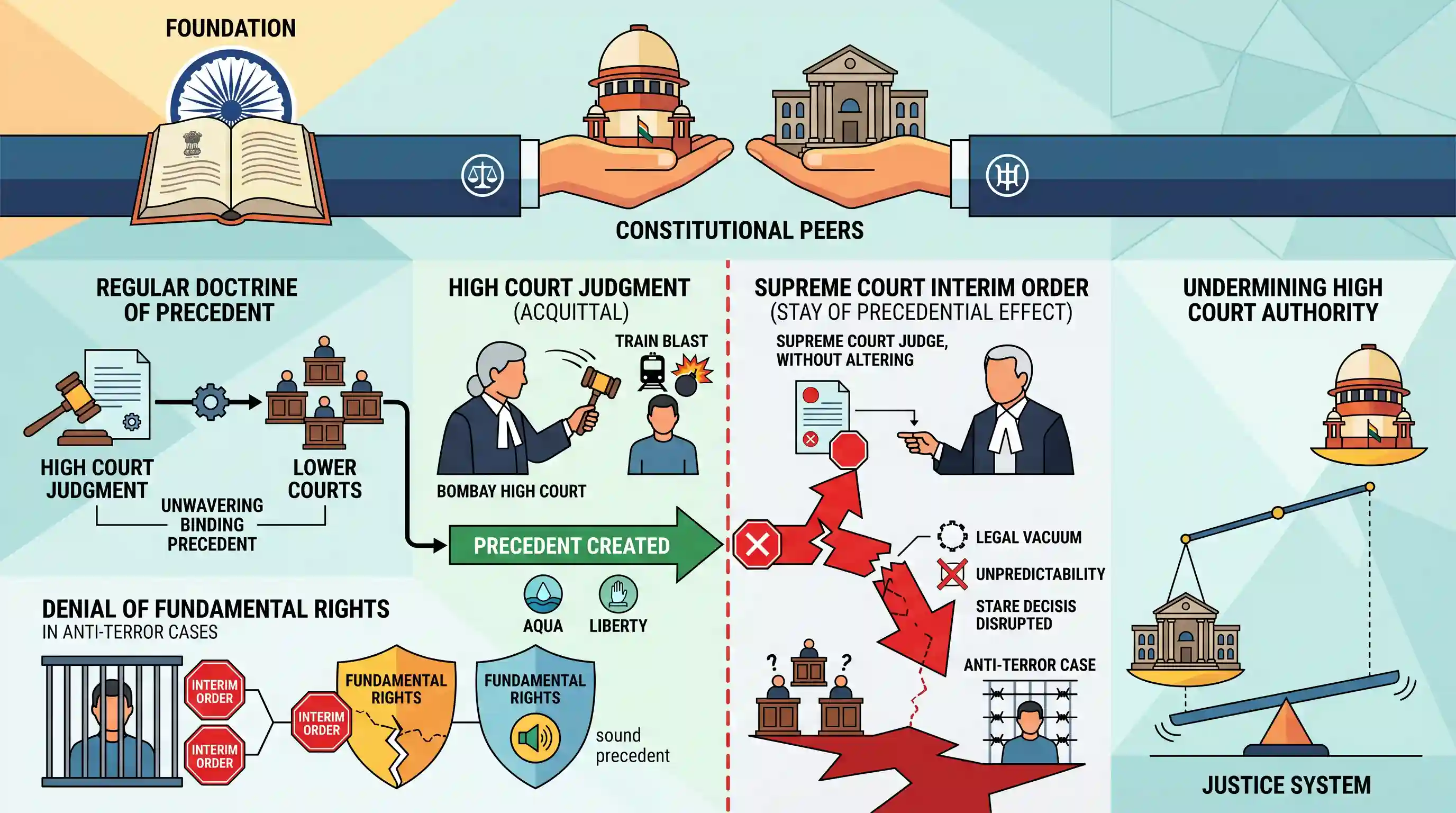
The article expresses concern over the Supreme Court's increasing practice of staying the "precedential effect" of High Court judgments via interim orders, highlighting a recent Bombay High Court acquittal in a train blast case. By suspending the legal principles laid down by the High Court before hearing the appeal on its merits, the Supreme Court inadvertently undermines the constitutional authority of High Courts, which are not merely subordinate courts but constitutional peers. This trend disrupts the doctrine of stare decisis and creates a legal vacuum for lower courts, leading to unpredictability in the justice system. The issue is especially alarming in anti-terror cases, where such stays can perpetuate prolonged incarceration and deny the accused their fundamental rights based on sound legal precedents.
Key Points
- The article criticizes the Supreme Court's recent interim order staying the 'precedential effect' of a Bombay High Court judgment that acquitted accused individuals in a train blast case.
- High Courts are independent constitutional courts, and staying their jurisprudential reasoning via interim orders without a full hearing on merits undermines their constitutional stature.
- Such stays create legal uncertainty, disrupting the doctrine of stare decisis, as lower courts are left without clear guidance on whether they can rely on the High Court's legal principles.
- The practice disproportionately affects the criminal justice system, particularly in terrorism or UAPA cases, where prolonged incarceration is common and accused rely on established legal precedents for bail or discharge.
Important Terms
Doctrine of Stare Decisis

A legal principle (Latin for 'to stand by things decided') requiring courts to follow established precedents from previous cases to ensure judicial consistency, predictability, and stability in the law.
UPSC context
GS-2 (Polity/Judiciary); tests understanding of the hierarchical judicial system and the role of precedents in maintaining the Rule of Law.
Article 141
A constitutional provision declaring that the law 'declared' by the Supreme Court is binding on all courts within India, establishing its position as the final authority on legal interpretation.
UPSC context
GS-2 (Polity/Judiciary); critical for questions on the Supreme Court’s powers, judicial uniformity, and the binding nature of its judgments.
Article 136 (Special Leave Petition)
Grants the Supreme Court discretionary power to permit an appeal against any judgment, decree, or order from any court/tribunal in India, often invoked to correct grave injustices.
UPSC context
GS-2 (Polity/Judiciary); covers the Supreme Court's extraordinary jurisdiction and its discretion in hearing civil or criminal appeals.
Ratio Decidendi
The 'reason for the decision'; the core legal principle or reasoning upon which a court's judgment is based, which constitutes the binding part of a judicial precedent.
UPSC context
GS-2 (Polity/Judiciary); tests technical legal knowledge regarding which parts of a judgment have binding force versus mere observations (obiter dicta).
MCOCA (Maharashtra Control of Organised Crime Act)
A stringent state-level anti-terror law in Maharashtra designed to combat organized crime; it features expanded police powers and rigorous bail conditions similar to national anti-terror legislation.
UPSC context
GS-3 (Internal Security); relevant for specialized security laws and their impact on criminal justice and fundamental rights.
Unlawful Activities (Prevention) Act (UAPA)
India's primary national anti-terror law, providing the state with extensive powers for the prevention of, and for coping with, terrorist activities and individuals or organizations involved in them.
UPSC context
GS-3 (Internal Security); a high-frequency topic regarding the balance between national security and civil liberties.
Interim Order
A temporary court order issued during the pendency of a case to maintain the status quo or provide immediate relief before a final judgment is delivered.
UPSC context
GS-2 (Polity/Judiciary); tests knowledge of judicial procedures and the temporary effects of stay orders on lower court rulings.
Prelims Trap
"High Courts are administratively subordinate to the Supreme Court under the integrated Indian judicial system."
While the SC has appellate jurisdiction over HCs, High Courts are independent constitutional courts. They are not administratively subordinate to the Supreme Court.
Static Concepts Connected
Are High Courts constitutionally subordinate to the Supreme Court?
- Constitutional Peers: HCs are independent constitutional courts (Articles 214-231), not administratively subordinate to the SC.
- Writ Jurisdiction: HC writ jurisdiction (Article 226) covers fundamental and legal rights, making it wider than the SC's (Article 32).
- Appellate Authority: The SC merely exercises appellate jurisdiction over HCs (e.g., Article 136 for Special Leave Petitions), not supervisory administrative control.
How does the doctrine of stare decisis operate under the Indian Constitution?
- Article 141: Mandates that the law declared by the Supreme Court shall be binding on all courts within the territory of India.
- High Court Precedents: HC judgments bind all subordinate courts within their specific territorial jurisdiction, but only hold persuasive value for other High Courts.
- SC Exception: The Supreme Court is not bound by its own previous decisions and can overrule them through larger benches.
Cross-Topic Patterns
Judicial Hierarchy & UAPA Bail Provisions
The trend of staying High Court precedents directly impacts civil liberties under UAPA, stalling bail applications where Section 43D(5) already creates a strict reverse burden of proof.
Erosion of Judicial Federalism
Routine SC stays on HC judgments without full hearings highlight a centralizing trend in the judiciary, reflecting wider GS2 debates on judicial federalism and a "Supreme-Court-centric" legal system.

Expect a 2026 multi-statement question on Article 141, HC vs SC writ jurisdictions, and the administrative independence of High Courts.
Linked PYQs · 4
Linked PYQs · 4
- 2023MainsGS2
“Constitutionally guaranteed judicial independence is a prerequisite of democracy.” Comment.
- 2021MainsGS2
‘Constitutional Morality’ is rooted in the Constitution itself and is founded on its essential facets. Explain the doctrine of ‘Constitutional Morality’ with the help of relevant judicial decisions.
- 2021PrelimsGS1
With reference to Indian judiciary, consider the following statements : 1. Any retired judge of the Supreme Court of India can be called back to sit and act as a Supreme Court judge by the Chief Justice of India with prior permission of the President of India. 2. A High Court in India has the power to review its own judgement as the Supreme Court does. Which of the statements given above is/are correct?
- 2019MainsGS3
Indian Government has recently strengthened the anti-terrorism laws by amending the Unlawful Activities (Prevention) Act (UAPA), 1967 and the NIA Act. Analyze the changes in the context of prevailing security environment while discussing the scope and reasons for opposing the UAPA by human rights organizations.
