Dalit Christians Scheduled Caste Status and Legal Provisions
Source:The Hindu ↗
Why It Matters
The article underscores the ongoing constitutional and legal debate over the criteria for Scheduled Caste status in India (Article 341). The exclusion of Dalit Christians and Muslims from the SC list raises critical questions about secularism, equality, and affirmative action for vulnerable sections facing historical untouchability regardless of their current religion.
Summary
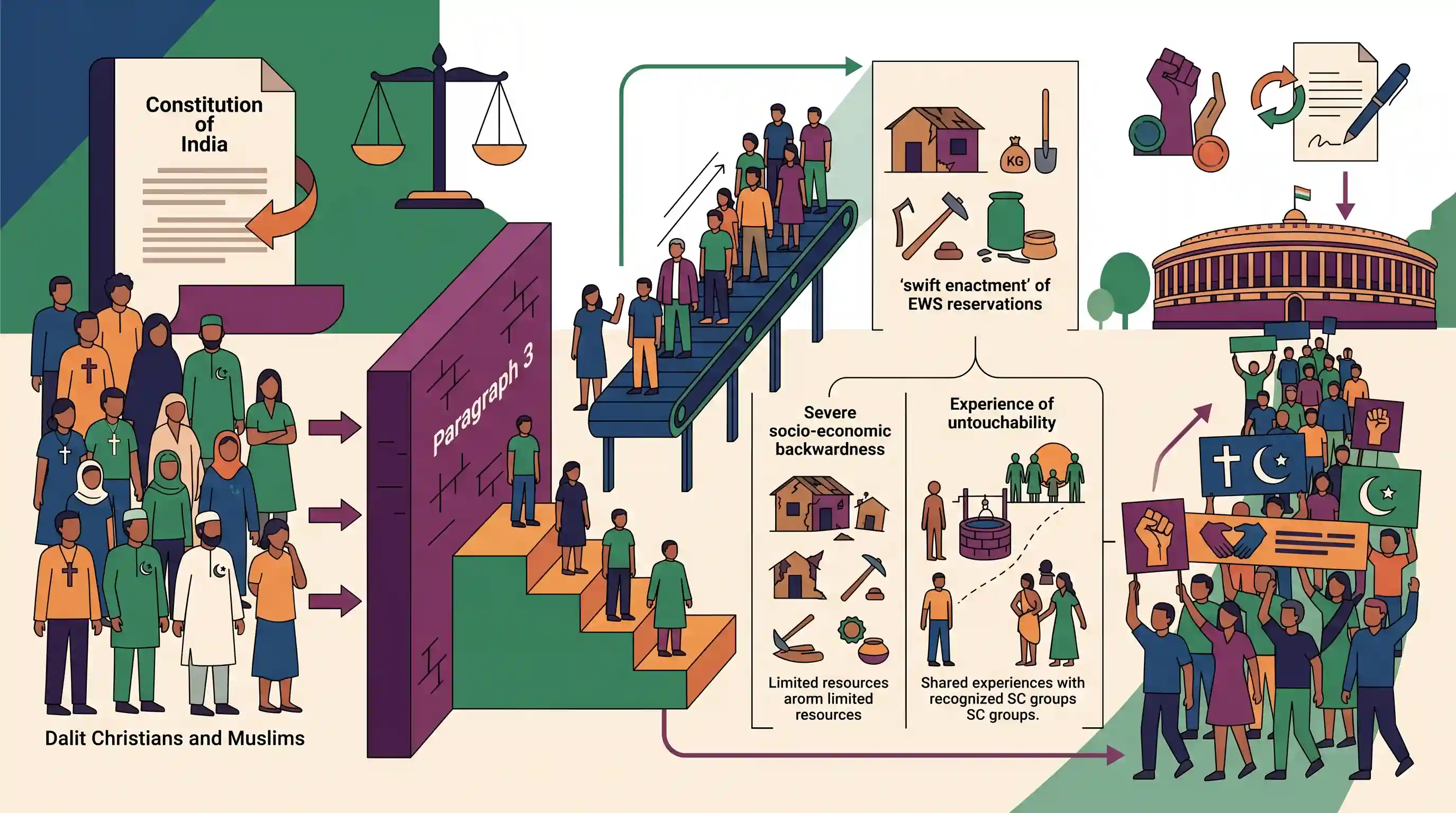
Representatives of the All India Bahujan Samaj Party (AIBSP), the Christian Coordination Council (CCC), and community leaders have intensified their demand for Scheduled Caste (SC) status for Dalit Christians in Andhra Pradesh. They argue that Dalit Christians continue to endure severe socio-economic backwardness and untouchability, yet are denied SC benefits solely because of religious conversion, owing to Paragraph 3 of the Constitution (Scheduled Castes) Order, 1950. Leaders criticized successive governments for swiftly enacting EWS reservations while ignoring the 74-year-old plight of Dalit Christians and Muslims. Community groups plan to mobilize politically, urging MPs and state parties to pressure the Centre for a constitutional amendment, including an upcoming 'Chalo Delhi' protest during the Parliament session.
Key Points
- Community groups and leaders in Andhra Pradesh are demanding Scheduled Caste (SC) status for Christians of Dalit origin, citing continuing untouchability and socio-economic exclusion.
- Under Paragraph 3 of the Constitution (Scheduled Castes) Order, 1950, SC status is currently restricted to individuals professing Hinduism, Sikhism, and Buddhism, excluding Muslims and Christians.
- Activists highlight a disparity in political will, noting that the 10% EWS reservation was rapidly implemented, while the 74-year-old demand for Dalit Christians remains unresolved.
- The community plans a statewide mobilization and a 'Chalo Delhi' agitation to press the central government and Parliament for a constitutional amendment.
Important Terms
Constitution (Scheduled Castes) Order, 1950

A Presidential order under Article 341 defining Scheduled Castes. Paragraph 3 restricts SC status to Hindus, Sikhs, and Buddhists, legally excluding Dalit Christians and Muslims from reservation benefits and Atrocities Act protections.
UPSC context
GS Paper 2 (Polity/Social Justice); Article 341, religious criteria in reservations, and recent Supreme Court challenges.
Economically Weaker Sections (EWS) reservation
A 10% quota for the poor in the 'General' category, introduced via the 103rd Constitutional Amendment (2019). It moved reservation criteria toward economic status rather than historical social backwardness.
UPSC context
GS Paper 2 (Constitution/Governance); 103rd Amendment, Indra Sawhney case, and basic structure doctrine.
Justice K.G. Balakrishnan Commission
A three-member panel appointed in 2022 to investigate the socio-economic status of Dalit converts to religions like Christianity and Islam to determine their eligibility for Scheduled Caste status.
UPSC context
GS Paper 2 (Governance); current-affairs relevance to executive commissions addressing long-standing reservation demands.
Ranganath Misra Commission
The 2007 report by the National Commission for Religious and Linguistic Minorities that recommended deleting Paragraph 3 of the 1950 Order to make SC status religion-neutral.
UPSC context
GS Paper 2 (Social Justice); key recommendations on minority rights and reservation policy reforms.
All India Bahujan Samaj Party (AIBSP)
A political faction in Andhra Pradesh advocating for 'Bahujan' (SC/ST/OBC/Minority) rights. It is currently leading protests to demand a constitutional amendment for Dalit Christian SC status.
UPSC context
GS Paper 2 (Polity); political mobilization and pressure group dynamics in regional social justice movements.
Christian Coordination Council (CCC)
An advocacy organization in Andhra Pradesh representing the interests of Christians of Dalit origin, coordinating political and legal pressure for reservation and constitutional parity.
UPSC context
GS Paper 2 (Social Justice/Polity); tests the role of civil society and religious minority interest groups.
Prelims Trap
"The President can amend the Scheduled Castes list to include Dalit Christians through an executive notification."
Under Article 341, the President issues the initial list, but any subsequent inclusions or exclusions can only be made by an Act of Parliament.
Static Concepts Connected
What is the constitutional procedure to modify the Scheduled Castes list?
- Initial Notification: The President issues the first SC list for a State or UT after consulting the Governor under Article 341.
- Parliamentary Power: Any subsequent modifications (inclusions or exclusions) to the Presidential order can only be enacted by Parliament via legislation.
How does religious eligibility differ for SC, ST, and OBC categories?
- SC Status: Restricted by the 1950 Order to individuals professing Hinduism, Sikhism (added 1956), and Buddhism (added 1990).
- ST and OBC: Completely religion-neutral. Persons of any faith, including Christianity and Islam, can claim ST or OBC status if they meet the backwardness criteria.
Cross-Topic Patterns
Freedom of Religion vs. Quotas
Tests the intersection of Article 25 (freedom to convert) and Article 15/16, questioning if changing faith legally erases historical caste disabilities like untouchability.
Balakrishnan & Ranganath Mishra Commissions
UPSC often compares contemporary committees (Balakrishnan on Dalit Christians) with historical ones (Mishra Commission, Sachar Committee) regarding the socio-economic status of religious minorities.

Expect a 2026 prelims question testing the religious neutrality of ST/OBCs versus SCs, paired with Parliament's powers under Article 341.
Linked PYQs · 3
Linked PYQs · 3
- 2018MainsGS2
Whether National Commission for Scheduled Castes (NCSC) can enforce the implementation of constitutional reservation for the Scheduled Castes in the religious minority institutions? Examine.
- 2023MainsGS2
“Development and welfare schemes for the vulnerable, by its nature, are discriminatory in approach.” Do you agree? Give reasons for your answer.
- 2024PrelimsGS1
Consider the following statements : 1. It is the Governor of the State who recognizes and declares any community of that State as a Scheduled Tribe. 2. A community declared as a Scheduled Tribe in a State need not be so in another State. Which of the statements given above is/are correct?
