SC ST Sub Classification and Creamy Layer Judicial Debate
Source:Indian Express ↗
ఇది ఎందుకు ముఖ్యం
It directly deals with the core constitutional debates on affirmative action, equality, social justice, and the evolving judicial interpretation of reservations for Scheduled Castes and Scheduled Tribes in India.
సారాంశం
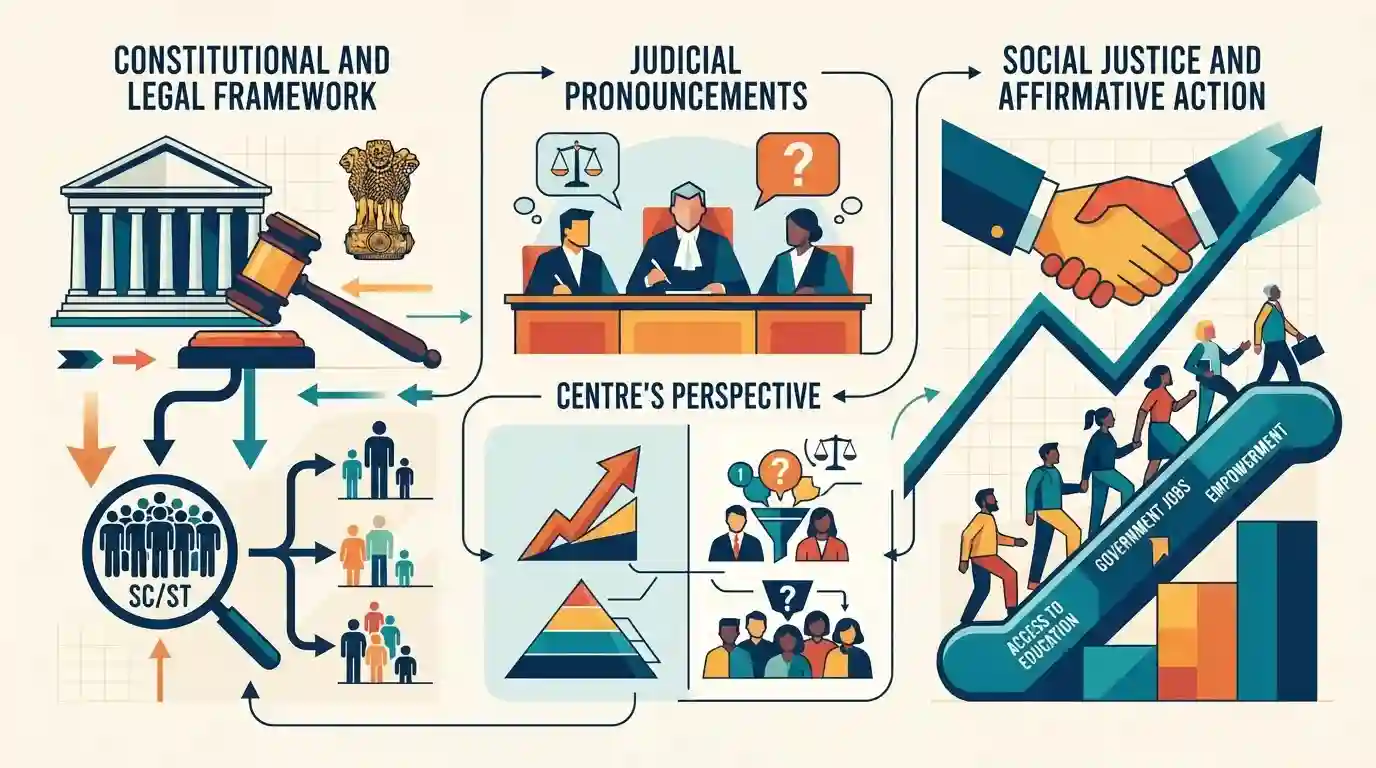
This article examines the ongoing legal, political, and social debates surrounding the Supreme Court's stance on sub-classification of SC/STs and the potential application of the 'creamy layer' principle to Scheduled Castes and Scheduled Tribes reservation, detailing the Centre's perspective and broader constitutional implications.
ముఖ్య అంశాలు
- The Supreme Court ruled that states have the power to sub-classify Scheduled Castes (SCs) and Scheduled Tribes (STs) to provide preferential treatment for the most backward among them.
- The judgment also discussed applying the concept of the 'creamy layer' to exclude the economically advanced members of SCs and STs from reservations.
- The Centre and various political stakeholders are reviewing the implications of implementing creamy layer criteria and sub-classification for SC/ST reservations.
- The debate highlights the balance between ensuring social justice through affirmative action and addressing internal inequalities within marginalized groups.
ముఖ్యమైన పదాలు
Creamy Layer

A judicial principle that excludes economically and socially advanced individuals or families within a reserved category from availing reservation benefits, originally established for OBCs under the Indra Sawhney judgment.
UPSC context
GS Paper II (Polity and Governance - Social Justice, Affirmative Action, Judicial Pronouncements). Essential for analyzing equality jurisprudence and reservation policies.
Supreme Court of India
The apex judicial body in India that interprets the Constitution, with the power of judicial review to check legislative and executive actions regarding fundamental rights and affirmative action.
UPSC context
GS Paper II (Indian Constitution - Features, Amendments, Significant Provisions, and Basic Structure). Tests understanding of separation of powers and judicial review.
Union Government
The executive branch of the Indian federal polity, comprising the Prime Minister and the Council of Ministers, responsible for policy formulation and defending legislative/constitutional intent before the courts.
UPSC context
GS Paper II (Governance, Federalism, and Executive-Judiciary Relations). Crucial for examining policy standpoints on contentious socio-legal issues like reservations.
ప్రిలిమ్స్ ఉచ్చు
The Supreme Court mandated the immediate application of the creamy layer principle and sub-classification for SC/ST reservations across all states and Union Territories.
Aspirants often confuse the Supreme Court's ruling on state legislative competence for sub-classification with a mandatory implementation of the creamy layer for SC/STs across all states.
అనుసంధానమైన స్థిర భావనలు
What is the constitutional basis and evolution of the 'creamy layer' principle in Indian reservations?
- Origin Judgment: It originated from the Indira Sawhney (1992) judgment, which upheld the 27% OBC reservation but mandated the exclusion of socially and economically advanced individuals.
- SC/ST Applicability: Unlike OBCs, the 1993 Supreme Court judgment in Jarnail Singh affirmed that the creamy layer concept applies to promotion reservations for SCs/STs, though original entry reservations lacked this explicit test until recent debates.
- Core Objective: It is designed to ensure that affirmative action benefits trickle down to the most marginalized sections within a designated reserved category rather than concentrating among a privileged few.
అంతర-అంశ నమూనాలు
Affirmative Action + Judicial Review + Federalism
The judicial introduction of economic criteria into caste-based affirmative action parallels the ongoing debate over the EWS quota and economic threshold testing in fundamental rights litigation.
Sub-classification + Centre-State Legislative Competence
State-level sub-classification of marginalized groups directly impacts cooperative and competitive federalism by altering state legislative competence over the Seventh Schedule lists.

SC/ST sub-classification and creamy layer exclusion will likely be tested via a statement-based question comparing OBC and SC/ST frameworks.
అనుసంధాన PYQలు · 2
అనుసంధాన PYQలు · 2
- 2018MainsGS2
Whether National Commission for Scheduled Castes (NCSC) can enforce the implementation of constitutional reservation for the Scheduled Castes in the religious minority institutions? Examine.
- 2024PrelimsGS1
Consider the following statements : 1. It is the Governor of the State who recognizes and declares any community of that State as a Scheduled Tribe. 2. A community declared as a Scheduled Tribe in a State need not be so in another State. Which of the statements given above is/are correct?
