Central Government Stance on Creamy Layer Exclusion for SC ST Quotas
Source:Indian Express ↗
हे का महत्त्वाचे आहे
This issue is critical as it defines the constitutional boundaries of affirmative action in India. It addresses the tension between judicial suggestions for reforming reservation policies (to avoid elite capture) and the executive/legislative view on historical caste discrimination as a structural issue distinct from economic wealth, reflecting crucial GS2 syllabus components on social justice, constitutional provisions, and the separation of powers.
सारांश
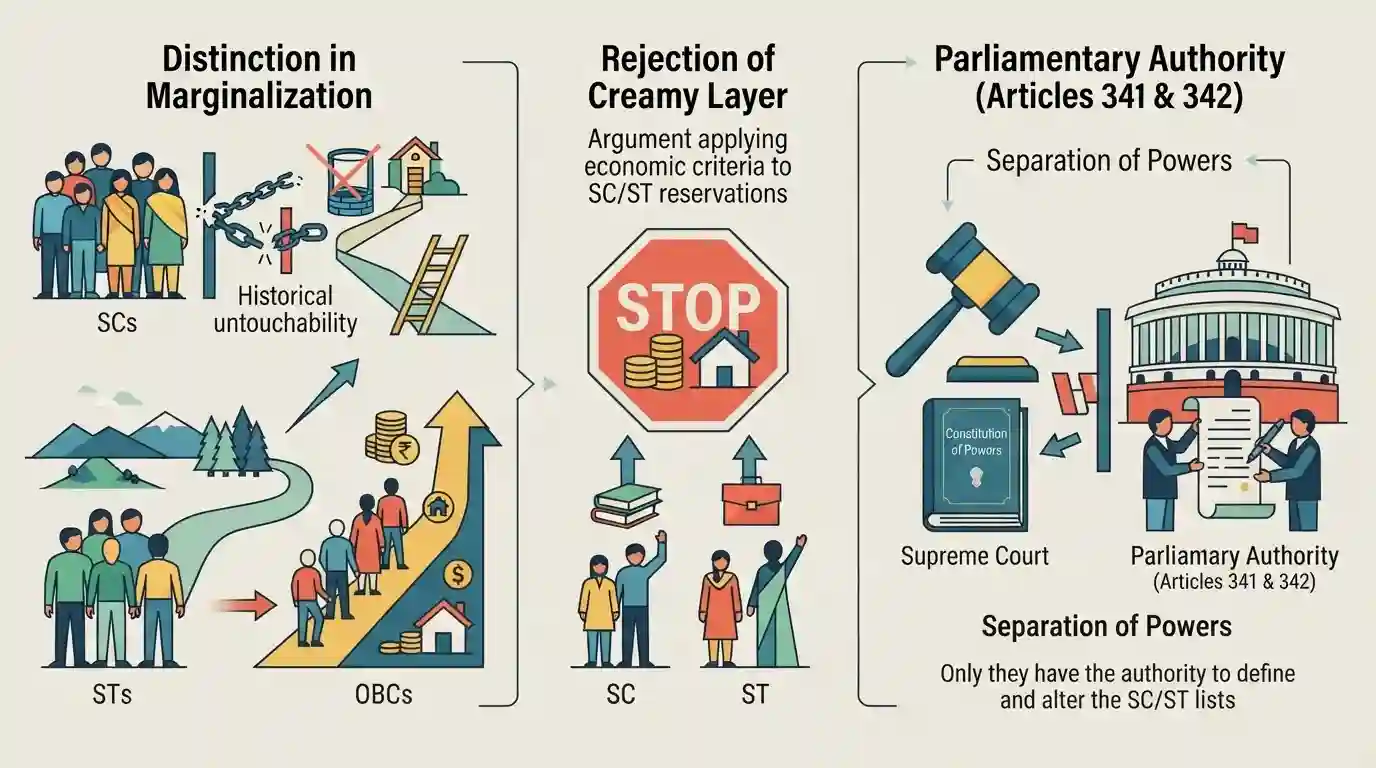
The Central government has filed an affidavit in the Supreme Court strongly opposing the extension of the 'creamy layer' concept to Scheduled Caste (SC) and Scheduled Tribe (ST) reservations. Arguing against a PIL inspired by the Supreme Court's August 2024 sub-classification judgment, the Centre asserted that the historical and structural marginalization of SCs (due to untouchability) and STs (due to geographical isolation) is fundamentally different from the socio-economic backwardness of OBCs. Therefore, economic status cannot be used to deny them reservation benefits. Furthermore, the Centre emphasized the separation of powers, noting that only Parliament holds the constitutional authority under Articles 341 and 342 to define and alter SC/ST lists.
मुख्य मुद्दे
- The Central Government filed an affidavit in the Supreme Court opposing the application of the 'creamy layer' concept to SC/ST reservations, distinguishing their social marginalization from OBCs.
- The Centre argues that Scheduled Castes face historical untouchability and Scheduled Tribes face geographical isolation and cultural distinctiveness, which are structural and do not disappear with economic advancement.
- This position was in response to a PIL by Ashwini Kumar Upadhyay, which cited the August 2024 SC judgment permitting sub-classification of SCs/STs where four of seven judges suggested extending the creamy layer concept to SC/STs.
- The Centre drew a stark legal and constitutional contrast between OBCs (identified under Article 340 for social and economic backwardness) and SC/STs (identified under Articles 341 and 342 based on historical and geographical criteria).
- The Centre asserted the principle of separation of powers, arguing that under Articles 341 and 342, only Parliament has the constitutional authority to alter, exclude, or modify the SC/ST lists.
- Past landmark rulings, including Indra Sawhney (1992) and Ashoka Kumar Thakur (2008), explicitly excluded SC/STs from the creamy layer restriction applied to OBCs.
महत्त्वाच्या संज्ञा
Article 341

A constitutional provision empowering the President to officially notify specific castes or tribes as Scheduled Castes for a State or UT. Once notified, only Parliament can modify this list through legislation.
UPSC context
Crucial for GS Paper 2 (Polity); tests the separation of powers regarding reservation policies and legislative authority.
Article 342
Empowers the President to publicly notify specific tribes or tribal communities as Scheduled Tribes for a State or UT. Subsequent inclusions or exclusions from this list can only be made by an Act of Parliament.
UPSC context
Important for GS Paper 2 (Indian Constitution); tests the mechanisms of affirmative action, legislative oversight, and tribal safeguards.
Indra Sawhney v. Union of India (1992)
A landmark Supreme Court judgment upholding 27% reservation for Other Backward Classes. It introduced the "creamy layer" principle to exclude affluent OBCs, but explicitly ruled that this exclusion does not apply to SCs or STs.
UPSC context
Highly relevant for GS Paper 2 (Social Justice); foundational for understanding India's affirmative action architecture and equality jurisprudence.
E.V. Chinnaiah v. State of Andhra Pradesh (2004)
A Supreme Court verdict holding that Scheduled Castes form a homogeneous constitutional class under Article 341, prohibiting states from creating sub-classifications for quota benefits. This judgment was recently overruled by a larger bench in 2024.
UPSC context
Essential for GS Paper 2 (Polity); frequently tested regarding federalism, state powers in reservation policies, and judicial review.
Article 340
A constitutional provision authorizing the President to appoint a commission to investigate the conditions of socially and educationally backward classes and recommend measures for their advancement, laying the groundwork for OBC reservations.
UPSC context
Vital for GS Paper 2 (Polity/Social Justice); highlights the constitutional distinction between Other Backward Classes and SCs/STs.
पूर्वपरीक्षा सापळा
"The President can amend or modify the Scheduled Castes list via subsequent notification."
While the President issues the initial notification specifying SCs/STs for a State, any subsequent inclusion or exclusion can ONLY be done by Parliament via legislation.
संबंधित स्थिर संकल्पना
How are Scheduled Castes and Scheduled Tribes notified under the Constitution?
- Presidential Notification: The President issues the initial list of SCs and STs for a State or UT after consulting the respective Governor.
- Parliamentary Supremacy: Under Articles 341(2) and 342(2), only Parliament, through legislation, can include or exclude any caste/tribe from this initial list.
- State Limitation: State legislatures and State governments have no constitutional power to modify the SC/ST lists.
How did the 'Creamy Layer' concept evolve in Indian reservation jurisprudence?
- Origin (1992): Introduced by the Supreme Court in the Indra Sawhney case (1992) to exclude socio-economically advanced members of Other Backward Classes (OBCs).
- SC/ST Exemption: In Ashoka Kumar Thakur (2008), the Supreme Court explicitly clarified that the creamy layer doctrine applies only to OBCs, not SCs/STs.
- Underlying Rationale: SC/ST marginalization is considered structural (untouchability/geographical isolation), whereas OBC backwardness is primarily social and educational.
आंतर-विषय नमुने
Sub-classification vs. Creamy Layer
While the Supreme Court recently allowed States to sub-classify SCs for targeted internal quotas, the Centre maintains that outright exclusion (creamy layer) violates Parliament's exclusive domain over SC/ST lists.
Separation of Powers in Quotas
This issue links judicial review with legislative supremacy. Courts can rule on quota ceilings (e.g., 50% limit), but altering beneficiary boundaries under Articles 341/342 remains strictly Parliament's domain.

Expect Prelims statements contrasting States' new power to sub-classify SCs with Parliament's exclusive power to amend Art 341/342 lists.
संबंधित PYQ · 3
संबंधित PYQ · 3
- 2018MainsGS2
Whether National Commission for Scheduled Castes (NCSC) can enforce the implementation of constitutional reservation for the Scheduled Castes in the religious minority institutions? Examine.
- 2026PrelimsGS1
Consider the following statements about the provisions pertaining to the Scheduled Castes and the Scheduled Tribes in India : 1. Provisions regarding the administration of the Tribal Areas in the States of Assam, Meghalaya, Tripura and Mizoram are given in the Fifth Schedule of the Constitution of India. 2. Some tribes of India are entitled to exemption from paying Income Tax on certain incomes. 3. The Constitution of India provides for reservation of seats in Panchayats for women belonging to the Scheduled Castes and the Scheduled Tribes. Which one of the following conclusions based on the above statements is correct ?
- 2026PrelimsGS1
Consider the following statements about the Committee on the Welfare of Scheduled Castes and Scheduled Tribes of the Parliament of India : 1. Although members of this Committee are elected from both Houses of Parliament, the Chairperson of this Committee is appointed by the Chairman of the Rajya Sabha. 2. Twenty members are elected by the Rajya Sabha and ten members by the Lok Sabha. 3. No Minister, except for the Union Minister of Social Justice and Empowerment, is eligible to be a member of this Committee. 4. Members are elected for a fixed term of two years from the date they enter their office. Which one of the following conclusions based on the above statements is correct ?
