Judicial Critique of Electoral Freebies and State Finances
Source:The Hindu ↗
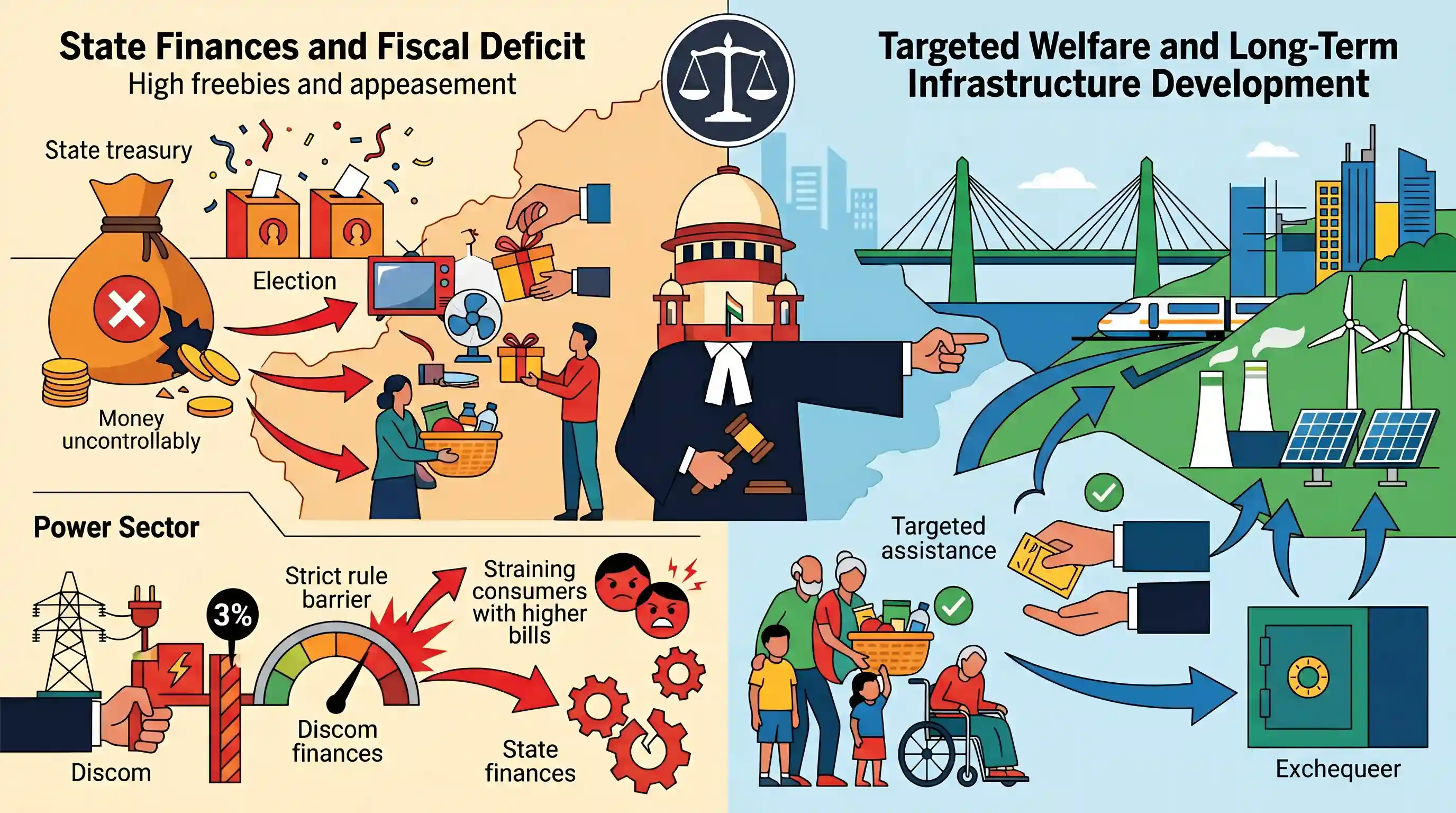
Why It Matters
The ongoing judicial and political debate over electoral freebies versus genuine welfare is a high-yield topic for UPSC. This article connects the political issue of populism directly with its economic consequences on State exchequers and the crippling debts of state-owned power distribution companies (Discoms), providing excellent fodder for answers on fiscal prudence and governance.
Summary
The Supreme Court rebuked State governments for indulging in indiscriminate "freebie" distribution and appeasement politics ahead of elections, despite running on huge revenue deficits. The observations came during a hearing where Tamil Nadu Power Distribution Corporation Limited (TNPDCL) challenged Rule 23 of the Electricity (Amendment) Act, 2024. The rule limits the gap between a discom's approved revenue requirement and estimated tariff revenue to just 3%, which states argue would cause massive consumer tariff shocks or cripple state finances. The Court emphasized that while supporting the marginalized is a fundamental duty, irrational largesse to the affluent drains the exchequer and compromises long-term infrastructure and welfare investments.
Key Points
- The Supreme Court criticized State governments for distributing irrational electoral freebies while running massive revenue deficits, warning that such appeasement hampers economic development.
- The bench heard a petition by TNPDCL challenging Rule 23 of the Electricity (Amendment) Act, 2024, which seeks to limit the revenue-expenditure gap of discoms to 3%.
- TNPDCL argued that enforcing Rule 23 would put an unsustainable strain on state finances and lead to an exponential tariff shock for electricity consumers.
- Chief Justice Surya Kant suggested that States should earmark at least 25% of their annual revenue exclusively for infrastructure and capital expenditure like roads, schools, and hospitals rather than short-sighted populism.
Important Terms
Electricity (Amendment) Rules, 2024

A set of central regulations mandating that electricity tariffs be cost-reflective, limiting the gap between a DISCOM's revenue requirement and actual revenue to 3%.
UPSC context
GS-III: Infrastructure (Energy). Tests knowledge of power sector reforms aimed at improving DISCOM financial health and reducing fiscal burdens.
Rule 23 (Electricity Rules)
A specific provision under the 2024 Rules that prohibits large gaps between power procurement costs and consumer tariffs, forcing states to reduce subsidies or hike rates.
UPSC context
GS-II: Statutory Bodies/Regulations. Relevant for analyzing center-state relations in the concurrent subject of electricity and regulatory overreach.
Electricity (Late Payment Surcharge) Rules, 2022
Regulations requiring DISCOMs to pay timely surcharges to power generators, aimed at clearing massive legacy dues and maintaining liquidity in the energy value chain.
UPSC context
GS-III: Economic Development. Tests understanding of structural reforms to address the "missing middle" of power sector finance.
Electoral Freebies
Often called 'Revdi culture', these are poll-eve promises of free goods/services (e.g., electricity, cash) that are not targeted at specific welfare outcomes and strain state exchequers.
UPSC context
GS-II/IV: Governance and Ethics. Tests the balance between populist politics, fiscal responsibility, and genuine welfare (Article 38).
TNPDCL
A state-owned utility responsible for power distribution in Tamil Nadu; it recently challenged central pricing rules in the Supreme Court citing consumer tariff shock.
UPSC context
GS-III: Energy Sector. Case study for the financial distress of state DISCOMs and their legal battles with central mandates.
Cost-Reflective Tariff
A pricing mechanism where electricity rates are determined based on the actual cost of generation, transmission, and distribution, excluding hidden subsidies or political capping.
UPSC context
GS-III: Infrastructure. Key concept in economic reforms to ensure sustainability of public utilities and attracting private investment.
Revenue Deficit
The excess of a government's total revenue expenditure over its total revenue receipts, indicating that the government is borrowing to meet day-to-day consumption needs.
UPSC context
GS-III: Indian Economy (Fiscal Policy). Essential for analyzing the fiscal health of states providing universal subsidies.
Prelims Trap
The Representation of the People Act, 1951 explicitly defines 'freebies' and makes promising them a corrupt electoral practice.
Neither the RPA nor the Constitution defines 'freebies'. The SC has previously held (Subramaniam Balaji case) that manifesto promises are not 'corrupt practices'.
Static Concepts Connected
What distinguishes a 'welfare measure' from an 'irrational freebie' in UPSC terms?
- Constitutional Backing: Welfare fulfills Directive Principles (Articles 38, 39, 41) like health and education. Freebies generally lack direct DPSP backing.
- Target Audience: Welfare is typically means-tested for the marginalized. Freebies (like universal free electricity) are often untargeted largesse given to all demographics.
- Fiscal Outcome: Welfare builds long-term human capital. Freebies drive up state revenue deficits without generating significant economic multiplier effects.
How do State Power Discoms measure their operational and financial inefficiencies?
- ACS-ARR Gap: The persistent shortfall between the Average Cost of Supply and the Average Revenue Realised per unit of electricity.
- Regulatory Assets: Discoms recording unrecovered costs (from delayed tariff hikes) as future receivables, artificially inflating their balance sheets over time.
- Cross-Subsidization: Industrial and commercial consumers pay higher tariffs to offset the free or subsidized power distributed to domestic and agricultural users.
Cross-Topic Patterns
Freebies + Article 293 borrowing limits
States funding freebies via off-budget borrowings often face strict borrowing caps under Article 293, leading to severe Centre-State fiscal federalism disputes.
Untargeted power + Groundwater depletion
Unmetered free agricultural electricity disincentivizes water conservation, linking state fiscal populism directly to India's severe groundwater crisis in the Northwest and South.

A GS-2 mains question linking the 'freebies' debate directly to State Discom losses (ACS-ARR gap) and FRBM constraints is highly likely.
Linked PYQs · 4
Linked PYQs · 4
- 2023MainsGS2
“Development and welfare schemes for the vulnerable, by its nature, are discriminatory in approach.” Do you agree? Give reasons for your answer.
- 2025MainsGS3
Explain how the Fiscal Health Index (FHI) can be used as a tool for assessing the fiscal performance of states in India. In what way would it encourage the states to adopt prudent and sustainable fiscal policies?
- 2021MainsGS3
Distinguish between Capital Budget and Revenue Budget. Explain the components of both these Budgets.
- 2015MainsGS3
In what way could replacement of price subsidy with Direct Benefit Transfer (DBT) change the scenario of subsidies in India ? Discuss.
