Supreme Court Criticizes Electoral Freebies and State Fiscal Deficits
Source:The Hindu ↗
Why It Matters
The debate over "freebies vs. welfare" is a highly relevant contemporary issue in Indian polity and governance. The Supreme Court's observations highlight the tension between electoral politics, state fiscal health, and the constitutional separation of powers where the judiciary must balance judicial review with the executive's policy-making domain.
Summary
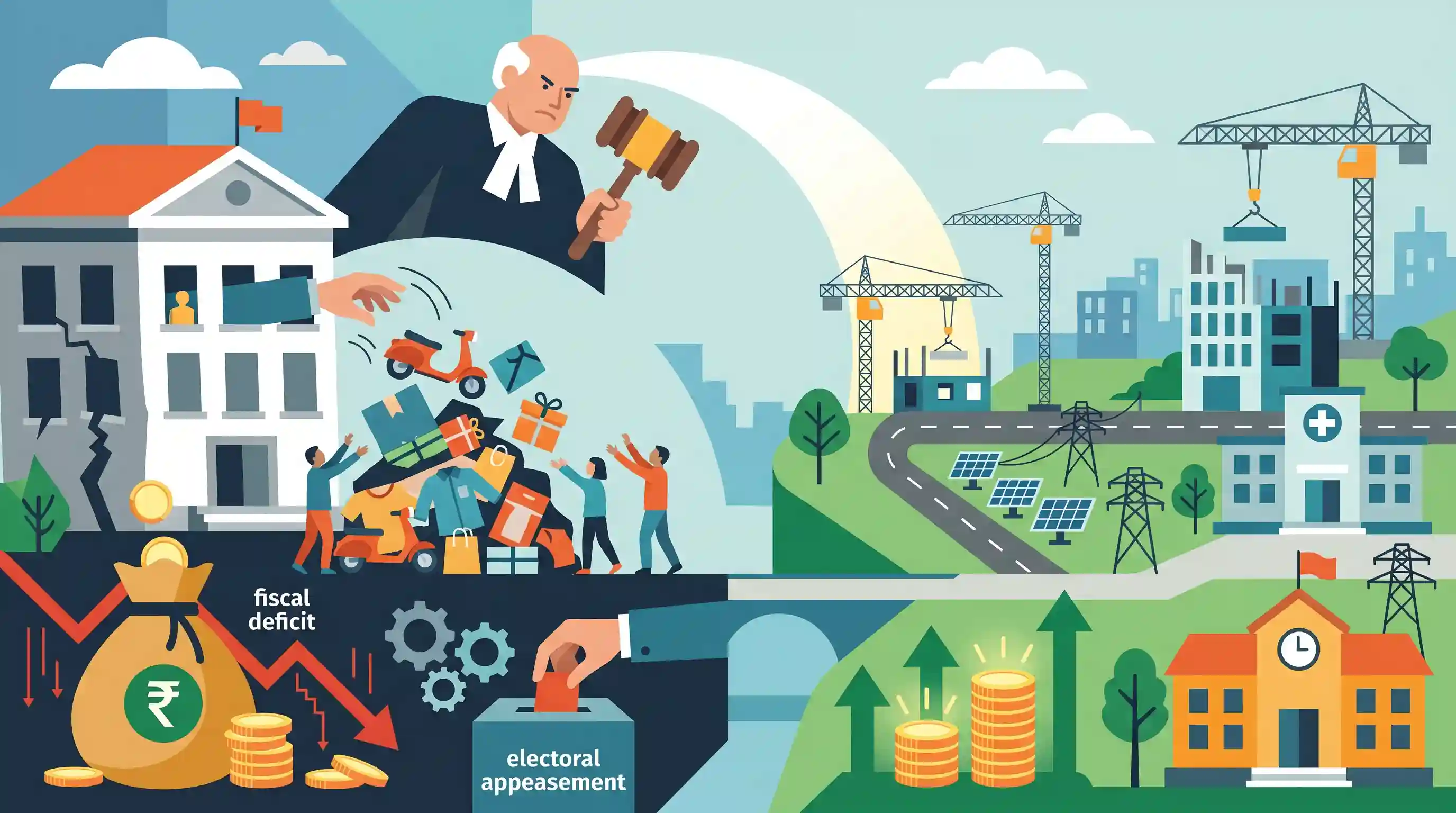
The Supreme Court has sharply criticized the growing "freebie culture" among State governments, urging a shift in focus from short-term electoral "appeasement" to sustainable long-term infrastructure and welfare investments. A three-judge Bench led by Chief Justice Surya Kant observed that states, many of which are running fiscal deficits, should prioritize spending on roads, hospitals, and schools rather than distributing irrational largesse like scooters and clothing. The observations were made during a hearing on a petition by the Tamil Nadu Power Distribution Corporation Limited (TNPDCL) challenging Rule 23 of the Electricity (Amendment) Act, 2024. The rule mandates a narrow 3% gap between a power utility's revenue requirement and its estimated revenue, which TNPDCL argued would cause significant tariff shocks and burden the state's finances. The Court maintained that while targeted welfare for the vulnerable is essential, broad-based freebies that reach affluent groups undermine fiscal prudence and economic development.
Key Points
- The Supreme Court criticized the indiscriminate distribution of freebies by State governments ahead of elections, calling it an "appeasement" policy that strains the public exchequer.
- The Court emphasized the need for fiscal prudence, stating that public funds should be prioritized for building infrastructure like roads, hospitals, and schools, rather than irrational largesse.
- The bench was hearing a petition from TNPDCL challenging Rule 23 of the Electricity (Amendment) Act, 2024, which limits the revenue-expenditure gap to 3%, potentially leading to an "exponential tariff shock".
- While acknowledging the state's fundamental duty to provide essential welfare to the vulnerable and underprivileged, the SC questioned the distribution of freebies to affluent sections.
- The Court ultimately noted that the purpose and delivery of welfare schemes fall under the domain of political wisdom and the elected executive, reflecting the separation of powers.
Important Terms
Freebies (Irrational Largesse)

State-funded goods or services provided free or at low cost, often for electoral gain, without specific targeting of the poor or clear budgetary provisions.
UPSC context
GS Paper-II/III: Governance and Economy; relates to welfare vs. populism, fiscal deficit, and judicial intervention in policy.
Rule 23, Electricity (Amendment) Rules, 2024
A 2024 central regulation requiring electricity tariffs to reflect actual costs, limiting the revenue gap between utility costs and income to 3%.
UPSC context
GS Paper-III: Infrastructure (Energy); tests understanding of power sector reforms, DISCOM financial health, and center-state regulatory relations.
Cost-Reflective Tariffs
A pricing mechanism where the consumer price of power equals the total cost of generation, transmission, and distribution, ensuring utility financial sustainability.
UPSC context
GS Paper-III: Infrastructure and Economic Development; crucial for reducing DISCOM losses and managing subsidies.
Revenue Deficit
Occurs when a government's total revenue expenditure (salaries, subsidies, interest) exceeds its total revenue receipts; a key indicator of state financial health.
UPSC context
GS Paper-III: Indian Economy and Fiscal Policy; tests knowledge of fiscal health and state-level financial management.
Fiscal Prudence
The practice of managing government finances through balanced spending and borrowing to ensure long-term economic stability and debt sustainability.
UPSC context
GS Paper-III: Budgeting and Fiscal Management; relevant to the FRBM Act and sustainable development.
Electricity (Late Payment Surcharge and Related Matters) Rules, 2022
Regulations introduced in 2022 to ensure timely payments by DISCOMs to power generators through surcharges and mandated payment security mechanisms.
UPSC context
GS Paper-III: Energy Sector Reforms; focuses on addressing the "vicious cycle" of debt in India's power value chain.
Tamil Nadu Power Distribution Corporation Limited (TNPDCL)
A state-owned utility responsible for power distribution in Tamil Nadu; the lead petitioner challenging federal electricity rules in the Supreme Court.
UPSC context
GS Paper-II: Federalism; represents the conflict between central regulatory mandates and state-level social welfare priorities.
Prelims Trap
The Supreme Court has empowered the ECI to deregister political parties promising irrational freebies in their election manifestos.
The SC explicitly upheld the separation of powers, noting welfare design remains the domain of the elected executive. The ECI cannot currently deregister parties for manifesto promises.
Static Concepts Connected
What constitutes a 'corrupt practice' regarding electoral promises under the RPA, 1951?
- Section 123: Section 123 defines corrupt practices, which include bribery and undue influence to manipulate voter choice.
- Balaji Ruling (2013): The 2013 S. Subramaniam Balaji judgment ruled that promising freebies in an election manifesto does not legally constitute a 'corrupt practice' directed at individuals.
- DPSP Defense: Political parties routinely defend such manifesto promises as valid expressions of fulfilling Directive Principles of State Policy (Article 38).
How are State government borrowings and fiscal deficits structurally regulated?
- Article 293(3): States require the Union government's consent to raise fresh loans if any previous Central loan or guarantee remains outstanding.
- Borrowing Ceilings: The Centre sets an annual Net Borrowing Ceiling (usually 3-3.5% of GSDP) based on Finance Commission guidelines and state-level FRBM Acts.
- Off-Budget Liabilities: Loans and guarantees given to state-owned SPVs and DISCOMs are increasingly being counted within the state's overall debt limits to enforce fiscal discipline.
Cross-Topic Patterns
DISCOM Debts + Subnational Borrowing
The struggle to fund free electricity promises forces states to rely on off-budget borrowing via DISCOMs, triggering central fiscal interventions under Article 293.
Welfare vs. Appeasement Debate
Mains questions frequently ask aspirants to conceptually distinguish between 'merit goods' (education/health) and 'non-merit goods' (scooters/TVs) in the context of DPSPs and macroeconomic stability.

Expect a multi-statement Prelims question blending RPA 1951 'corrupt practices' clauses with Article 293 restrictions on State borrowings.
Linked PYQs · 5
Linked PYQs · 5
- 2022MainsGS2
Besides the welfare schemes, India needs deft management of inflation and unemployment to serve the poor and the underprivileged sections of the society. Discuss.
- 2023MainsGS2
“Development and welfare schemes for the vulnerable, by its nature, are discriminatory in approach.” Do you agree? Give reasons for your answer.
- 2019MainsGS2
Performance of welfare schemes that are implemented for vulnerable sections is not so effective due to absence of their awareness and active involvement at all stages of policy process. Discuss.
- 2025MainsGS3
Explain how the Fiscal Health Index (FHI) can be used as a tool for assessing the fiscal performance of states in India. In what way would it encourage the states to adopt prudent and sustainable fiscal policies?
- 2020MainsGS2
Judicial Legislation is antithetical to the doctrine of separation of powers as envisaged in the Indian Constitution. In this context justify the filing of large number of public interest petitions praying for issuing guidelines to executive authorities.
