Judicial Reforms and High Court Judgment Pronouncement Deadlines
Source:The Hindu ↗
Why It Matters
The ruling directly addresses the chronic problem of delayed judgments and the plight of undertrials in India. It is highly relevant for GS2 Polity questions on judicial reforms, the right to speedy trial (Article 21), bail jurisprudence, and the Supreme Court's supervisory role over the administration of High Courts.
Summary
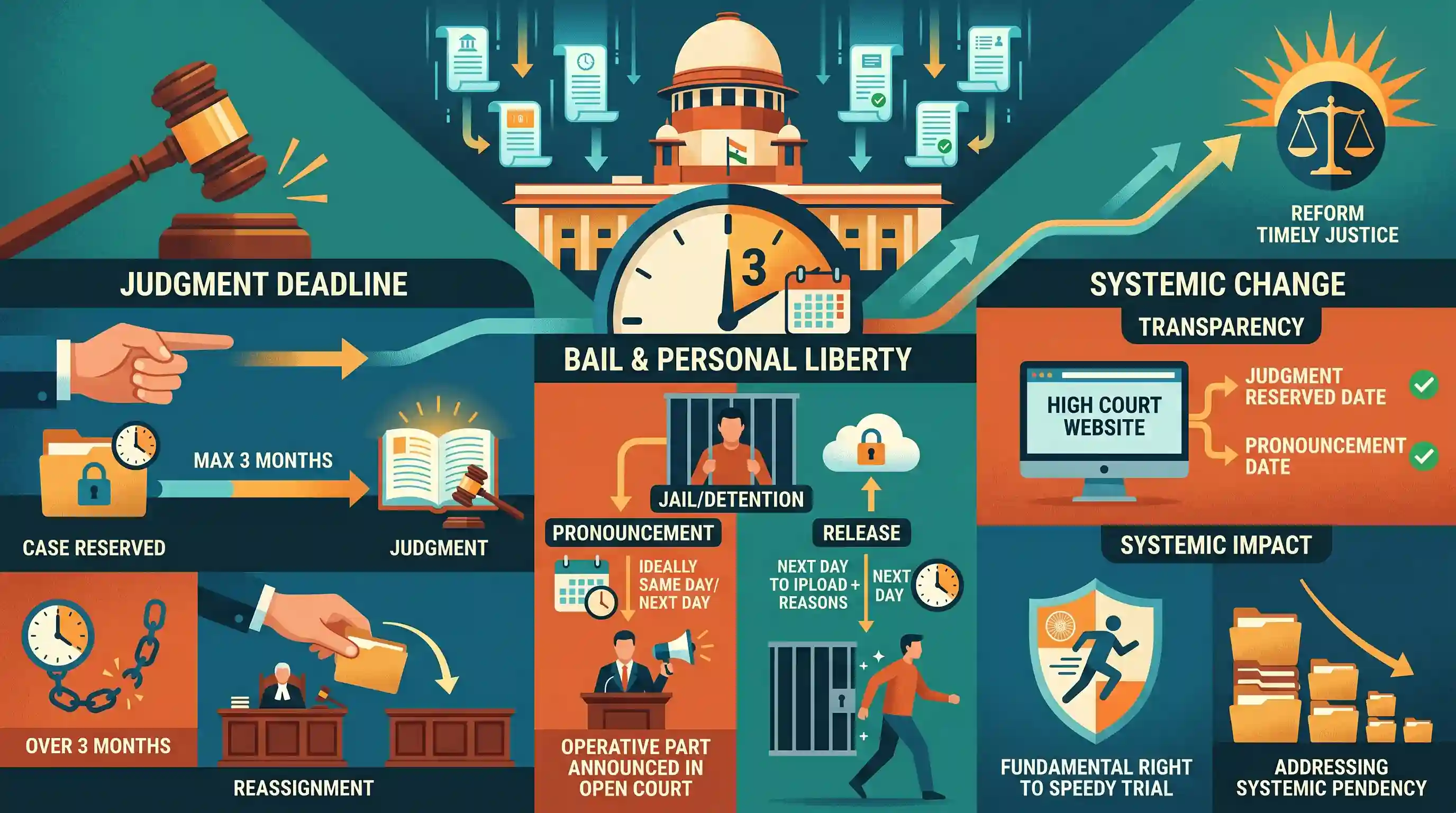
The Supreme Court has issued strict guidelines to curb judicial delays in High Courts, setting a mandatory three-month deadline for pronouncing judgments after a case is reserved. A Bench headed by Justice Surya Kant emphasized that bail orders should ideally be pronounced by the next day, with the operative part announced in open court. Reasons for bail must be uploaded within a week, ensuring undertrials are released from jail either the same or the next day. To improve transparency, High Court websites must now reflect the exact dates judgments are reserved. If a Bench fails to meet the three-month deadline, the case should be reassigned. This ruling aims to protect the fundamental right to a speedy trial and address the systemic issue of judicial pendency.
Key Points
- The Supreme Court set a strict three-month limit for High Courts to pronounce judgments after reserving a case.
- Bail orders should ideally be pronounced the next day, with the operative portion announced in open court and reasons published within a week.
- Undertrials granted bail must be released from jail on the same day or the following day.
- High Court websites must transparently show the date when a judgment is reserved.
- If the three-month deadline is missed, the Chief Justice of the High Court should allocate the case to another Bench.
Important Terms
Supreme Court of India

The apex judicial body of India established under Article 124, serving as the final interpreter of the Constitution and the highest court of appeal.
UPSC context
GS Paper II: Judiciary. Key for understanding judicial activism, constitutional interpretation, and the enforcement of Fundamental Rights.
High Courts
The highest judicial authority in a state or group of states, established under Article 214, possessing significant writ jurisdiction under Article 226.
UPSC context
GS Paper II: Judiciary. Relevant for state-level judicial administration and the hierarchy of the Indian legal system.
Judicial Pendency
The backlog of unresolved legal cases within the court system, often cited as a major barrier to the timely delivery of justice.
UPSC context
GS Paper II: Governance/Judiciary. A critical issue concerning judicial efficiency, reforms, and the 'Right to Speedy Trial'.
Right to Speedy Trial
A fundamental right interpreted under Article 21, ensuring that an accused person is tried within a reasonable time to prevent prolonged detention without conviction.
UPSC context
GS Paper II: Fundamental Rights. Tests the application of Article 21 and judicial guidelines to protect personal liberty.
Reserving Judgment
The judicial act of concluding hearings but postponing the announcement of the final verdict to allow time for deliberation and drafting.
UPSC context
GS Paper II: Judiciary. Important for discussing procedural reforms aimed at reducing delays in judgment delivery.
Undertrials
Persons who are in judicial custody while their case is still being tried in a court of law, often facing long periods of incarceration.
UPSC context
GS Paper II: Criminal Justice System. Central to discussions on bail reform, prison overcrowding, and human rights.
Article 21
A fundamental article of the Indian Constitution protecting life and personal liberty, which serves as the basis for numerous derived rights.
UPSC context
GS Paper II: Polity. The most vital article for UPSC, frequently linked to judicial overreach and individual freedoms.
Prelims Trap
The Constitution sets a strict three-month deadline for High Courts to pronounce judgments after reserving a case.
The Constitution does not specify time limits for judgments. This 3-month deadline is a judicial guideline set by the Supreme Court, not a constitutional mandate.
Static Concepts Connected
What is the "Master of the Roster" system in Indian High Courts?
- Administrative control: The Chief Justice of the High Court has the exclusive prerogative to constitute Benches and allocate cases to different judges.
- Reassignment power: Under the new SC guidelines, the Chief Justice exercises this power to reallocate a case to another Bench if the 3-month deadline is missed.
- Restriction on judges: Puisne (other) judges cannot suo motu take up cases or allocate matters to themselves unless assigned by the Chief Justice.
How is the Right to Speedy Trial protected under the Indian Constitution?
- Implicit in Article 21: It is not explicitly written but has been interpreted by the Supreme Court as an integral part of the Right to Life and Personal Liberty.
- Hussainara Khatoon case: The landmark Hussainara Khatoon v. Home Secretary, State of Bihar (1979) case firmly established speedy trial as a fundamental right.
- Broad applicability: The right spans all stages of the criminal justice process, including police investigation, inquiry, trial, appeal, and retrial.
Cross-Topic Patterns
Prison overcrowding and Bail Guidelines
Speedy bail pronouncements directly address prison overcrowding, linking judicial pendency with NCRB prison statistics where over 75% of Indian inmates remain undertrials.
E-Courts phase III and Digital Transparency
Mandating HC websites to display 'judgment reserved' dates aligns with the E-Courts Phase III objective of maximizing digital transparency and creating citizen-centric judicial dashboards.

Prelims 2026 may test implicit rights under Article 21, specifically pairing the Right to Speedy Trial with recent SC bail guidelines.
Linked PYQs · 2
Linked PYQs · 2
- 2021PrelimsGS1
With reference to India, consider the following statements : 1. Judicial custody means an accused is in the custody of the concerned magistrate and such accused is locked up in police station, not in jail. 2. During judicial custody, the police officer in charge of the case is not allowed to interrogate the suspect without the approval of the court. Which of the statements given above is/are correct?
- 2023PrelimsGS1
In essence, what does 'Due Process of Law' mean?
