Lokpal Jurisdiction and Judicial Accountability Constitutional Debate
Source:The Hindu ↗
Why It Matters
This case brings to the forefront the foundational constitutional debate balancing judicial independence with anti-corruption accountability. It is highly relevant for GS-2 Polity as it questions the limits of the Lokpal's statutory jurisdiction over constitutional functionaries and explores the historical origins of High Courts in India.
Summary
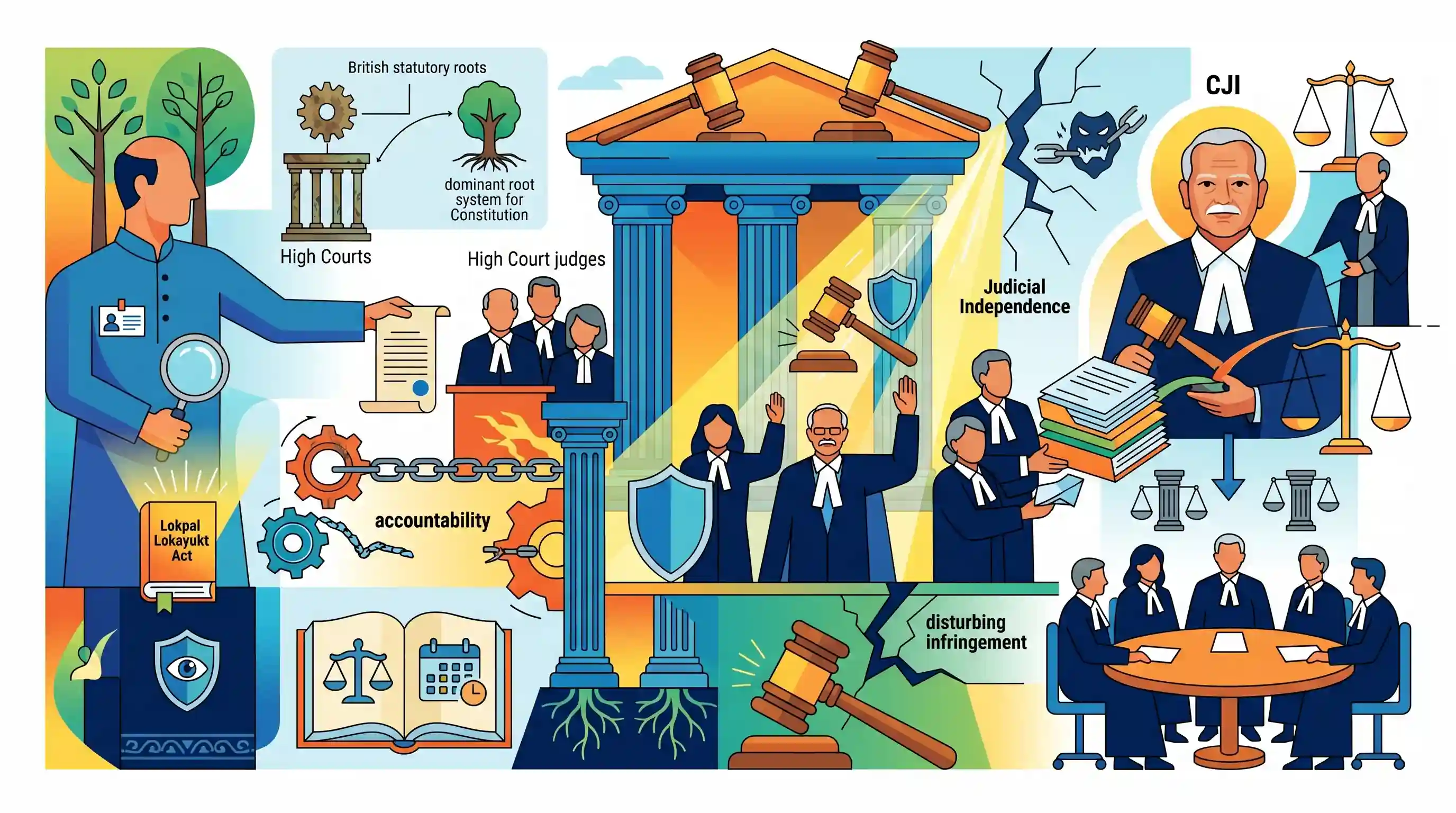
The Supreme Court has transferred a suo motu case concerning the Lokpal's jurisdiction to entertain complaints against serving High Court judges back to the Chief Justice of India to constitute a fresh Bench. Previously, a Special Bench had stayed a Lokpal order asserting such jurisdiction, describing it as a "disturbing" infringement on judicial independence. The Lokpal had argued that High Court judges qualify as "public servants" under the Lokpal and Lokayuktas Act, 2013, asserting that High Courts were originally established by British-era Acts of Parliament rather than being purely constitutional bodies.
Key Points
- The Supreme Court referred a suo motu case on whether the Lokpal can examine complaints against serving High Court judges to the Chief Justice of India for reassignment to a new Bench.
- The Lokpal assumed jurisdiction over HC judges in January, concluding they are "public servants" under the Lokpal and Lokayuktas Act, 2013.
- The Lokpal contended that High Courts were established by British parliamentary Acts (1861, 1935) rather than directly by the Constitution, which only "intrinsically recognises" them under Article 214.
- The Supreme Court had earlier stayed the Lokpal's order, citing concerns that subjecting constitutional courts to a statutory ombudsman threatens judicial independence.
- The issue highlights the constitutional tension between ensuring judicial accountability and maintaining the independence of the higher judiciary.
Important Terms
Lokpal

The national anti-corruption ombudsman established to investigate allegations of corruption against public officials, including the Prime Minister (with exceptions) and Union Ministers.
UPSC context
GS Paper II: Important aspects of governance, transparency, and accountability; statutory bodies.
Lokpal and Lokayuktas Act, 2013
The legislation enacted to establish an anti-corruption ombudsman at the Union (Lokpal) and State (Lokayuktas) levels to combat corruption in public administration.
UPSC context
GS Paper II: Statutory, regulatory and various quasi-judicial bodies; anti-corruption laws.
Judicial Independence
A fundamental constitutional principle ensuring that the judiciary is free from influence or control by the executive and legislative branches of government.
UPSC context
GS Paper II: Structure, organization and functioning of the Judiciary; Basic Structure doctrine.
Indian High Courts Act, 1861
A 1861 British parliamentary statute that abolished the Sadr Adalats and established the first three High Courts in Calcutta, Madras, and Bombay.
UPSC context
GS Paper I: Modern Indian History; GS Paper II: Historical underpinnings of the Indian Constitution.
Constitutional Body
An institution established and empowered directly by the Constitution of India, such as the Supreme Court (Art. 124) and High Courts (Art. 214).
UPSC context
GS Paper II: Comparison of the Indian constitutional scheme with that of other countries; Constitutional bodies.
Public Servant
A person in the service or pay of the government or remunerated by fees for public duties; currently central to debates on judicial accountability.
UPSC context
GS Paper II: Role of civil services in a democracy; Prevention of Corruption Act.
Prelims Trap
"Serving High Court judges fall under the definition of 'public servants' investigated by the Lokpal."
Aspirants may assume anti-corruption laws cover all state actors. However, higher judiciary accountability is strictly governed by Articles 124/217 and the Judges (Inquiry) Act, 1968, to protect independence.
Static Concepts Connected
What is the defined jurisdiction of the Lokpal at the Centre?
- Executive & Legislature: Covers the Prime Minister (with specific safeguards against foreign affairs/security probes), Union Ministers, and Members of Parliament.
- Bureaucracy: Encompasses Groups A, B, C, and D officers and officials of the Central Government.
- Aided Entities: Applies to directors and officers of boards, corporations, and societies wholly or partly financed by the Centre.
What is the historical and constitutional foundation of High Courts?
- 1861 Act: The Indian High Courts Act abolished Crown Supreme Courts and Company Sadar Adalats, creating unified High Courts in Calcutta, Bombay, and Madras.
- Article 214: The Constitution mandates a High Court for each state, elevating them to independent constitutional courts, superseding their colonial statutory origins.
- Disciplinary Mechanism: Accountability is enforced exclusively via parliamentary impeachment for 'proved misbehaviour or incapacity' under Articles 124(4) and 217.
Cross-Topic Patterns
Statutory Oversight vs. Basic Structure
The Lokpal's attempt to regulate judges mirrors the NJAC debate, framing a classic separation of powers conflict where statutory mechanisms threaten judicial independence.
Colonial History in Modern Litigation
Relying on the 1861 Indian High Courts Act to argue HCs are statutory bodies shows how colonial administrative history directly informs modern constitutional interpretation battles.

A Prelims multi-statement question on Lokpal jurisdiction will likely test if constitutional court judges are 'public servants'.
Linked PYQs · 1
Linked PYQs · 1
- 2025MainsGS2
"Constitutional morality is the fulcrum which acts as an essential check upon the high functionaries and citizens alike...." In view of the above observation of the Supreme Court, explain the concept of constitutional morality and its application to ensure balance between judicial independence and judicial accountability in India.
