Supreme Court Notice on Ministerial Reappointment Under Article 164
Source:The Hindu ↗
Why It Matters
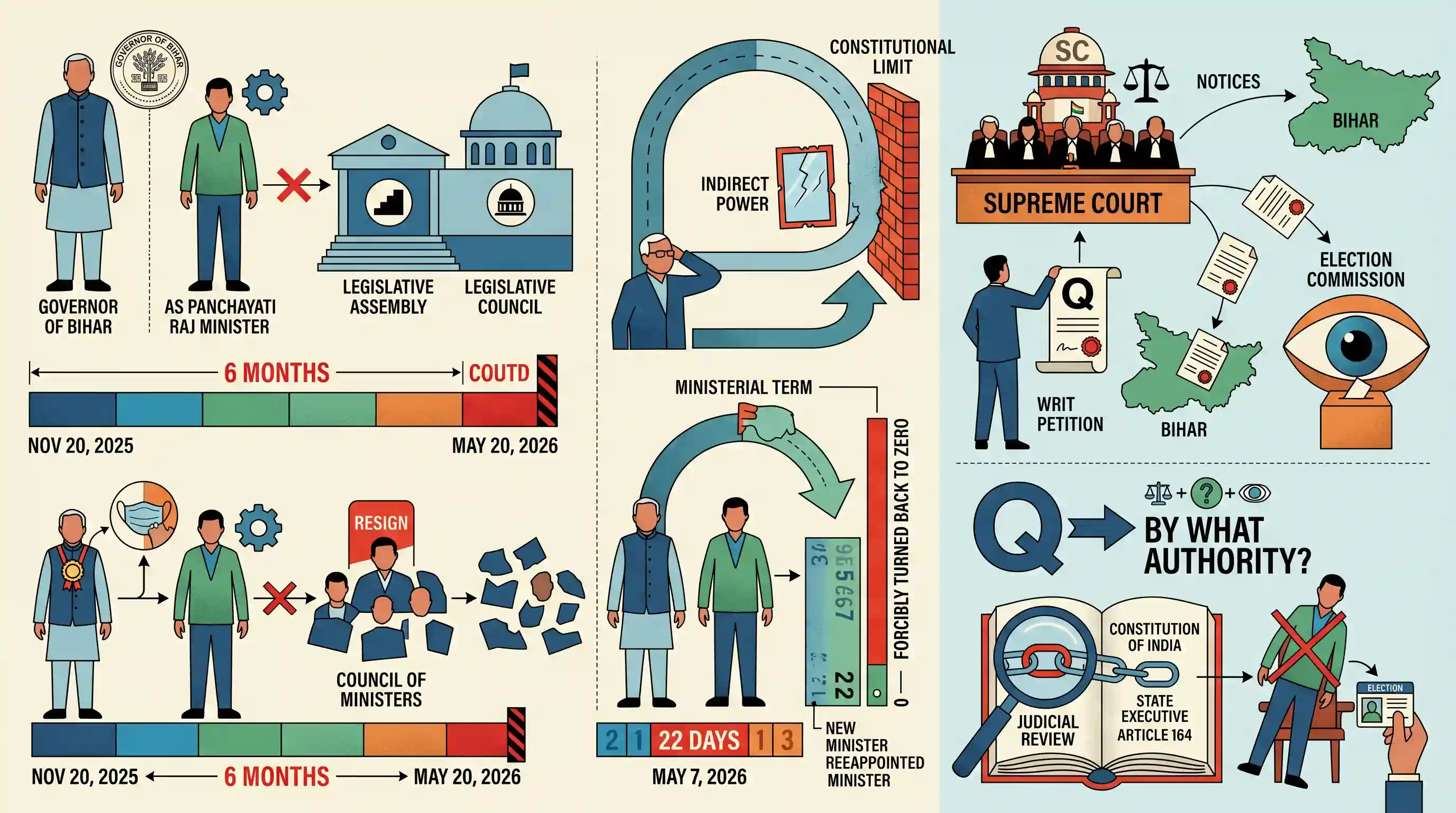
This case directly addresses a critical loophole/interpretation regarding Article 164(4) of the Constitution, exploring whether a non-legislator can circumvent the six-month limit for ministerial appointments through resignation and subsequent reappointment under a new Cabinet/Chief Minister within the same assembly term. It reflects key constitutional principles of parliamentary democracy and judicial check on executive power.
Summary
The Supreme Court has issued notices to the Election Commission and the Bihar government on a plea challenging the second consecutive term of Deepak Prakash as Bihar's Panchayati Raj Minister. The petitioner argues that Prakash's reappointment without being elected to either the Legislative Assembly or Legislative Council violates Article 164(4) of the Constitution, which restricts non-legislator ministerial terms to six months. The petitioner seeks a writ of quo warranto, claiming that resetting the six-month grace period via executive reshuffles or change of Chief Minister constitutes a colourable exercise of power.
Key Points
- The Supreme Court issued notices to the Bihar government, the Election Commission, and State Minister Deepak Prakash regarding a plea challenging his reappointment as a minister.
- Prakash was appointed Panchayati Raj Minister on November 20, 2025, under CM Nitish Kumar, and reappointed on May 7, 2026, under CM Samrat Choudhary, without being a member of either the Legislative Assembly or the Legislative Council.
- The petitioner, Rakesh Kumar Singh, argues that Prakash's consecutive appointments violate Article 164(4) of the Constitution, which limits a non-legislator's ministerial tenure to six consecutive months.
- The petition contends that the six-month grace period is a one-time privilege during the lifetime of a Legislative Assembly and cannot be reset or revived by resignation, cabinet reshuffle, or a change in the Chief Minister.
- The petitioner has filed for a writ of quo warranto, calling the reappointment a 'colourable exercise of constitutional power'.
Important Terms
Article 164(4)

A constitutional provision permitting a non-legislator to be appointed as a state minister for a maximum of six consecutive months, after which they must secure election to the legislature or vacate office.
UPSC context
GS Paper II (Polity/State Executive); tests constitutional checks, parliamentary accountability, and executive-legislative balance.
Writ of Quo Warranto
A high court or Supreme Court writ issued to inquire into the legality of a person's claim to a public office, preventing unauthorized usurpation of public positions.
UPSC context
GS Paper II (Constitutional Remedies/Judicial Review); tests knowledge of fundamental rights, writs, and judicial oversight.
Election Commission of India
An autonomous, constitutionally established body under Article 324 responsible for conducting free and fair elections to the Parliament, state legislatures, and key executive offices.
UPSC context
GS Paper II (Constitutional Bodies); tests knowledge of electoral machinery, democratic processes, and constitutional supervision.
Supreme Court of India
The apex judicial body and ultimate interpreter of the Constitution, possessing original, appellate, and advisory jurisdictions to safeguard fundamental rights and resolve constitutional disputes.
UPSC context
GS Paper II (Judiciary); tests understanding of judicial review, separation of powers, and landmark constitutional judgements.
Constitution of India
The supreme legal document of India, establishing the framework for government institutions, outlining their powers, and guaranteeing fundamental rights and obligations to citizens.
UPSC context
GS Paper II (Indian Constitution); foundational for evaluating governance, statutory bodies, and federal relations.
Prelims Trap
A non-legislator minister can be reappointed for another six months if a new Chief Minister takes office and forms a new Cabinet.
The Supreme Court in S.R. Chaudhuri (2001) held that the six-month period is a one-time concession during an Assembly's term; cabinet reshuffles cannot reset this limit.
Static Concepts Connected
What is the nature and scope of the Writ of Quo Warranto?
- Definition: It translates to "by what authority" and prevents the illegal usurpation of a public office by an individual.
- Standing: Unlike other writs, any public-spirited citizen can petition for it; the petitioner does not need to be personally aggrieved.
- Scope: It applies only to substantive public offices of a permanent character created by the Constitution or a statute.
What are the rules governing non-legislator ministerial appointments under Article 164?
- Six-Month Limit: A non-legislator appointed as minister must secure membership in either house of the state legislature within six consecutive months.
- No Reappointment: As per the S.R. Chaudhuri (2001) precedent, consecutive reappointment without election is a patent subversion of constitutional democracy.
- Collective Responsibility: Despite non-legislator appointments, the Council of Ministers remains collectively responsible only to the Legislative Assembly.
Cross-Topic Patterns
Judicial Review vs Executive Discretion
The judiciary's use of quo warranto to police ministerial appointments showcases courts actively regulating executive discretion to protect democratic norms.
Amendments & Asymmetrical Federalism
Exempting Bihar from tribal minister mandates under the 94th Amendment shows how the Constitution adapts structural executive rules to demographic changes.

Expect a multi-statement question combining Article 164(4) limits, the S.R. Chaudhuri precedent, and the unique standing rules of Quo Warranto.
Linked PYQs · 3
Linked PYQs · 3
- 2019BPSC_PRELIMSGS1
Which one of the following constitutional remedies is also known as 'postmortem'?
- 2023BPSC_PRELIMSGS1
The Council of Ministers in a State is collectively responsible to
- 2018BPSC_PRELIMSGS1
The Governor of a State is appointed by
