Supreme Court Seeks Centre Response on Autism Welfare Plea
Source:The Hindu ↗
Why It Matters
This development is highly relevant for GS Paper 2 as it exposes the gap between statutory protections (like the RPwD Act, 2016) and their actual implementation. It provides a contemporary example of judicial intervention addressing institutional apathy towards vulnerable sections and highlights the necessity of administrative sensitization and inclusivity.
Summary
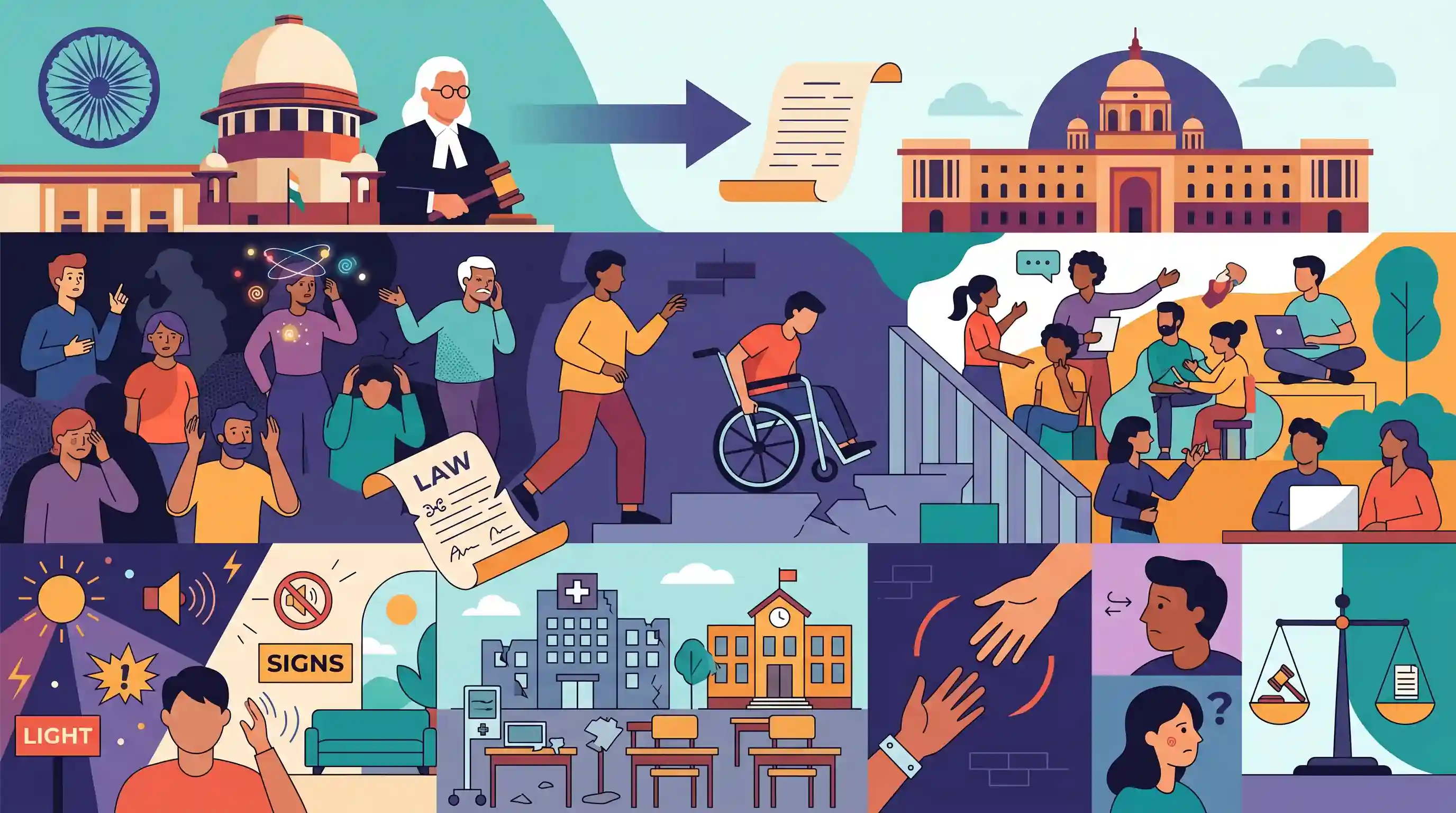
The Supreme Court has directed the Central Government to respond to a petition alleging systemic apathy toward individuals with autism spectrum disorders and other neurodivergent conditions. The plea underscores the inadequate implementation of welfare and disability laws, arguing that such negligence deprives neurodivergent persons of their rights to be self-reliant and part of mainstream society. The case highlights ongoing challenges in ensuring accessibility, sensitization, and robust institutional support for persons with disabilities in India.
Key Points
- The Supreme Court has issued a notice seeking the Union Government's response to a plea concerning institutional and systemic apathy toward individuals with Autism Spectrum Disorders (ASD).
- The plea highlights that despite existing welfare laws, neurodivergent persons suffer from poor implementation, which curtails their ability to lead self-reliant lives and integrate into mainstream society.
- The intervention stresses the need for better sensitization in public spheres (such as transport infrastructure) and effective execution of constitutional and statutory obligations regarding disability rights.
Important Terms
Rights of Persons with Disabilities (RPwD) Act, 2016

Primary legislation replacing the 1995 Act; it expanded recognized disabilities from 7 to 21 and shifted India's disability policy from a welfare-based to a rights-based framework.
UPSC context
GS II (Social Justice/Governance): Crucial for understanding legislative protections for vulnerable sections and India's compliance with international human rights treaties.
Autism Spectrum Disorder (ASD)
A neurodevelopmental condition affecting communication, social interaction, and behavior. It is one of the 21 disabilities recognized under the RPwD Act, 2016.
UPSC context
GS II (Health/Social Justice): Highlights the specific needs of diverse disability groups and the gaps in specialized public service delivery.
National Trust Act, 1999
Specific legislation constituting a statutory body to support persons with autism, cerebral palsy, and intellectual disabilities through guardianship, welfare schemes, and legal protection.
UPSC context
GS II (Welfare Schemes/Statutory Bodies): Tests knowledge of specialized institutional mechanisms established for the protection of specific neurodivergent groups.
UN Convention on the Rights of Persons with Disabilities (UNCRPD)
An international human rights treaty ratified by India in 2007, emphasizing dignity, non-discrimination, and full participation of persons with disabilities in society.
UPSC context
GS II (International Relations/Governance): The foundational global framework that dictates the standards for India's domestic disability laws and policies.
Unique Disability ID (UDID)
A project by the Ministry of Social Justice to create a national database for PwDs and provide a single card for identification and benefit-tracking.
UPSC context
GS II (Governance/E-Governance): Tests understanding of digital inclusion and the administrative challenges in accessing government welfare schemes.
Neurodivergence
An umbrella term for neurological differences (e.g., autism, dyslexia) viewed as natural human variations rather than disorders requiring a cure.
UPSC context
GS II (Social Justice): Reflects the evolving discourse on mental health and disability, moving from a medical to a social-inclusion model.
Prelims Trap
Autism Spectrum Disorder is classified only under mental illnesses and not as a distinct disability under the RPwD Act, 2016.
ASD is not just a mental illness category; it is explicitly recognized as a distinct neurodevelopmental condition among the 21 specified disabilities under the RPwD Act, 2016.
Static Concepts Connected
What are the key features of the Rights of Persons with Disabilities (RPwD) Act, 2016?
- Expanded List: Increased the number of officially recognized disabilities from 7 (under the 1995 Act) to 21, adding conditions like ASD, dwarfism, and acid attack victims.
- Reservation Quota: Increased the reservation for persons with benchmark disabilities (at least 40% disability) from 3% to 4% in government jobs.
- Reasonable Accommodation: Mandates public and private entities to make necessary adjustments so persons with disabilities can exercise their rights equally without discrimination.
How does the Indian Constitution protect the rights of persons with disabilities?
- Article 41 (DPSP): Directs the State to secure the right to work, education, and public assistance in cases of unemployment, old age, sickness, and disablement.
- Fundamental Rights: The Supreme Court has read disability rights into Article 14 (Equality) and Article 21 (Right to a dignified life), mandating inclusivity.
- Seventh Schedule: 'Relief of the disabled and unemployable' is explicitly mentioned as a State subject (Entry 9, List II) in the Seventh Schedule.
Cross-Topic Patterns
Urban Infrastructure & Reasonable Accommodation
The plea's focus on transport infrastructure highlights the growing overlap between disability rights (RPwD Act) and urban development schemes (AMRUT, Smart Cities) in standardizing universal design and accessibility.
Judicial Activism in Welfare Implementation
The SC's intervention highlights a recurring theme: judicial oversight being required to force the executive to implement existing statutory welfare mandates (like the RPwD Act's accessibility norms).

Expect a Prelims question identifying which specific conditions (like ASD, dwarfism, or thalassemia) belong to the 21 disabilities of the RPwD Act.
Linked PYQs · 3
Linked PYQs · 3
- 2017MainsGS2
Does the Rights of Persons with Disabilities Act, 2016 ensure effective mechanism for empowerment and inclusion of the intended beneficiaries in the society? Discuss.
- 2019MainsGS2
Performance of welfare schemes that are implemented for vulnerable sections is not so effective due to absence of their awareness and active involvement at all stages of policy process. Discuss.
- 2023MainsGS2
“Development and welfare schemes for the vulnerable, by its nature, are discriminatory in approach.” Do you agree? Give reasons for your answer.
