Supreme Court rules economic policy cannot override human lives
Source:The Hindu ↗
આ શા માટે મહત્વનું છે
It directly addresses the intersection of judicial oversight, socio-economic rights (right to health), and state policy regarding essential drug pricing and market regulations.
સારાંશ
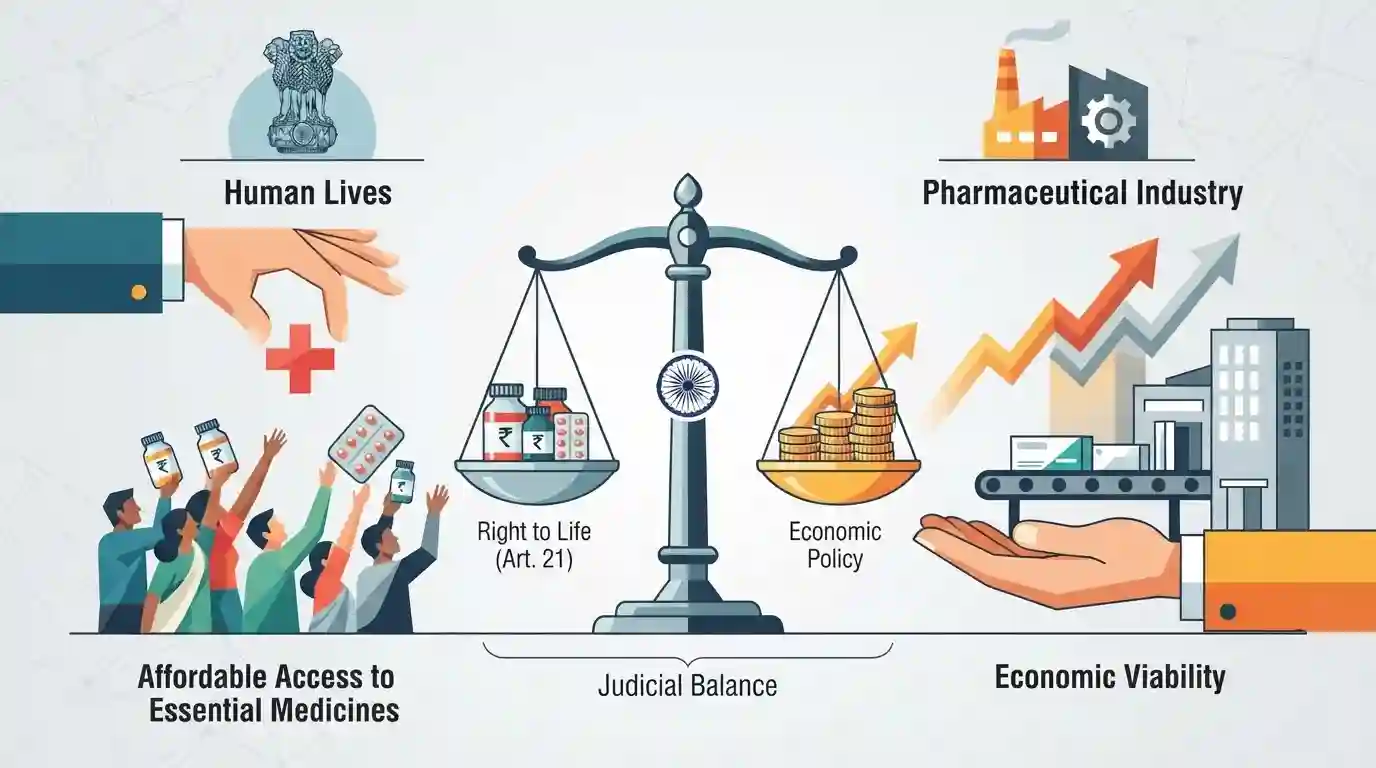
The Supreme Court of India asserted that economic policy cannot take precedence over human lives as the Centre defended its calibrated mechanism for drug price controls. The discourse highlights the judicial balance between ensuring affordable access to essential medicines as part of the Right to Life (Article 21) and maintaining the economic viability of the pharmaceutical industry.
મુખ્ય મુદ્દા
- The Supreme Court stated that economic policy cannot take precedence over human lives while examining drug price controls.
- The Centre defended its calibrated approach to drug price control, balancing affordable healthcare access for citizens with ensuring industry viability.
- The case highlights the tension between market-driven pharmaceutical pricing and the constitutional right to health under Article 21.
મહત્વપૂર્ણ શબ્દો
Drugs (Prices Control) Order (DPCO)

An order issued under the Essential Commodities Act enabling the government to fix prices of essential medicines to ensure affordability and public health access in India.
UPSC context
GS Paper II (Health Governance & Welfare Schemes). Tests understanding of drug pricing regulations, access to medicines, and market interventions.
Supreme Court of India
The apex judicial body in India that interprets the Constitution, possessing powers of judicial review to protect fundamental rights like Article 21.
UPSC context
GS Paper II (Polity and Constitution). Tests awareness of judicial activism, separation of powers, and protection of the Right to Life.
Centre / Government of India
The executive branch of the Indian Union responsible for formulating and implementing national policies, economic measures, and public welfare regulations.
UPSC context
GS Paper II (Governance). Tests understanding of executive policymaking, policy trade-offs between economic growth and public welfare.
સંલગ્ન સ્થિર ખ્યાલો
What are the core statutory and constitutional mechanisms governing drug price control in India?
- DPCO Framework: Enacted under the Essential Commodities Act, 1955, allowing government control over prices and distribution of scheduled drugs.
- Article 21 Nexus: Implicitly includes the right to health and access to affordable essential medicines as a non-negotiable state obligation.
- Regulating Body: Maintained by the National Pharmaceutical Pricing Authority (NPPA), established in 1997 to monitor and implement price controls.
આંતર-વિષય પેટર્ન
DPCO Price Caps vs. TRIPS Obligations
The tension between intellectual property rights (TRIPS), compulsory licensing, and domestic price controls (DPCO) forms a recurring governance battleground.

Expect a statement-based prelims question on DPCO, Essential Commodities Act, and the constitutional roots of health rights.
સંલગ્ન PYQ · 2
સંલગ્ન PYQ · 2
- 2024MainsGS2
In a crucial domain like the public healthcare system the Indian State should play a vital role to contain the adverse impact of marketisation of the system. Suggest some measures through which the State can enhance the reach of public healthcare at the grassroots level.
- 2013MainsGS3
Bringing out the circumstances in 2005 which forced amendment to the section 3(d) in Indian Patent Law, 1970, discuss how it has been utilized by the Supreme Court in its judgement in rejecting Novratis' patent application for 'Glivec'. Discuss briefly the pros and cons of the decision.
