Religious Conversion and Muslim Backward Class Quota Eligibility
Source:Indian Express ↗
Why It Matters
This ruling clarifies the complex intersection between religious conversion, social backwardness, and reservation benefits in India, which has significant implications for constitutional jurisprudence on affirmative action and equality.
Summary
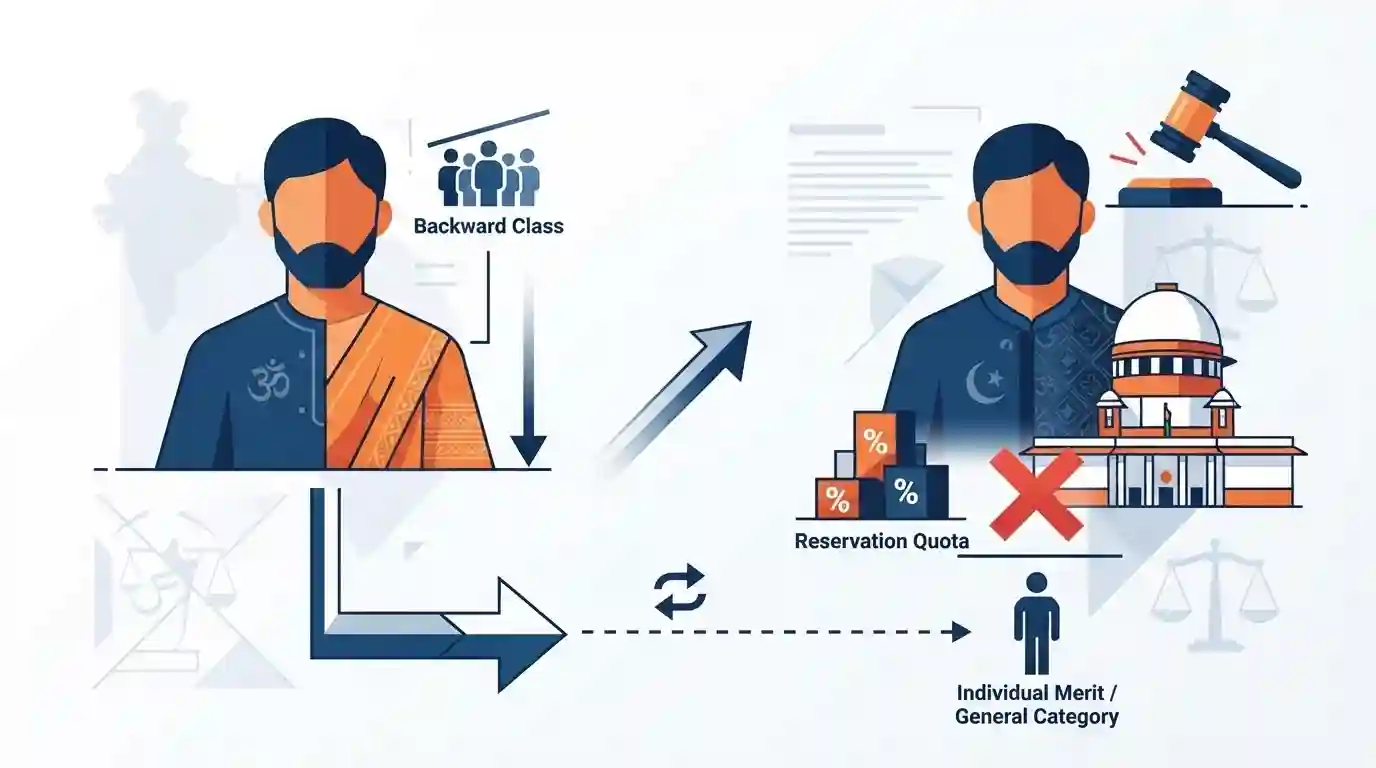
The Supreme Court of India ruled that individuals who convert from Hinduism to Islam cannot automatically claim Backward Class Muslim reservation quotas based on their pre-conversion status, reinforcing principles governing social backwardness and affirmative action.
Key Points
- The Supreme Court ruled that a person who converts from Hinduism to Islam cannot claim benefits under the Backward Class Muslim quota based on their original status.
- The judgment addresses the nuances of social backwardness, religious conversion, and eligibility criteria for affirmative action and reservation benefits.
- Affirmative action classifications evaluate social and educational backwardness post-conversion based on the specific socio-economic reality of the converted individual within their new religious or social stratum.
Important Terms
Supreme Court of India

The apex judicial court of India under the Constitution, serving as the ultimate interpreter of laws and the Constitution, guarantor of fundamental rights, and arbitrator of federal disputes.
UPSC context
GS Paper II (Polity and Governance - Judiciary, Structure, Organization, and Functioning). Tests understanding of constitutional jurisprudence and judicial review.
Prelims Trap
Conversion from Hinduism to Islam automatically disqualifies a person from all categories of reservation benefits without exception.
Aspirants often confuse the constitutional strictures of Scheduled Caste (SC) definitions under Article 341 with state-level Backward Class (BC) quotas, assuming conversion uniformly strips all reservation benefits.
Static Concepts Connected
What are the constitutional provisions and limitations regarding Scheduled Caste and Backward Class reservations in India?
- Article 341 Scope: Article 341 empowers the President to specify castes/tribes deemed to be Scheduled Castes, originally restricted by the 1950 Order to Hindus (later extended to Sikhs and Buddhists).
- Article 16(4) Mandate: Article 16(4) permits the State to make provisions for the reservation of appointments for any backward class of citizens not adequately represented in state services.
- Backwardness Assessment: Social backwardness under affirmative action requires distinct empirical validation, and caste status does not automatically translate across religious boundaries upon conversion.
Cross-Topic Patterns
Reservation Quotas vs. Religious Conversion Dynamics
While SC protects Scheduled Caste status restrictions under Article 341, state-level Backward Class lists (Article 16(4)) involve distinct criteria regarding religious minority quotas and conversion dynamics.
Article 25 Freedom of Conscience vs. Affirmative Action
The intersection of secularism, freedom of religion (Article 25), and state-sponsored affirmative action tests whether civil rights extend to group-based entitlements post-conversion.

Expect a statement-based question combining Article 16(4), Article 341 criteria, and the legal fiction of caste post-religious conversion.
Linked PYQs · 5
Linked PYQs · 5
- 2018MainsGS2
Whether National Commission for Scheduled Castes (NCSC) can enforce the implementation of constitutional reservation for the Scheduled Castes in the religious minority institutions? Examine.
- 2022MainsGS2
Discuss the role of the National Commission for Backward Classes in the wake of its transformation from a statutory body to a constitutional body.
- 2024MainsGS2
Discuss India as a secular state and compare with the secular principles of the US constitution.
- 2023PrelimsGS1
Consider the following statements: Statement-I: The Supreme Court of India has held in some judgements that the reservation policies made under Article 16(4) of the Constitution of India would be limited by Article 335 for maintenance of efficiency of administration. Statement-II: Article 335 of the Constitution of India defines the term 'efficiency of administration'. Which one of the following is correct in respect of the above statements?
- 2026PrelimsGS1
Consider the following statements about the provisions pertaining to the Scheduled Castes and the Scheduled Tribes in India : 1. Provisions regarding the administration of the Tribal Areas in the States of Assam, Meghalaya, Tripura and Mizoram are given in the Fifth Schedule of the Constitution of India. 2. Some tribes of India are entitled to exemption from paying Income Tax on certain incomes. 3. The Constitution of India provides for reservation of seats in Panchayats for women belonging to the Scheduled Castes and the Scheduled Tribes. Which one of the following conclusions based on the above statements is correct ?
