Supreme Court Rules on Religious Conversion and Quota Claims
Source:Indian Express ↗
આ શા માટે મહત્વનું છે
This Supreme Court ruling clarifies the complex interface between religious conversion, social identity, and affirmative action policies, impacting state-level reservation quotas and judicial interpretation of backwardness.
સારાંશ
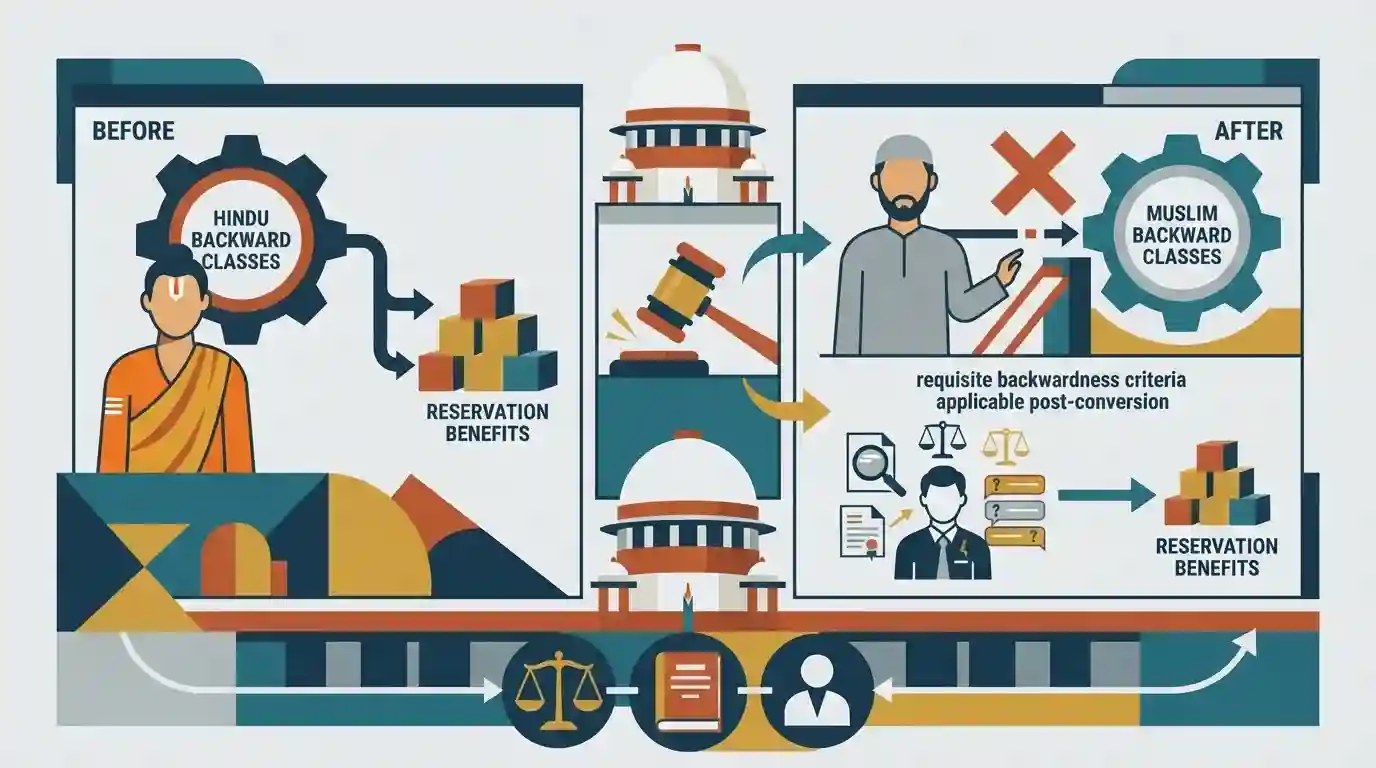
The Supreme Court of India ruled that an individual who converts from Hinduism to Islam cannot claim the benefit of Backward Class Muslim quotas based solely on their previous religious social standing or without satisfying the requisite backwardness criteria applicable post-conversion. The judgment emphasizes the parameters governing affirmative action, identity, and the legal implications of religious conversion regarding state reservation benefits.
મુખ્ય મુદ્દા
- The Supreme Court ruled that a person who has converted from Hinduism to Islam cannot claim benefits under the Backward Class Muslim quota based on their pre-conversion status if they belong to a forward caste or do not meet criteria in their new religious/social context.
- Affirmative action and reservation benefits hinge on social and educational backwardness evaluated within specific constitutional and legal frameworks.
- The ruling addresses the nuances of religious conversion, social identity, and eligibility for reservation benefits under state-specific quotas.
મહત્વપૂર્ણ શબ્દો
Backward Class Muslim Quota Conversion Ruling

A ruling by the Supreme Court of India stating that individuals converting from Hinduism to Islam cannot automatically claim Backward Class Muslim reservation quotas based purely on their pre-conversion social standing.
UPSC context
Important for GS Paper II (Polity and Governance - Constitutional Law, Judicial Pronouncements, and Reservation Policies).
Article 16(4)
A constitutional provision empowering the State to make provisions for the reservation of appointments or posts in public services for any backward class of citizens not adequately represented.
UPSC context
Essential for GS Paper II (Fundamental Rights and Affirmative Action/Reservation policies).
Constitution (Scheduled Castes) Order, 1950
An order issued under Article 341 restricting Scheduled Caste status initially to Hindus, later amended to include Sikhs and Buddhists, thereby excluding converts to Islam or Christianity from automatic SC benefits.
UPSC context
Important for GS Paper II (Social Justice, Vulnerable Sections, and Constitutional Frameworks).
સંલગ્ન સ્થિર ખ્યાલો
What are the constitutional provisions and judicial tests governing affirmative action and backwardness in India?
- Constitutional Basis: Article 15(4) and 16(4) empower the State to make special provisions for the advancement of any socially and educationally backward classes of citizens.
- Indra Sawhney Landmark: The Indra Sawhney (1992) judgment upheld the 27% OBC quota, introduced the creamy layer concept, and ruled against sub-classification based solely on religion without empirical data.
- Twin Criteria: Backwardness must be both social and educational; economic criteria alone cannot form the sole basis for identifying backward classes under Article 16(4).
આંતર-વિષય પેટર્ન
Religious Conversion and SC/BC Quotas Compared
While Scheduled Caste status is statutorily restricted by the 1950 Presidential Order to Hindus, Sikhs, and Buddhists, Backward Class quotas operate under different socio-economic criteria, creating distinct jurisprudence across religions.

Expect an analytical statement on whether constitutional reservation benefits are transferable across religions or tied to post-conversion status.
સંલગ્ન PYQ · 3
સંલગ્ન PYQ · 3
- 2018MainsGS2
Whether National Commission for Scheduled Castes (NCSC) can enforce the implementation of constitutional reservation for the Scheduled Castes in the religious minority institutions? Examine.
- 2022MainsGS2
Discuss the role of the National Commission for Backward Classes in the wake of its transformation from a statutory body to a constitutional body.
- 2023PrelimsGS1
Consider the following organizations/bodies in India: 1. The National Commission for Backward Classes 2. The National Human Rights Commission 3. The National Law Commission 4. The National Consumer Disputes Redressal Commission How many of the above are constitutional bodies?
