Supreme Court Ruling on Religious Conversion and Quota
Source:Indian Express ↗
ఇది ఎందుకు ముఖ్యం
It clarifies constitutional and legal jurisprudence surrounding affirmative action, the definition of social backwardness, and how religious conversion impacts eligibility for caste-based or community-based reservations in India.
సారాంశం
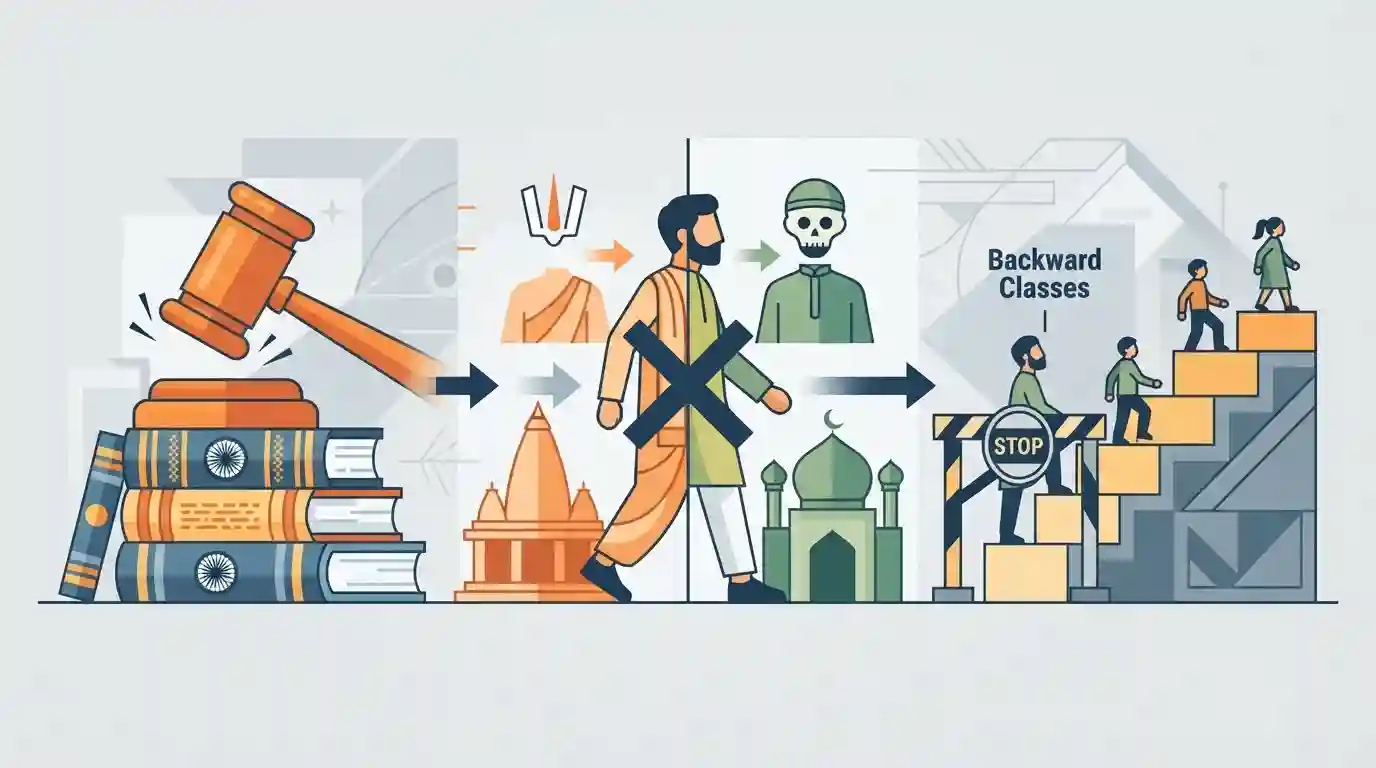
The Supreme Court of India ruled that individuals converting from Hinduism to Islam cannot claim benefits under Backward Class Muslim reservation quotas based on their pre-conversion background, highlighting strict legal boundaries regarding religious conversion and affirmative action benefits.
ముఖ్య అంశాలు
- The Supreme Court ruled that a person who converts from Hinduism to Islam cannot claim reservation benefits under the 'Backward Class Muslim' quota based on their pre-conversion social status or birth.
- The Court emphasized that social backwardness linked to caste or class under reservation frameworks cannot be automatically carried forward or claimed after converting to a religion that does not recognize the caste system in the same statutory context.
- This ruling reinforces judicial scrutiny regarding the criteria for affirmative action, social backwardness, and the legal implications of religious conversion on statutory reservations in India.
ముఖ్యమైన పదాలు
Supreme Court of India

The apex judicial body of India, established under Part V of the Constitution, possessing final appellate jurisdiction and power of judicial review to interpret constitutional provisions and laws.
UPSC context
Important for GS Paper II (Indian Constitution - Judiciary, Basic Structure, and Judicial Review).
ప్రిలిమ్స్ ఉచ్చు
individuals converting from Hinduism to Islam can claim Backward Class Muslim reservation quotas based on their pre-conversion background
Aspirants often assume reservation benefits for backward classes can be carried forward across religious conversions, confusing it with domicile or residency benefits.
అనుసంధానమైన స్థిర భావనలు
What are the constitutional provisions and statutory orders governing religious restrictions on Scheduled Caste (SC) reservations in India?
- Para 3 Constraint: Constitution Order 1950 originally restricted SC status to Hindus; amended in 1956 to include Sikhs and in 1990 to include Buddhists.
- Exclusion Scope: Islam and Christianity remain excluded from the statutory SC list due to the requirement of social disabilities linked to the Hindu caste system.
- OBC vs SC distinction: Backward Classes (OBCs/BCs) under Article 15(4) and 16(4) are distinct, as state-level lists can include Muslims based on social and educational backwardness.
అంతర-అంశ నమూనాలు
Religious Conversion & SC/BC Reservation Frameworks
Judicial scrutiny on religious conversion intersects with debates over Scheduled Caste status for Dalit Christians and Dalits who convert to Islam.
State Quota Orders & Judicial Review
Tamil Nadu government orders on quotas regularly challenge constitutional boundaries, intersecting with the 69% reservation case under the Ninth Schedule.

SC rulings on conversion and reservations will appear as a statement-based prelims question on statutory backward class entitlements.
అనుసంధాన PYQలు · 3
అనుసంధాన PYQలు · 3
- 2023PrelimsGS1
Consider the following statements: Statement-I: The Supreme Court of India has held in some judgements that the reservation policies made under Article 16(4) of the Constitution of India would be limited by Article 335 for maintenance of efficiency of administration. Statement-II: Article 335 of the Constitution of India defines the term 'efficiency of administration'. Which one of the following is correct in respect of the above statements?
- 2018MainsGS2
Whether National Commission for Scheduled Castes (NCSC) can enforce the implementation of constitutional reservation for the Scheduled Castes in the religious minority institutions? Examine.
- 2022MainsGS2
Discuss the role of the National Commission for Backward Classes in the wake of its transformation from a statutory body to a constitutional body.
