Supreme Court Rules on Conversion and Backward Class Quota Eligibility
Source:Indian Express ↗
આ શા માટે મહત્વનું છે
This judgment has significant implications for jurisprudence surrounding affirmative action, religious conversion, and the determination of social backwardness for reservation benefits in India.
સારાંશ
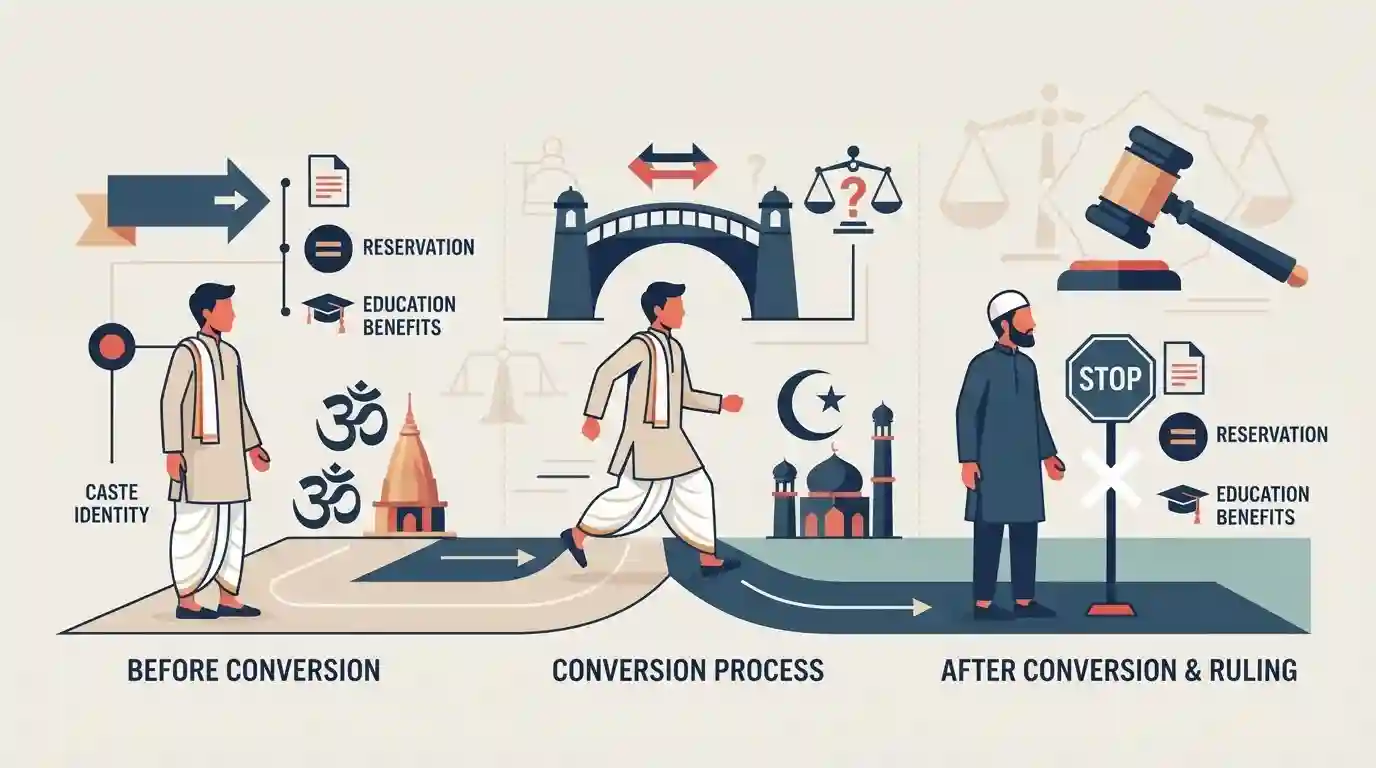
The Supreme Court of India held that individuals converting from Hinduism to Islam cannot claim the benefit of reservation under the Backward Class Muslim quota based on their original caste status prior to conversion. The ruling deals with the constitutional and legal frameworks surrounding religious conversion and eligibility for affirmative action quotas.
મુખ્ય મુદ્દા
- The Supreme Court ruled that a person who has converted from Hinduism to Islam cannot claim benefits under the Backward Class Muslim quota based on their pre-conversion status.
- The judgment reinforces the principle that social backwardness linked to caste in Hinduism does not automatically translate or transfer upon conversion to religions that do not officially recognize caste hierarchies in the same manner.
- The ruling addresses nuances of affirmative action, religious conversion, and the eligibility criteria for reservation benefits under state-specific backward class categories.
મહત્વપૂર્ણ શબ્દો
Supreme Court of India

The apex judicial authority of India, empowered to interpret the Constitution, protect fundamental rights, and adjudicate disputes between states or on legal validity of state actions.
UPSC context
Essential for GS Paper II (Polity and Governance - Judiciary, Constitutional Interpretation, and Judicial Review).
Article 341
A constitutional provision empowering the President to specify castes, races, or tribes as Scheduled Castes, restricted via the 1950 Order to individuals professing Hindu, Sikh, or Buddhist religions.
UPSC context
Critical for GS Paper II (Indian Constitution, Fundamental Rights, Social Justice, and Affirmative Action Policies).
Backward Class Muslim Quota
A specific sub-quota category within reservation frameworks (such as in Tamil Nadu) designed for socially and educationally backward Muslim communities.
UPSC context
Important for GS Paper II (Social Justice, Reservation Policies, and Minorities welfare).
પ્રિલિમ્સ ટ્રેપ
Conversion to Islam entirely bars any form of reservation benefits similar to the absolute statutory exclusion under the Scheduled Caste Presidential Order.
Aspirants often confuse the strict religious criteria applied to Scheduled Caste (SC) status (which excludes Muslims and Christians by statute) with Backward Class (OBC) quotas, where conversion rules depend entirely on whether social backwardness is retained and recognized under state lists.
સંલગ્ન સ્થિર ખ્યાલો
What is the constitutional basis and legal scope of reservations for Backward Classes in India?
- Constitutional Articles: Article 15(4) and Article 16(4) empower the State to make special provisions for the advancement of any socially and educationally backward classes of citizens or for Scheduled Castes and Scheduled Tribes.
- Religious Scope: Unlike Scheduled Castes (restricted by the 1950 Presidential Order to Hindus, Sikhs, and Buddhists), Backward Class (OBC) reservations can include non-Hindu communities based on social and educational backwardness.
આંતર-વિષય પેટર્ન
Caste Conversion + OBC Quotas vs. SC Quotas
SC jurisprudence on affirmative action for converts consistently distinguishes between Scheduled Castes (where Hindu/Sikh/Buddhist bounds apply) and OBC/Backward Class quotas governed by state-specific social backwardness criteria.

SC rulings on conversion and reservation eligibility are high-yield for polity statement-based MCQs on fundamental rights and equality.
સંલગ્ન PYQ · 3
સંલગ્ન PYQ · 3
- 2023PrelimsGS1
Consider the following statements: Statement-I: The Supreme Court of India has held in some judgements that the reservation policies made under Article 16(4) of the Constitution of India would be limited by Article 335 for maintenance of efficiency of administration. Statement-II: Article 335 of the Constitution of India defines the term 'efficiency of administration'. Which one of the following is correct in respect of the above statements?
- 2022MainsGS2
Discuss the role of the National Commission for Backward Classes in the wake of its transformation from a statutory body to a constitutional body.
- 2018MainsGS2
Whether National Commission for Scheduled Castes (NCSC) can enforce the implementation of constitutional reservation for the Scheduled Castes in the religious minority institutions? Examine.
