Supreme Court Ruling on Reservation Claims After Conversion
Source:Indian Express ↗
ఇది ఎందుకు ముఖ్యం
This judgment impacts the jurisprudence surrounding affirmative action, religious conversion, and the criteria for determining backwardness and reservation benefits in India.
సారాంశం
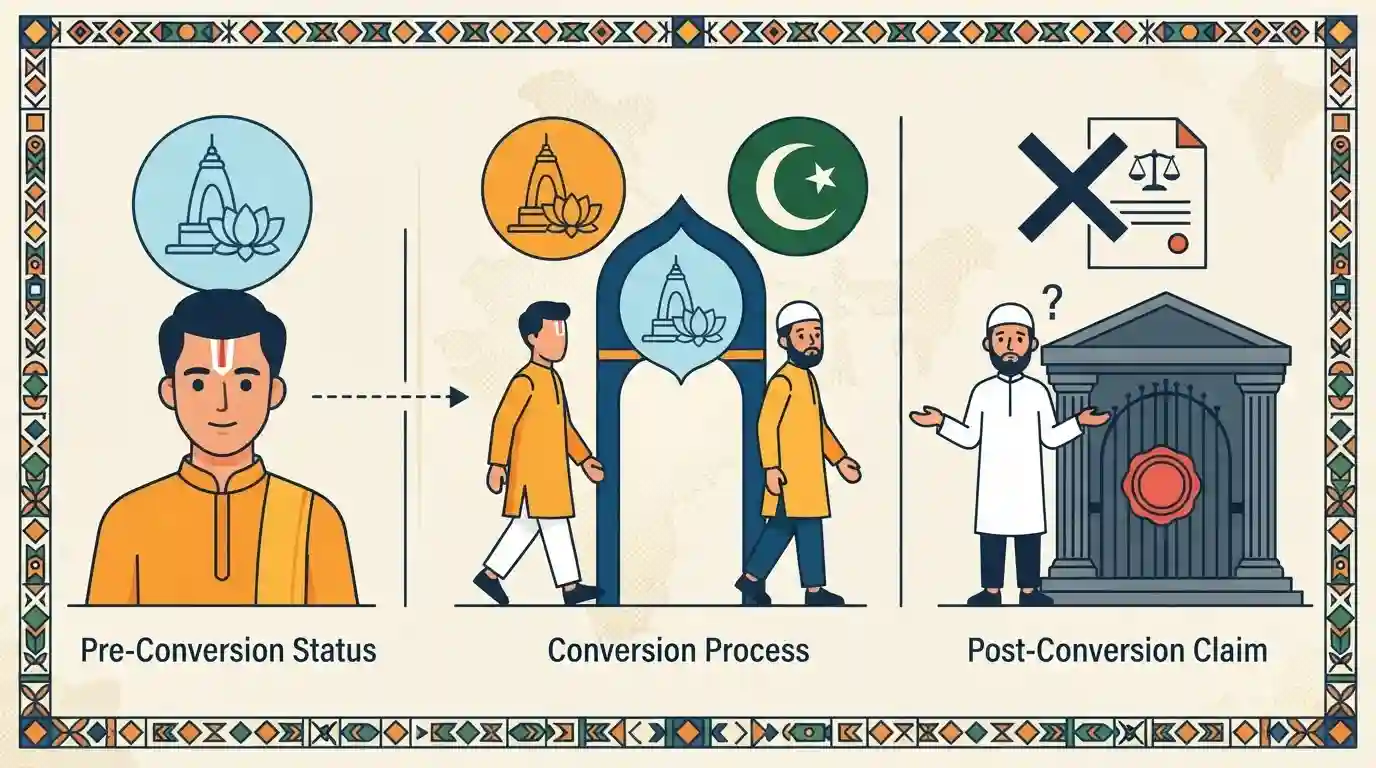
The Supreme Court of India held that individuals converting from Hinduism to Islam cannot claim backward class Muslim quotas based on their pre-conversion status, reinforcing principles governing affirmative action and religious identity in reservations.
ముఖ్య అంశాలు
- The Supreme Court ruled that a person who has converted from Hinduism to Islam cannot claim the benefit of reservation under the Backward Class Muslim quota based on their original status.
- The judgment addresses the complex interplay between religious conversion, social identity, and affirmative action policies in India.
- It highlights that quotas meant for backward classes within specific religious or social frameworks cannot be arbitrarily claimed post-conversion unless proven eligible under the legal and constitutional criteria applicable to the converted religion.
ముఖ్యమైన పదాలు
Supreme Court of India

The apex judicial authority of India under Article 124, responsible for constitutional interpretation, safeguarding fundamental rights, and settling federal disputes.
UPSC context
UPSC GS Paper II (Indian Constitution & Polity). Tests judicial review, basic structure doctrine, and constitutional interpretation of rights and reservations.
అనుసంధానమైన స్థిర భావనలు
What are the constitutional provisions and criteria governing the extension of reservations to socially and educationally backward classes in India?
- Enabling Provisions: Article 15(4) and 16(4) empower the State to make special provisions for the advancement of any socially and educationally backward classes (SEBCs) of citizens or for SCs and STs.
- Creamy Layer Cap: Indra Sawhney judgment (1992) capped reservations at 50% (barring extraordinary circumstances) and upheld the exclusion of the creamy layer from backward class benefits.
- Religious Restriction: Constitution (Scheduled Castes) Order, 1950 originally restricted SC status to Hindus, later amended to include Sikhs (1956) and Buddhists (1990).
అంతర-అంశ నమూనాలు
Religious Conversion and Constitutional Reservations
Constitutional reservations for SCs/STs are tied to religious markers (Hindu, Sikh, Buddhist), sparking ongoing debates on extending similar quotas to Dalit Christians and Dalit Muslims under Articles 15 and 16.
State Quota Expansion vs. Judicial Review
The striking down of state executive orders highlights the constitutional limits of sub-classification within backward classes and judicial scrutiny over state-level quota expansion.

Conversion and reservation eligibility (SC/BC quotas) will be framed as a multi-statement question testing Articles 15, 16, and 341.
అనుసంధాన PYQలు · 2
అనుసంధాన PYQలు · 2
- 2022MainsGS2
Discuss the role of the National Commission for Backward Classes in the wake of its transformation from a statutory body to a constitutional body.
- 2018MainsGS2
Whether National Commission for Scheduled Castes (NCSC) can enforce the implementation of constitutional reservation for the Scheduled Castes in the religious minority institutions? Examine.
