Supreme Court rules on religious conversion and backward class quota
Source:Indian Express ↗
આ શા માટે મહત્વનું છે
It clarifies constitutional and legal limits regarding religious conversion and reservation benefits, impacting policy, social justice jurisprudence, and the identification criteria for backward classes.
સારાંશ
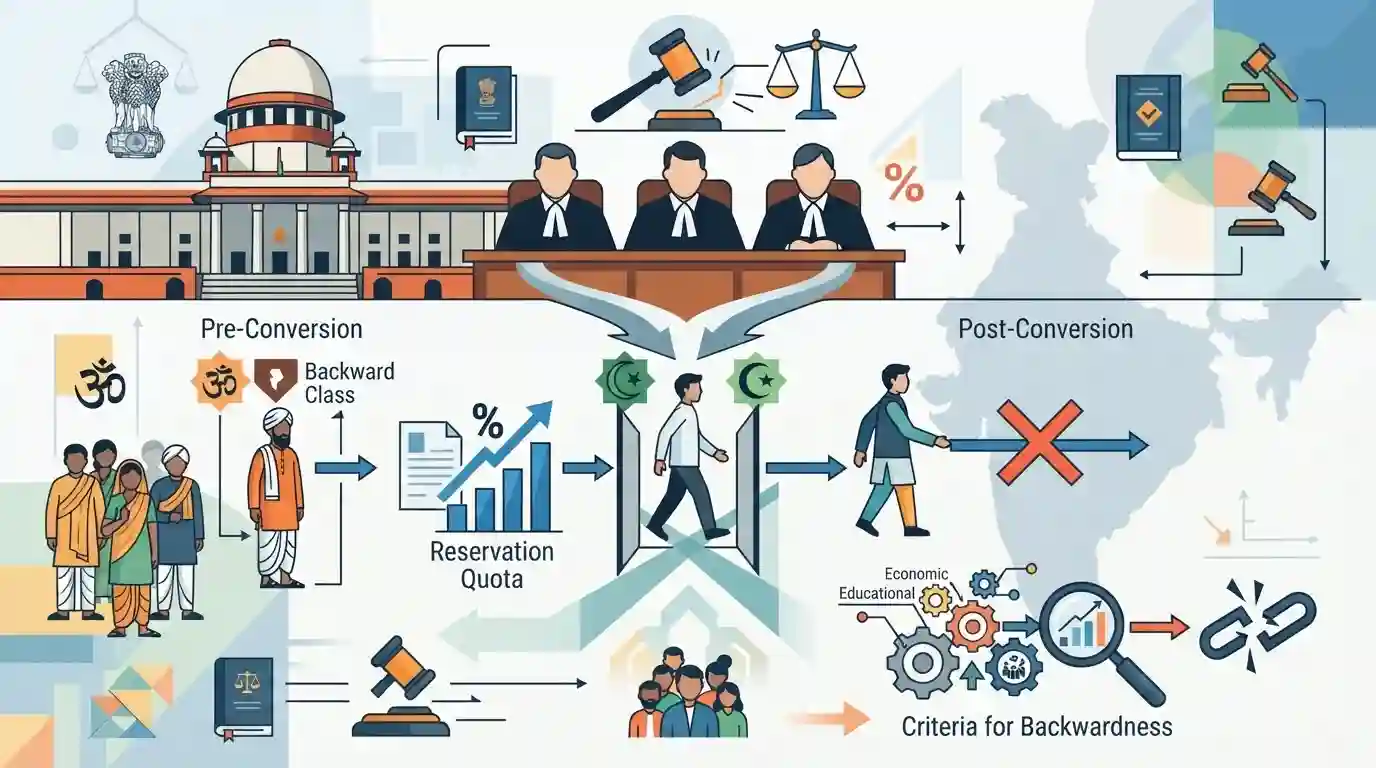
The Supreme Court ruled that individuals converting from Hinduism to Islam cannot claim backward class Muslim quotas based on their pre-conversion status if the criteria for backwardness do not translate or apply. The verdict highlights legal parameters surrounding religious conversion, caste dynamics, and affirmative action benefits in India.
મુખ્ય મુદ્દા
- The Supreme Court ruled that a person who has converted from Hinduism to Islam cannot claim the benefit of the Backward Class Muslim quota based on their pre-conversion status if they belong to a category that is not recognized as backward in Islam or if the social disadvantages associated with their previous caste do not persist or apply under the converted framework.
- The judgment addresses the complex intersection between religious conversion, social backwardness, and affirmative action policies (reservations) in India.
- Affirmative action classifications for backward classes are tied to specific social and educational backwardness profiles within communities, which do not automatically carry over upon conversion to another religion unless explicitly covered by law or state rules.
મહત્વપૂર્ણ શબ્દો
Supreme Court

The apex judicial body of India under the Constitution, responsible for judicial review, protecting fundamental rights, and acting as the final court of appeal.
UPSC context
UPSC GS Paper II (Indian Polity): Tests understanding of the judiciary, judicial review, constitutional interpretation, and fundamental rights.
પ્રિલિમ્સ ટ્રેપ
Conversion from Hinduism to Islam extinguishes all forms of pre-existing reservation benefits, including Backward Class Muslim quotas.
Aspirants often confuse the absolute religious bar for Scheduled Caste (SC) status under the 1950 Order with backward class (OBC/BC) quotas, assuming conversion automatically carries over any form of affirmative action.
સંલગ્ન સ્થિર ખ્યાલો
What are the constitutional provisions and statutory limits governing religious conversion and reservation benefits in India?
- SC Order 1950: SC Order 1950 restricts Scheduled Caste status strictly to Hindus, Sikhs, and Buddhists to prevent claims of untouchability outside these folds.
- Article 16(4): Article 16(4) empowers the state to make provisions for the reservation of appointments for any backward class of citizens inadequately represented.
- Backwardness Proof: Caste and Backwardness linkage means backward class status in Islam or Christianity must be proven through empirical data of social and educational backwardness, not mere pre-conversion status.
આંતર-વિષય પેટર્ન
Affirmative Action vs. Religious Conversion Mechanics
While the Constitution restricts SC status to Hindus, Sikhs, and Buddhists, religious minority quotas for backward classes are governed by state-specific enactments and judicial scrutiny under Article 16(4).

Expect a statement-based question linking the SC Order 1950 (religion-based SC exclusion) with state-level OBC/BC Muslim quota eligibility rules.
સંલગ્ન PYQ · 2
સંલગ્ન PYQ · 2
- 2022MainsGS2
Discuss the role of the National Commission for Backward Classes in the wake of its transformation from a statutory body to a constitutional body.
- 2018MainsGS2
Whether National Commission for Scheduled Castes (NCSC) can enforce the implementation of constitutional reservation for the Scheduled Castes in the religious minority institutions? Examine.
