Supreme Court Withdraws Order on Allahabad High Court Judge
Source:The Hindu ↗
Why It Matters
The incident raises crucial questions about judicial independence, the hierarchical relationship between the Supreme Court and High Courts, and the boundaries of judicial accountability. It is directly relevant for GS2 (Structure, organization and functioning of the Executive and the Judiciary) and helps contextualize the 'master of the roster' doctrine and ongoing challenges with the misuse of criminal law in civil matters.
Summary
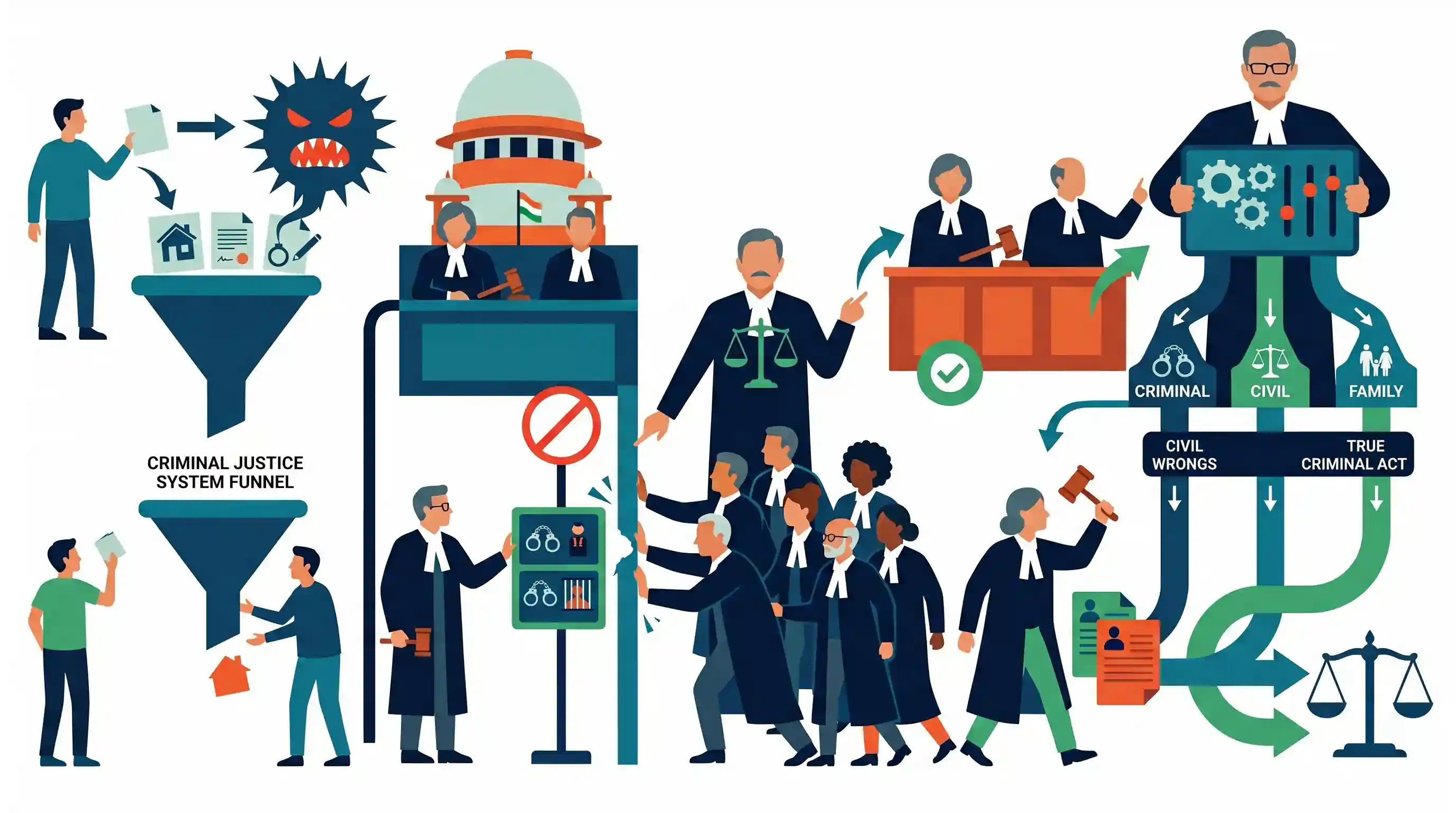
The Supreme Court has reversed its August 4 order that barred an Allahabad High Court judge from adjudicating criminal cases, following an intervention by the Chief Justice of India and resistance from 13 High Court judges. The initial bench of Justices J.B. Pardiwala and R. Mahadevan issued the ban to curb the growing misuse of the criminal justice system, where purely civil disputes are disguised as criminal cases. While rolling back the order, the apex court affirmed the High Court Chief Justice's administrative authority as the 'master of the roster' and maintained that its intention was solely to check the criminalisation of civil wrongs, not to undermine judicial independence or embarrass the judge.
Key Points
- The Supreme Court withdrew its unprecedented order barring Allahabad High Court judge Justice Prashant Kumar from hearing criminal cases after the intervention of the CJI and a protest letter from 13 HC judges.
- The original SC order highlighted a troubling trend where purely civil disputes (such as unpaid dues or property matters) are being converted into criminal proceedings (e.g., criminal breach of trust) to coerce settlements.
- The SC clarified it did not intend to embarrass the HC judge or interfere with the administrative powers of the High Court Chief Justice, acknowledging the latter's prerogative as the 'master of the roster'.
- The episode underscores the delicate balance between the Supreme Court's supervisory role over the judicial system and the constitutional independence of High Courts and their Chief Justices in administrative matters.
Important Terms
Master of the Roster

The exclusive administrative authority of a Chief Justice to form judicial benches and allocate specific cases to judges within their court.
UPSC context
GS Paper II: Judiciary. Tests the distinction between administrative leadership and judicial equality.
Judicial Independence
The constitutional principle that the judiciary must be free from external influence or pressure to ensure impartial justice and the rule of law.
UPSC context
GS Paper II: Basic Structure. Tests knowledge of safeguards protecting judges and separation of powers.
Criminalization of Civil Disputes
The practice of disguising purely civil or contractual disagreements as criminal offenses to exploit the pressure of the criminal justice system.
UPSC context
GS Paper II: Criminal Justice Reforms. Concerns judicial efficiency and misuse of legal processes.
Article 142
Grants the Supreme Court plenary power to pass any order necessary for doing 'complete justice' where existing laws may be insufficient.
UPSC context
GS Paper II: Supreme Court. Tests understanding of the apex court’s unique discretionary powers.
Supreme Court of India
The highest constitutional court in India, acting as the final court of appeal and the ultimate interpreter of the Constitution.
UPSC context
GS Paper II: Judiciary. A core institution governing federalism and fundamental rights.
Allahabad High Court
Established in 1866, it is the High Court for Uttar Pradesh and currently the largest High Court in India by judge strength.
UPSC context
GS Paper II: State Judiciary. Tests knowledge of judicial structure and state-level administrative challenges.
Prelims Trap
The Supreme Court exercises both judicial and administrative superintendence over all High Courts in India.
High Courts are independent constitutional bodies. While the SC has appellate judicial authority over them, it lacks administrative control. The HC Chief Justice is the exclusive 'master of the roster'.
Static Concepts Connected
What is the 'Master of the Roster' principle in the Indian Judiciary?
- Exclusive Authority: The Chief Justice (of the SC or HC) holds the exclusive administrative prerogative to constitute benches and allocate cases to judges.
- Primus Inter Pares: The Chief Justice is 'first among equals' (primus inter pares), meaning they have administrative control over the roster but no judicial superiority over other judges.
How is administrative control structured between High Courts and Subordinate Courts?
- Constitutional Autonomy: High Courts are independent constitutional courts. They are part of an integrated judicial system but are not administratively subordinate to the Supreme Court.
- Article 235 Control: Under Article 235, administrative and disciplinary control over district and subordinate courts vests entirely with the respective High Court, insulating lower courts from executive interference.
Cross-Topic Patterns
Master of Roster vs Article 142
The Supreme Court's inherent powers under Article 142 cannot be used to bypass the High Court Chief Justice's administrative autonomy in bench constitution.
Civil court backlogs & criminalisation
The SC's underlying concern—civil disputes maliciously disguised as criminal cases—highlights how massive judicial pendency harms contract enforcement and coerces illegal settlements.

Expect a Prelims question testing the boundary between the SC's judicial appellate power and its lack of administrative control over HCs.
Linked PYQs · 2
Linked PYQs · 2
- 2025MainsGS2
"Constitutional morality is the fulcrum which acts as an essential check upon the high functionaries and citizens alike...." In view of the above observation of the Supreme Court, explain the concept of constitutional morality and its application to ensure balance between judicial independence and judicial accountability in India.
- 2023MainsGS2
“Constitutionally guaranteed judicial independence is a prerequisite of democracy.” Comment.
