Supreme Court Review of Lok Sabha Inquiry Against Sitting Judge
Source:Indian Express ↗
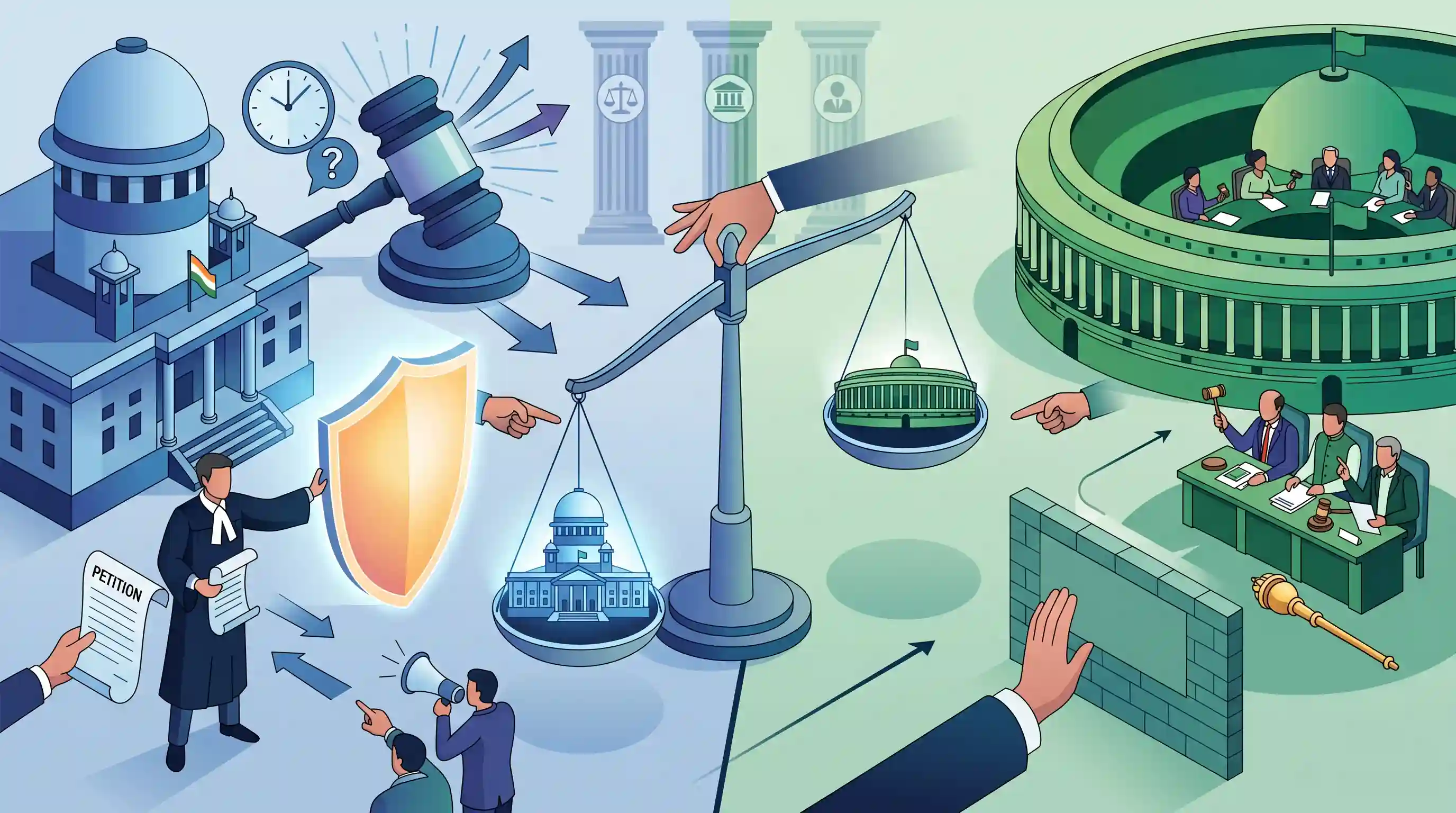
Why It Matters
This issue represents a rare and high-stakes constitutional friction point between the Legislature and the Judiciary. Aspirants must understand the nuances of judicial immunity, the scope of parliamentary committees, and the overarching framework of checks and balances that prevent one organ of the state from encroaching upon another.
Summary
The Supreme Court of India reserved its judgment on a plea filed by Justice Yashwant Varma, who challenged the formation of an inquiry committee against him by the Lok Sabha. Emphasizing the need to "balance rights," the apex court's eventual ruling will have significant implications for the doctrine of separation of powers. The case touches upon the delicate equilibrium between the independence of the higher judiciary and the legislative and inquiry powers of Parliament. This brings into sharp focus constitutional provisions such as Article 121, which shields a judge's conduct from parliamentary discussion (except during an impeachment motion), and Article 122, which limits judicial intervention in internal parliamentary proceedings.
Key Points
- The Supreme Court has reserved its judgment on a plea by Justice Yashwant Varma challenging the formation of a Lok Sabha inquiry committee.
- The court emphasized the need to 'balance rights,' highlighting the delicate tension between parliamentary privileges and judicial independence.
- The issue invokes the doctrine of separation of powers, examining whether legislative bodies can inquire into the actions of a sitting constitutional court judge.
- The matter tests the boundaries of Article 121 (which restricts Parliament from discussing a judge's conduct) and Article 122 (which restricts courts from reviewing parliamentary proceedings).
Important Terms
Judges (Inquiry) Act, 1968

A law regulating the procedure for investigating and proving 'misbehaviour' or 'incapacity' of Supreme Court and High Court judges, operationalizing the constitutional removal process through a three-member inquiry committee.
UPSC context
GS Paper II: Judiciary & Parliament. Essential for understanding the statutory process of judicial accountability and the removal of higher court judges.
Article 121
A constitutional provision that prohibits the discussion of a Supreme Court or High Court judge's conduct in Parliament, except during a formal motion for their removal.
UPSC context
GS Paper II: Constitutional Provisions. Tests knowledge of safeguards ensuring judicial independence and the limits of parliamentary oversight.
Article 122
A provision stating that the validity of any parliamentary proceedings cannot be questioned in court on grounds of 'procedural irregularity,' reinforcing legislative independence.
UPSC context
GS Paper II: Separation of Powers. Critical for understanding the immunity of legislative proceedings from judicial intervention.
Separation of Powers
A constitutional doctrine that divides government functions into Legislative, Executive, and Judicial branches, ensuring each operates within its sphere while maintaining checks and balances.
UPSC context
GS Paper II: Governance & Constitution. A 'Basic Structure' concept tested regarding institutional friction and inter-organ relationships.
In-house Procedure
An informal, peer-review mechanism within the higher judiciary to investigate allegations of misconduct against judges, functioning prior to or independently of formal parliamentary removal.
UPSC context
GS Paper II: Judicial Accountability. Relevant for debates on internal judicial discipline versus the formal impeachment process.
Proved Misbehaviour
A constitutional ground for removing a judge, requiring a formal finding of misconduct by an inquiry committee and a special majority in Parliament.
UPSC context
GS Paper II: Judiciary. Tests the legal thresholds required to initiate and conclude the removal of a constitutional judge.
Prelims Trap
Parliament is absolutely barred from discussing the conduct of any Supreme Court or High Court judge under any circumstances.
Article 121 prohibits discussing a judge's conduct in Parliament, but explicitly makes an exception when a formal motion for their removal (impeachment) is underway.
Static Concepts Connected
How do Articles 121 and 122 balance powers between the Legislature and Judiciary?
- Article 121 shield: Prohibits Parliament from discussing the conduct of SC/HC judges in the discharge of their duties, except during an active impeachment motion.
- Article 122 shield: Prevents courts from invalidating parliamentary proceedings solely on the grounds of alleged procedural irregularities, protecting legislative autonomy.
- Substantive review exception: Despite Article 122, courts can still review parliamentary actions if they violate fundamental rights or suffer from gross, substantive unconstitutionality.
What is the investigation procedure under the Judges (Inquiry) Act, 1968?
- Initiating the motion: A removal motion requires the signatures of 100 Lok Sabha members or 50 Rajya Sabha members to be admitted by the Speaker/Chairman.
- Committee composition: If admitted, a three-member panel is formed comprising a Supreme Court judge, a High Court Chief Justice, and a distinguished jurist.
- Statutory mandate: The committee investigates charges of 'proved misbehaviour or incapacity'. Parliament only votes on removal if the committee finds the judge guilty.
Cross-Topic Patterns
Parliamentary Privileges vs. Judicial Review
Connects to the Raja Ram Pal and Sita Soren rulings, where the SC asserted that parliamentary privileges under Article 105 are not absolute and remain subject to judicial review for unconstitutionality.
NJAC and Basic Structure Doctrine
Mirrors the tensions seen in the NJAC judgment, where legislative encroachment into the judicial domain was struck down, reaffirming the separation of powers as a Basic Structure element.

Articles 121 & 122 vs Parliamentary privileges will likely form a multi-statement Prelims question testing the limits of judicial immunity.
Linked PYQs · 2
Linked PYQs · 2
- 2019PrelimsGS1
Consider the following statements: 1. The motion to impeach a Judge of the Supreme Court of India cannot be rejected by the Speaker of the Lok Sabha as per the Judges (Inquiry) Act, 1968. 2. The Constitution of India defines and gives details of what constitutes 'incapacity and proved misbehaviour' of the Judges of the Supreme Court of India. 3. The details of the process of impeachment of the Judges of the Supreme Court of India are given in the Judges (Inquiry) Act, 1968. 4. If the motion for the impeachment of a Judge is taken up for voting, the law requires the motion to be backed by each House of the Parliament and supported by a majority of total membership of that House and by not less than two-thirds of total members of that House present and voting. Which of the statements given above is/are correct?
- 2019MainsGS2
Do you think that Constitution of India does not accept principle of strict separation of powers rather it is based on the principle of 'checks and balance'? Explain.
