Supreme Court Upholds Constitutional Validity of Death by Hanging
Source:Indian Express ↗
ఇది ఎందుకు ముఖ్యం
It touches upon crucial jurisprudence surrounding capital punishment, the right to life and human dignity under Article 21, and the debate on humane execution methods in India.
సారాంశం
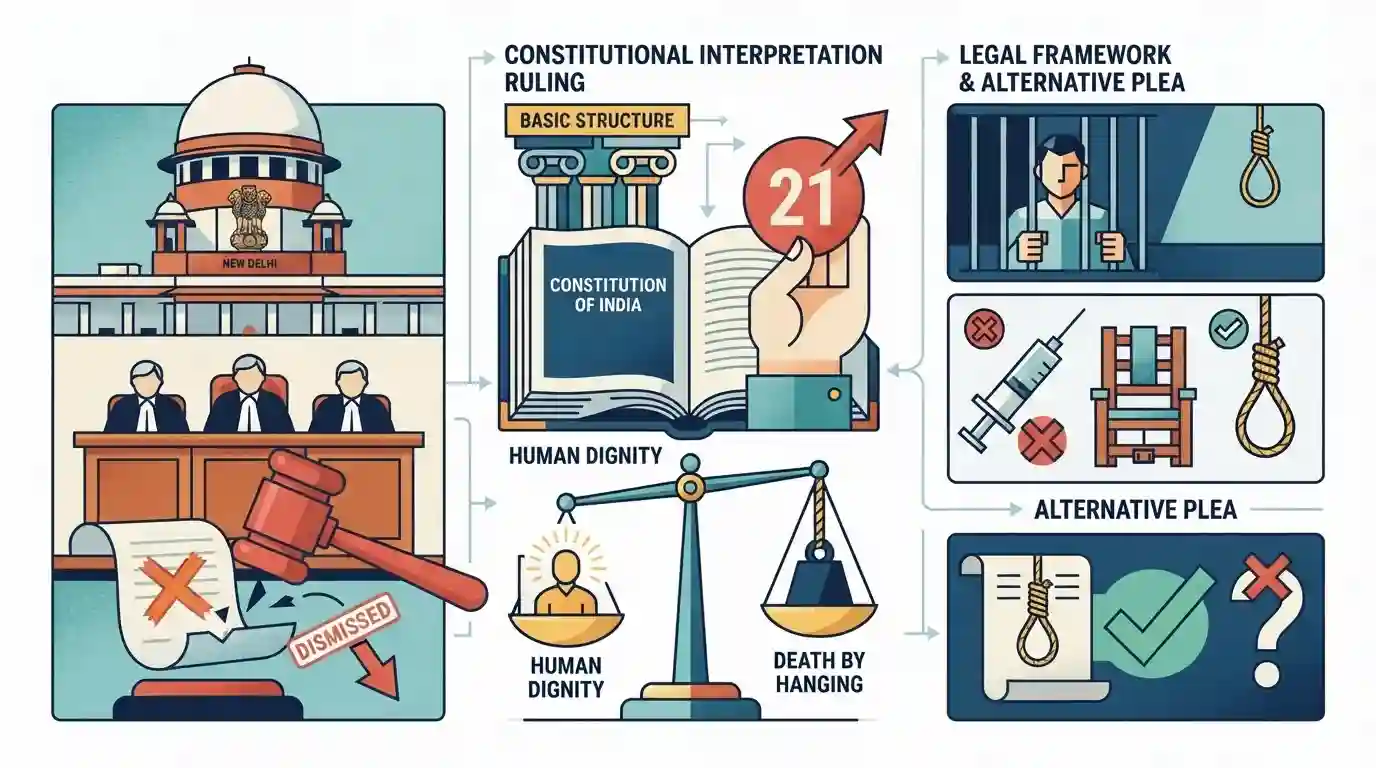
The Supreme Court of India has dismissed a petition questioning the constitutional validity of death by hanging, reiterating that hanging remains legally permissible under the current legal framework. The plea had raised concerns regarding human dignity and alternative, less painful modes of execution under Article 21.
ముఖ్య అంశాలు
- The Supreme Court of India rejected a plea challenging the constitutional validity of death by hanging as a mode of execution.
- The petitioner argued that hanging violates the right to life with dignity under Article 21 and is a cruel, inhuman, or degrading punishment.
- The apex court upheld the validity, maintaining that death by hanging remains an established legal mode of execution under Indian criminal jurisprudence, though the debate on reform and humane execution methods continues.
ముఖ్యమైన పదాలు
Article 21 of the Constitution

Guarantees the protection of life and personal liberty, stating no person shall be deprived of these except according to procedure established by law. Expanded to include human dignity.
UPSC context
GS Paper II (Indian Constitution - Fundamental Rights); frequently tested for its expansive judicial interpretation regarding right to life and human dignity.
Supreme Court of India
The apex judicial body of India, serving as the ultimate guardian of the Constitution and arbiter of constitutional validity and fundamental rights challenges.
UPSC context
GS Paper II (Indian Judiciary, Judicial Review, and Constitutional Interpretation); tests the Court's role in reviewing penal methods and protecting rights.
ప్రిలిమ్స్ ఉచ్చు
hanging violates the right to life with dignity under Article 21 and is per se unconstitutional
Aspirants often assume the Supreme Court has declared hanging unconstitutional due to evolving global human rights standards, whereas the Court explicitly reaffirmed its validity under BNSS 2023 and Deena v. Union of India (1983).
అనుసంధానమైన స్థిర భావనలు
What are the key judicial milestones and constitutional tests regarding capital punishment in India?
- Bachan Singh (1980): Rarest of rare cases doctrine established to guide judicial discretion in awarding the death penalty.
- Deena v. Union of India (1983): Evaluated hanging under the 'just, fair, and reasonable' procedure test mandated by Article 21.
- Gian Kaur (1996): Held that the right to life under Article 21 does not include the right to die or right to be killed.
అంతర-అంశ నమూనాలు
Criminal Procedure Code Reform vs Fundamental Rights
The debate on humane execution bridges procedural criminal law (BNSS 2023) with fundamental rights (Article 21), a recurring theme in criminal justice reform questions.
Human Dignity Standards in Global Jurisprudence
Judicial review of penal methods reflects evolving standards of human dignity, connecting Supreme Court jurisprudence with international human rights norms against cruel punishment.

Article 21 'just, fair, and reasonable' test applied to capital punishment will likely feature in a matching or statement-based question.
అనుసంధాన PYQలు · 2
అనుసంధాన PYQలు · 2
- 2024MainsGS2
Right to privacy is intrinsic to life and personal liberty and is inherently protected under Article 21 of the constitution. Explain. In this reference discuss the law relating to D.N.A. testing of child in the womb to establish its paternity.
- 2021MainsGS2
‘Constitutional Morality’ is rooted in the Constitution itself and is founded on its essential facets. Explain the doctrine of ‘Constitutional Morality’ with the help of relevant judicial decisions.
